Wednesday, May 1, 2013

150th of Chancellorsville, Day 1

File:Battle of Chancellorsville.png
The Battle of Chancellorsville by Kurtz and Allison.

Today is the 150th Anniversary of the first day of significant fighting during the Battle of Chancellorsville, Virginia.

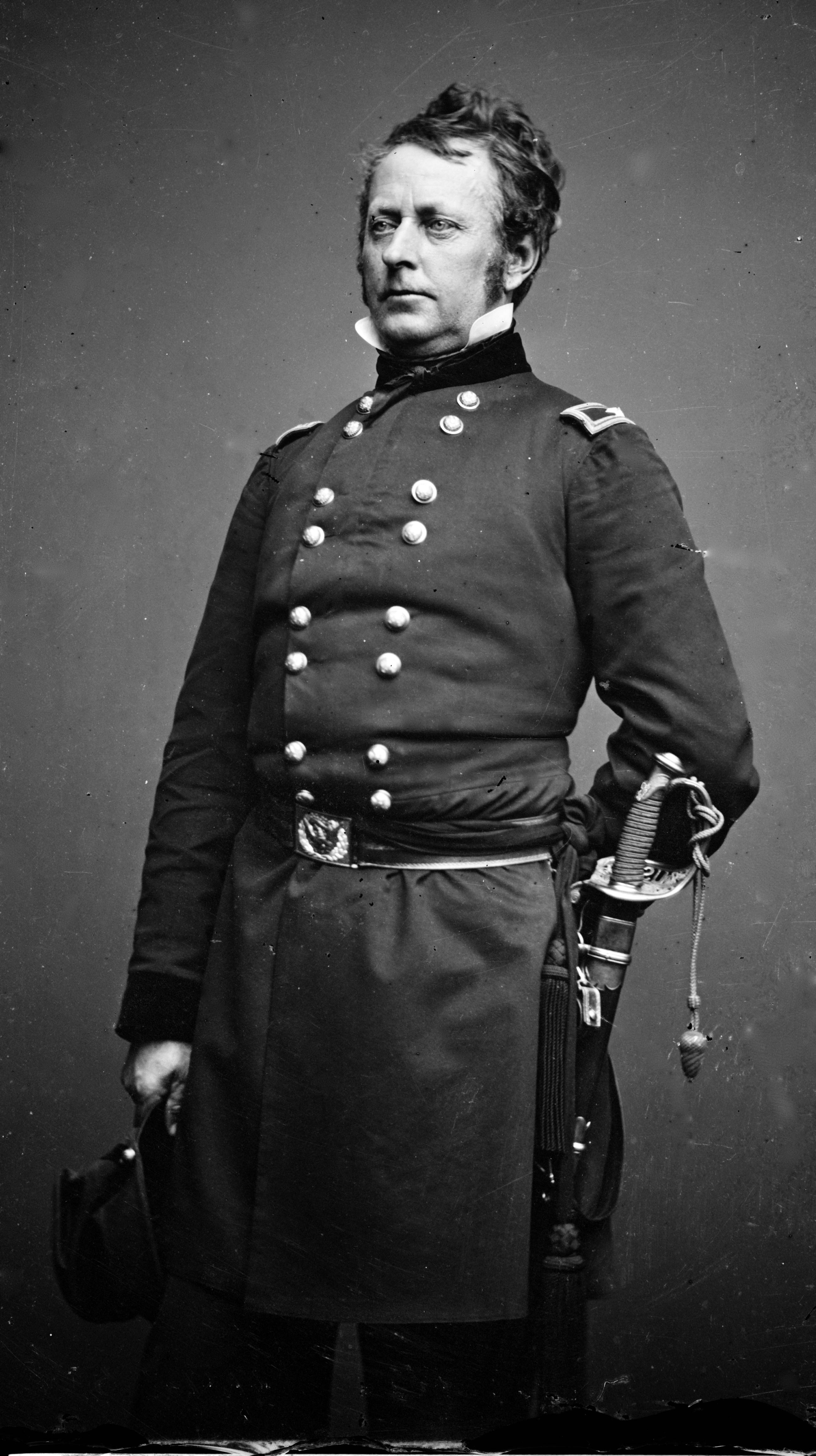
File:Robert Edward Lee.jpgFile:Joseph Hooker - Brady-Handy--restored.jpg
Left: CS General Robert E. Lee      Right: US General Joseph Hooker

150 years ago the Spring campaigning season resumed for the Union Army of the Potomac and the Confederate Army of Northern Virginia.  The Confederate Army of Northern Virginia had spent the winter in the area of Fredericksburg, Virginia, on the south side of the Rappahannock River, having repelled the attack on that city by the Union army under Ambrose Burnside the previous 13 December.  The army was under the command of the legendary Robert E. Lee.  Worthy of note was the a portion of the army under CS General James Longstreet was, at the start of May 1863, campaiging in the area of Suffolk in southeast Virginia.  Thus, Lee had at Fredericksburg some 60,000 men.

The Union Army of the Potomac, after its disaster at Fredericksburg and in the Mud March that followed in January, wintered in Stafford County, on the north side of the Rappahannock.  On 25 January 1863, the Army of the Potomac received a new commanding offier: US Major General Joseph Hooker.  Hooker was certainly not lacking in confidence, and attempted to revive the flagging morale of his massive army -- it was he that introduced the corps badges that would be so famous.  He had at his command some 133,000 men.  Hooker outnumbered Lee 2 to 1, and proudly announced: "May God have mercy on General Lee, for I will have none."
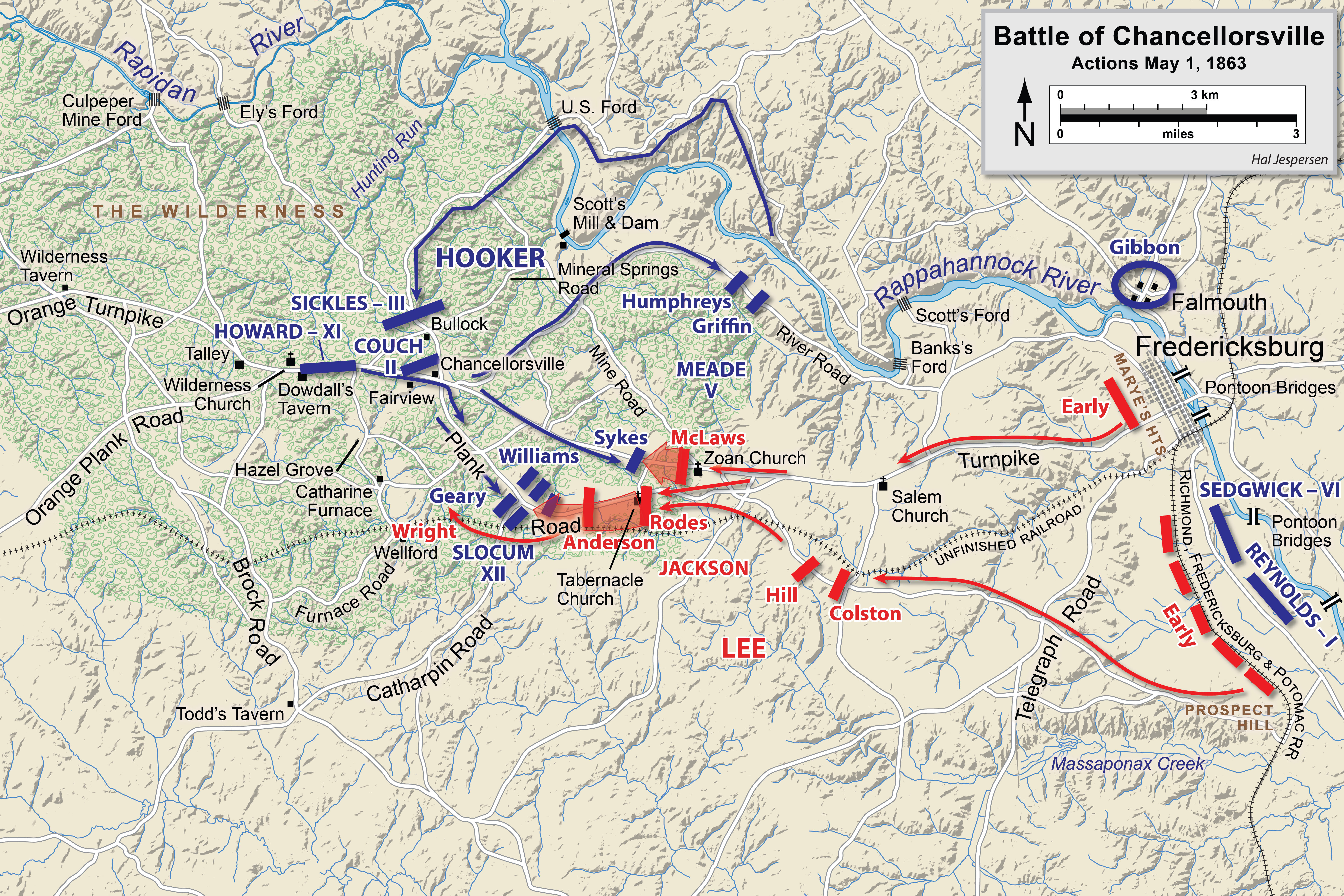
File:Chancellorsville May1.png
Map of the action at Chancellorsville, 1 May 1863.  Attribution: Map by Hal Jespersen, www.cwmaps.com

Joseph Hooker decided to take the initiative, hatching a bold plan to rapidly put his army into motion, to swing west, ford the Rappahannock at US Ford upstream of Fredericksburg, and place his army in the rear of that of Robert E. Lee.  The VI Corps would be left in Falmouth to keep Lee's attention, and hopefully pin the Army of Northern Virginia in place along the river.

The initial phases of this move were rather successful, and Hooker had the XII Corps of Slocum and the V Corps of Meade moving east through the crossroads of Chancellorsville (it is little more than that -- a crossroads with an old ordinary) towards Fredericksburg by mid day.  It seemed that Hooker had Lee trapped in a vise, and with no way out.  But, Hooker would lose his nerve.

General Lee quickly realized the peril of his situation and reacted boldly: despite being outnumbered 2 to 1, he split his army in the face of the Army of the Potomac, leaving a division under CS General Jubal Early in Fredericksburg to hold off the Union VI Corps, while moving the rest of his army to confront Hooker's main force.  The great CS General Thomas "Stonewall" Jackson commanded the vanguard that, at midday, slammed into the Union army along the Plank Road, the local road leading from Chancellorsville to Fredericksburg.  Despite initally pushing the Union back, the Yankee forces stablized and began to drive the Confederates.  At that point, much to the dismay of some of his subordinates, Joseph Hooker ordered his forward Corps back to the Chancellorsville crossroads.  At that moment, he had given the initiative to Robert E. Lee, who would not let such a chance pass.

The next day, Lee would divide his army yet again, this time entrusting to Jackson a march around the Union army to hit it from behind.  It is there we continue tomorrow...

For more on the battle you might note:
National Park Service Battle Description

Civil War Trust Chancellorsville Page

Fredericksburg and Spotsylvania National Military Park

Live well!

Monday, April 29, 2013

Counties, Cities, and Towns in Va.

Virginia counties and independent cities
A map of the counties and cities of the Commonwealth of Virginia.  You will note that the cities are exclusive of the counties.

From state to state, the types of local government structures, and the relationship between them varies a great deal.  In New England, the township is the dominate local government body, rather than the county, and these exist alongside cities.  Indeed, in Massachusetts, all parts of the state are part of either a town or city -- in effect, the whole state is incorporated.  In the Mid-Atlantic and much of the Midwest, in a state like Pennsylvania, counties are divided into townships with the two structures sharing responsibilities, but some areas are incorporated as cities, as well.

In the South and West of the USA, the county dominates as the main structure of local government, and townships do not even exist.  Some parts of the county are permitted to incorporate and do so under a variety of names, usually city, town, or village.  In Georgia, for instance, all incorporated areas are technically cities, even if they are small, and prefer to be called towns.  Any territory not specifically incorporated in Southern or Western states is simply county land.

Virginia is highly unusual insofar as, while the county is the dominate form of local government as with its neighbors, incorporated areas take two uniquely distinct forms: cities and towns.

Cities in Virginia are politically independent of counties.  They are, in effect, urban counties.  Thus, the City of Manassas, despite being surrounded by Prince William County, is not in or part of Prince William County.  The capital City of Richmond, Virginia, is not in or part of any county.  If you ask someone in the City of Fredericksburg what their county is, the answer is the City of Fredericksburg.  Virginia has 39 such independent cities -- the rest of the United States has only three: Baltimore, Maryland, St. Louis, Missouri, and Carson City, Nevada.

Towns, on the other hand, while incorporated with their own government, are still within the territory of the local county, as most incorporated areas are in the rest of the United States.  Towns, for instance, do not have their own school systems or courts, as counties and cities both do.  So, functionally what is called a city in Georgia, is called a town in Virginia.

This chart gives a splendid breakdown of responsibility between the counties, cities, and towns of the Commonwealth of Virginia:
http://www.dhcd.virginia.gov/CommissiononLocalGovernment/PDFs/Function.pdf

Live well!

Monday, April 22, 2013

1st Anniversary of this Blog

Saint Robert Bellarmine.png
St. Robert Bellarmine, whose work, Ars bene moriendi, is the inspiration for the name of this blog, and the content of my Sunday posts.

This blog, Ars bene moriendi, has now seen a full calendar year of daily posts on a variety of subjects of at least passing interest to this blogger.

Endeavoring to post something each and every day has been an intriguing challenge, and great opportunity to refresh interest in hobbies and interests.

Nevertheless, having done so for a year, the plan is now for the blog to be maintained, but for posts to be presented as keen interest, anniversaries, feasts, or guest posts suggest.  Daily output is going to take a back seat in the order of priority.  All the same, I do intend to continue regular posts, and hope that you will continue, or start to join me!

Of course, there are now over 350 posts for you to search and browse!  Enjoy!

Until tomorrow, and the feast of St. George!

Live well!

Saturday, April 20, 2013

News Sources

File:NYTimes-Page1-11-11-1918.jpg
A 1918 Front Page of the New York Times -- a news outlet that I do not consult.

As a historian, teacher, and student of current events, I am constantly trying to keep on top of the latest developments around the globe.

To that end, I consult several news sources on a regular basis, which I present to you here.  Please bear in mind that this is my short list -- I am certainly aware of, and consult, other sources when conditions suggest.  Of course, I would welcome quality suggestions to supplement my list.

NEWS
For Church News, look no further than News.va! http://www.news.va/en
New Advent does a great job in pulling headlines from multiple sources on Church news: http://www.newadvent.org/
The Drudge Report, while often a bit on the spectacle mongering side, often breaks noteworthy stories, or links to interesting headlines: http://www.drudgereport.com/
I like to check the Telegraph of the UK, as well: http://www.telegraph.co.uk/
I am a big fan of the graphics of the National Post of Canada: http://www.nationalpost.com/index.html
Finally, when events unfold in the Middle East, as they usually always do, I appreciate the quality of reporting of Al Jazeera (this, of course, is not an endorsement of their worldview!):
http://www.aljazeera.com/

WEATHER
My go-to source for weather is the National Weather Service: http://www.weather.gov/
I find the intellicast site rather useful for radar and a few other items: http://www.intellicast.net/

BLOGS
My favorite blogger is the great Fr. John Zulhsdorf: http://wdtprs.com/blog/
Also a useful resource for Church News, Whispers in the Loggia: http://whispersintheloggia.blogspot.com/
Finally, for Traditional Catholic news, I check Rorate Caeli: http://rorate-caeli.blogspot.com/

Live well!

Thursday, April 18, 2013

Railwatch in Folkston, GA

City Logo
Recently the town of Folkston, Georgia, hosted Railwatch 2013. 


Railfans from all over the region converge on one of the busiest spots in the Southeast.
Folkston is gateway to the vast Okefenokee Swamp, and has a long railroad history.


Fans were out in force--the nice weather was a bonus!

This section of track is also known as the Folkston Funnel because of the different CSX lines that converge here.

Many people had tripods and were taking video.

This southbound intermodal train is bound for Jacksonville, FL.
The photo contest winners were announced.
For lunch we had some Southern homesyle cookin'.
With my Railwatch button, I was official!

The northbound trains that are aligned on straight track sometimes travel 60-65 mph.  By this time, the evening shadows are lengthening and crowds have dispersed.

This shiny new engine 3093 was delivered to CSX from the factory less than a week ago.  It must still have that 'new locomotive' smell.

This northbound Amtrak is headed up the east coast.
The Folkston Funnel.

Wednesday, April 17, 2013

Overview of the Government of Virginia

File:Virginia population map.png
Population Density Map for the Commonwealth of Virginia.

Having recently moved, this blogger has had the opportunity to take note of the intricacies of local government, as he changes his address with multiple organs of government.

In that spirit, here is a summary and overview of the structure of government in the Commonwealth of Virginia.  Obviously, this is a bit of a simplified perspective, but a decent place to start, all the same:

  • Governed under the Constitution of 1971:
    • Article I: Bill of Rights.
    • Article II: Franchise and Officials.
    • Article III: Division of Powers.
    • Article IV: Legislature.
    • Article V: Executive.
    • Article VI: Judiciary.
    • Article VII: Local Government.
    • Article VIII: Education.
    • Article IX: Corporations.
    • Article X: Taxation and Finance.
    • Article XI: Conservation.
    • Article XII: Amendments and Convention.


  • LEGISLATIVE BRANCH:
    • The General Assembly of the Senate and House of Delegates forms this branch.
    • Senate: The 33-40 (currently 40) member upper chamber of the General Assembly.  Senators are popularly elected to 4 year terms.  Members must be at least 21 years of age.  The Lieutenant Governor serves as President of the Senate, and can vote in the case of a tie in that chamber.
    • House of Delegates:  The 90-100 (currently 100) member lower chamber of the General Assembly.  Delegates are popularly elected to 2 year terms.  Members must be at least 21 years of age.  The delegates elect a Speaker of the House.
    • All proposed legislation must pass both chambers of the General Assembly before being presented to the governor for his signature.

  • EXECUTIVE BRANCH:
    • Governor: Chief Executive and Commander-in-Chief of the state.  Popularly elected to non-consecutive 4 year terms.  He must be at least 30 years of age.  By law, the governor must reside in the capital city of Richmond, where the governor’s mansion sits next to the capitol.
    • Lieutenant Governor: He serves as President of the Senate, and, when required, acts in place of an incapacitated governor.  He is popularly elected to 4 year terms at the same time as the governor.  He, also, must be at least 30 years of age.
    • Attorney General: He serves as the Commonwealth of Virginia’s official legal counsel.  He is popularly elected to 4 year terms at the same time as the governor.  In addition to the required age of 30, he must also have sufficient legal credentials (the same as a judge).  He is next in line after the Lt. Governor should a vacancy in the governor’s office take place.
    • The Executive Branch of the Commonwealth of Virginia also has a host of executive departments, including:


      • Agriculture & Consumer Services.
      • Alcoholic Beverage Control.
      • Corrections.
      • Education.
      • Forestry.
      • Game and Inland Fisheries.
      • Health.
      • Labor and Industry.
      • Motor Vehicles.
      • State Police.
      • Taxation.
      • Transportation.
      • Treasury.


  • JUDICIAL BRANCH:
    • Supreme Court: Consists of 7 members (subject to change with the consent of the General Assembly) elected to 12 year terms by the General Assembly.  All judges in Virginia must have been admitted to the bar.  The chief justice is chosen by a vote of the members of the court.  This court is the final court of appeals in the Commonwealth, and has original jurisdiction in some cases.  This court sits in Richmond.
    • Court of Appeals: This 11 member court consists of members elected to 8 year terms by the General Assembly.  This court receives appeals from the lower, circuit, courts.  The chief justice of this court is chosen for a 4 year term by the other members.  This court meets in Richmond, Alexandria, Chesapeake, and Salem.
    • Circuit Courts: There are 31 circuits, with 120 courts that operate as the primary location for court cases.  Judges are appointed by the General Assembly to 8 year terms.
    • District Courts: These local courts fit into 32 districts and deal with small claims and lesser offenses (less than $15,000 involved).  Judges are appointed by the General Assembly to 8 year terms.  If you go to court for speeding, this is typically where you go.

  • LOCAL GOVERNMENT:
    • The Commonwealth of Virginia is divided into 95 counties and 39 cities.  Within these counties are often incorporated towns that, while still part of the county, have their own elected government.
    • A County is governed by a popularly elected Board of Supervisors, which serves as both the executive and legislative board of the county.  The chairman is either elected by the other members or popularly elected at-large to the position.  The number of members varies, but they are popularly elected to 4 year terms.  Each represents one of the magisterial districts of the county.  In many counties, the Board appoints a County Executive to run the daily affairs of the county.
    • A City is governed by a popularly elected City Council and one member of the council serves as mayor.  They are popularly elected to 4 year terms.  In most cities, the Council appoints a City Manager to run the daily affairs of the city.
    • Each county and city should have the following Constitutional officers (some are exempt), each popularly elected and serving 4 year terms (the clerk serves for 8):
      • Treasurer.
      • Sheriff.
      • Commonwealth’s Attorney.
      • Clerk of Court.
      • Commissioner of the Revenue.
    • In smaller (second class) cities, the offices of Sheriff, Commonwealth’s Attorney, and Clerk of Court, can be shared with the surrounding county.
    • Towns can be incorporated within counties, establishing their own elected council and government with the power to pass ordinances for those in the town.

Live well!

Tuesday, April 16, 2013

Central African Empire

File:Imperial Coat of arms of Central Africa (1976–1979).svg
The Coat of Arms of the Central African Empire.

From 1976-1979 the Central African Republic was, by decree of its one and only "Emperor," the Central African Empire.  It was ruled by the dictator Jean-Bedel Bokassa, or Emperor Bokassa I, after September 1976.

File:Central African Republic (orthographic projection).svg

The Central African Republic had been a the territory of Ubangi-Shari in French Equatorial Africa, with its capital at Bangui, as it is today.  It was natural that a petty psychopathic dictator of such a country determined to be an Emperor, would need a coronation modeled on something Napoleon might have done.  Hence, on 4 December 1977, he received his rather expensive coronation.  It is said that this event consumed a third of their national budget!  Emperor Bokassa I was confident that it was give the CAE greater respect and prominence in the world.  He was a nut.  You can watch some film of that event here:


Human rights violations and massacres, in addition to general misrule, led to the French-supported coup d'etat in 1979 that toppled the Emperor Bokassa I and restored the Central African Republic.  Bokassa, himself, survived the fall of his Empire, and has since been rehabilitated and cleared of all charges by his motherland.  He died there in 1996.

This French-language documentary details the days of this bizarre Empire:


Of course, the poor CAR remains in the midst of turmoil and unrest in our own day.

Live well!