Friday, May 31, 2013

The University & the Arts

In this graduation season, it is interesting to recall the Medieval origins of the University.  In these universities, there were four faculties -- each of which still retain their own hood colors in modern academic garb -- Arts (White), Theology (Red), Law (Purple), and Medicine (Green).  Historically, the highest degree in Arts was the Master's degree, while Law and Medicine, as today, terminated with a Doctor's degree.

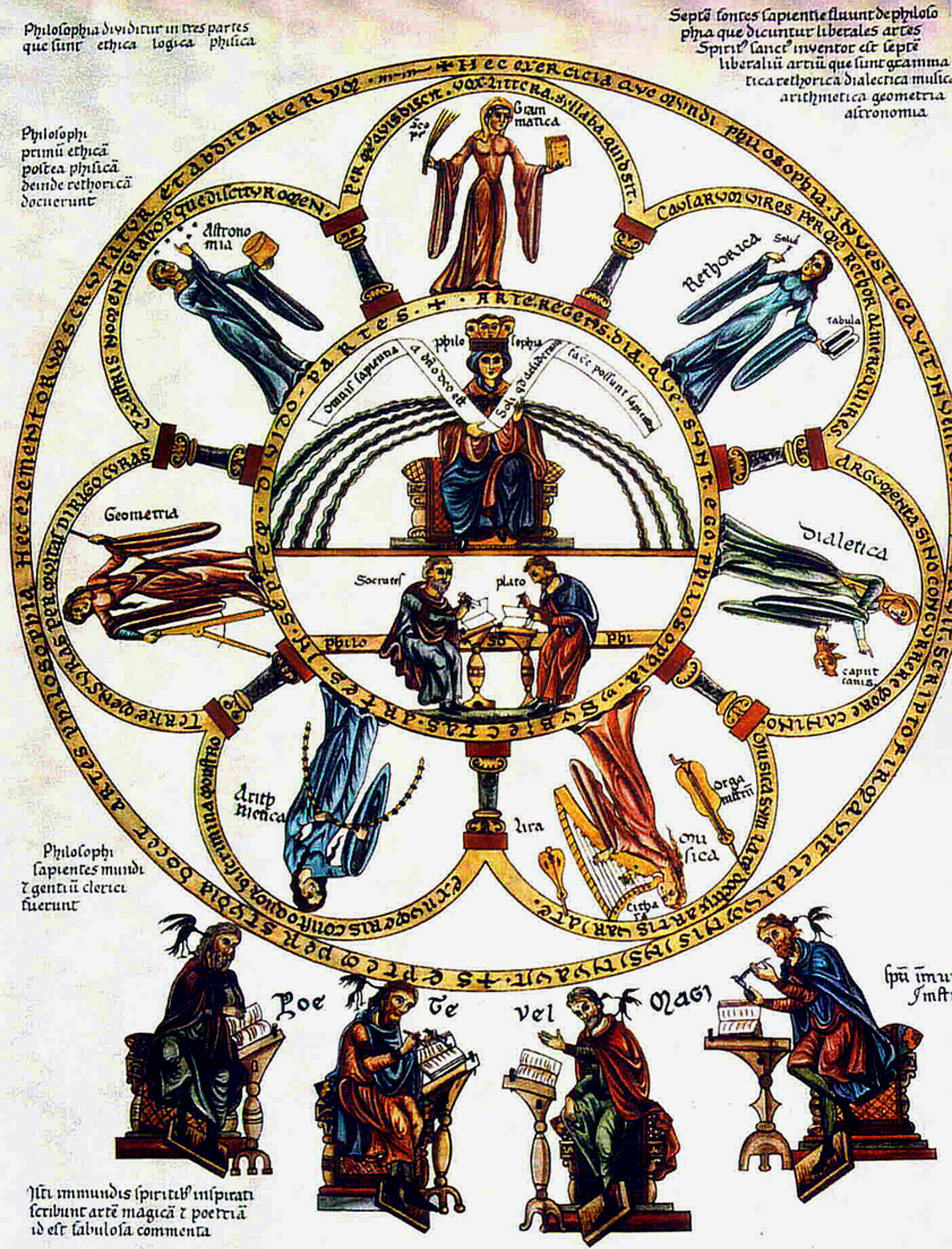
File:Septem-artes-liberales Herrad-von-Landsberg Hortus-deliciarum 1180.jpg
The Seven Liberal Arts from Hortus deliciarum of Herrad von Landsberg (+1195AD)

These excerpts from the Old Catholic Encyclopedia give you an idea of the curriculum and course of study for those in the Arts faculty:
----
The studies leading to the Baccalaureate varied naturally with the length of time required. Those prescribed at Oxford in 1267 were as follows:

  1. The Old Logic: Porphyry, "Isagoge", the "Categoriae" and "De Interpretatione" of Aristotle, and the "Sex Principia" of Gilbert de la Porrée, twice; the Logical Works of Boethius (except "Topics", book IV), once.
  2. The New Logic: Aristotle, "Priora Analytica", "Topica", "De Sophisticis Elenchis", twice; "Posteriora Analytica", once.
  3. Grammar: Priscian, "De Constructionibus", twice; Donatus, "Barbarismus", once. Or, in place of Grammar, Natural Philosophy: Aristotle, "Physica", "De Anima", "De Generatione et Corruptione".
  4. To have "responded" "De Sophismatibus" for a year, or to have heard the "Posteriora Analytica" twice instead of once. [Anstey, "Munimenta Academica", 35, 36. Rashdall, "Universities of Europe in the Middle Ages", II, Pt. II, 455.]

The following list includes the books that were to be "read," or lectured on, by the Masters of the Faculty of Arts, at Paris in 1254. It covers the period of six or seven years from entrance, or matriculation, up to the Master's degree, and, were the "disputations" added, it might be regarded as typical of the Arts course in the medieval universities generally. A specific date was set for finishing the "reading" of each book.  
  1. Old Logic: Porphyry, "Isagoge" (Introduction to the Categoriae); Aristotle, "Categoriae" and "Perihermenia"; Boethius, "Divisiones" and "Topica," except Bk. IV.
  2. New Logic: Aristotle, "Topica," "Elenchi," "Analytica Priora," and "Analytica Posteriora."
  3. Ethics: Aristotle, "Ethica," (ad Nichomachum), four books.
  4. Metaphysics: Aristotle, "Metaphysica."
  5. Astronomy: Aristotle, "De Coelo," "Meteora," first Bk.
  6. Psychology and Natural Philosophy: Aristotle, "Physica," "De Animalibus," "De Anima," "Da Generatione," "De Causis (attributed at the time to Aristotle), "De Sensu et Sensato," "De Somno et Vigilia," "De Plantis," "De Memoria et Reminiscentia," "De Morte et Vita," Costa Ben Luca, "De Differentia Spiritus et Animae."     
  7. Grammar and Rhetoric: Priscian Major (16 books of his "Institutiones Grammaticae"), Priscian Minor (last two books of the same); Gilbert de la Porrée, "Sex Principia"; Barbarismus (third book of Donatus, "Ars Major"); Priscian, "De Accentu," (Cf. Chartularium Univ. Paris, Part I, n. 246.)
[Source: http://www.newadvent.org/cathen/01757a.htm]
----

Thus, the Arts degree assumed competence in both the Trivium (the "Arts" of Grammar, Logic, and Rhetoric) and the Quadrivium (the "Sciences" of Arithmetic, Geometry, Music, and Astronomy).  I wonder how many holders of Master of Arts degrees are ready to lecture from Aristotle's Categories?

The following is a letter of Pope Gregory IX written to the University of Paris in 1231.  It makes an interesting read, giving insight into the structure and challenges of a University in the 13th century -- and a University with a papal charter, as at Paris:

---
"Gregory, the bishop, servant of the servants of God, to his beloved sons, all the masters and students of Paris - greeting and apostolic benediction.

Paris, the mother of the sciences, like another Cariath Sepher, a city of letters, shines forth illustrious, great indeed, but concerning herself she causes greater things to be desired, full of favor for teaching and students...

...Wherefore, since we have diligently investigated the questions referred to us concerning a dissension which, through the instigation of the devil, has arisen there and greatly disturbed the university, we have decided, by the advice of our brethren, that these should be set at rest rather by precautionary measures, than by a judicial sentence.

Therefore, concerning the condition of the students and schools we have decided that the following should be observed: each chancellor, appointed hereafter at Paris, at the time of his installation, in the presence of the bishop, or at the command of the latter in the chapter at Paris - two masters of the students having been summoned for this purpose, and present on behalf of the university - shall swear that, in good faith, according to his conscience he will not receive as professors of theology and canon law any but suitable men, at a suitable place and time, according to the condition of the city and the honor and glory of those branches of learning; and he will reject all who are unworthy without respect to persons or nations. Before licensing anyone, during three months, dating from the time when the license is requested, the chancellor shall make diligent inquiries of all the masters of theology present in the city, and of all other honest and learned men through whom the truth can be ascertained, concerning the life, knowledge, capacity, purpose, purpose, prospects and other qualities needful in such persons; and after the inquiries in good faith and according to his conscience, he shall grant or deny the license to the candidate as seems fitting and expedient. The masters of theology and canon law will give true testimony on the above points. The chancellor shall swear, that, he will in no way reveal the advice of the masters, to their injury; the liberty and privileges being maintained in their full vigor for the canons of at Paris, as they were in the beginning. Moreover, the chancellor shall promise to examine in good faith the masters in medicine and arts and in the other branches, to admit only the worthy and to reject the unworthy.

In other matters, because confusion easily creeps in where there is no order, we grant to you the right of making constitutions and ordinances regulating the manner and time of lectures and disputations, the costume to be worn, the burial of the dead; and also concerning the bachelors, who are to lecture and at what hours and on what they are to lecture; and concerning the prices of the lodging or the interdiction of the same; and concerning a fit punishment for those who violate your constitutions or ordinances, by exclusion from your society. And if, perchance, the assessment of the lodgings is taken from you, or anything else is lacking, or an injury or outrageous damage, such as death or the mutilation of a limb, is inflicted on one of you; unless through a suitable admonition satisfaction is rendered within fifteen days, you may suspend your lectures until you have received full satisfaction. And if it happens that any one of you is unlawfully imprisoned, unless the injury ceases on remonstrance from you, you may, if you judge it expedient, suspend your lectures immediately.

We command, moreover, that the bishop of Paris shall so chastise the excesses of the guilty, that the honor of the students shall be preserved and evil deeds shall not remain unpunished. But in no way shall the innocent be seized on account of the guilty; nay, rather if a probable suspicion arises against anyone, he shall be detained honorably and, on giving suitable bail he shall be freed, without any exactions from the jailers. But if, perchance, such a crime has been committed that imprisonment is necessary, the bishop shall detain the criminal in his prison. The chancellor is forbidden to keep him in his prison. We also forbid holding a student for a debt contracted by another, sine this is interdicted by canonical and legitimate sanctions. Neither the bishop nor his official, nor the chancellor shall exact a pecuniary penalty for removing penalty for removing an excommunication or any other censures of any kind. Nor shall the chancellor demand from the masters who are licensed an oath, or obedience, or any pledge nor shall he receive any emolument or promise for granting a license, but be content with the above mentioned oath.

Also the vacation in summer is not to exceed one month, and the bachelors, if they wish, can continue their lectures in vacation time. Moreover, we prohibit more expressly the students from carrying weapons in the city, and the university from protecting those who disturb peace and study, And those who call themselves students but do not frequent the schools, or acknowledge any master, are in no way to enjoy the liberties of the students.

Moreover, we order that the masters in arts shall always read one lecture on Priscian, and one book after the other in regular courses. Those books on natural philosophy which for a certain reason were prohibited in a provincial council, are not t be used at Paris until they have been examined and purged of all suspicion of error. The masters and students in theology shall strive to exercise themselves laudably in the branch which they profess; they shall not show themselves philosophers but strive to become God's learned. And they shall not speak in the language of the people, confounding the sacred language with the profane. In the schools they shall dispute only on such questions as can be determined by the theological books and the writings of the holy fathers.

***

It is not lawful for any whatever to infringe this deed of our provision, constitution, concession, prohibition and inhibition or to act contrary to it, from rash presumption. If anyone, however, should dare attempt this , let him know that he incurs the wrath of almighty God and of the blessed Peter and Paul, his apostles.

Given at the Lateran, on the Ides of April [April 13], in the fifth year of our pontificate."
 
from Statutes of Gregory IX in Dana C. Munro, trans., University of Pennsylvania Translations and Reprints, (Philadelphia: University of Pennsylvania Press, 1897), Vol. II: No. 3, pp. 7-11 . cf: http://www.fordham.edu/halsall/source/UParis-stats1231.html
----

The medieval period was, indeed, that of the flowering of the University.  Prior to the 12th century, only a handful had been founded: Constantinople, Bologna (1088), Paris (1150), and Oxford (1167); while the 1200s added: Cambridge (1209), Salamanca (1218), Padua (1222), Toulouse (1229), Siena (1240) [Pope John XXI taught there], Valencia (1245), Seville (1254), and Lisbon (1290), to name a few.

For more, you might note: Old Catholic Encyclopedia: Universities

Live well and ever seek the truth in the noblest tradition of the University!

Thursday, May 30, 2013

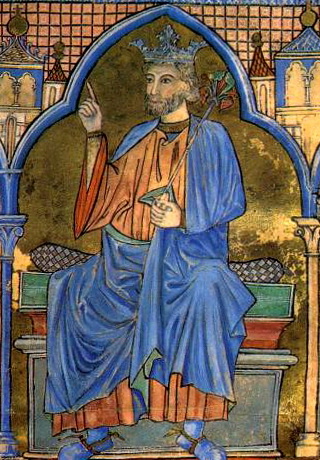
King St. Ferdinand III of Castile & Leon

File:Fernando III de Castilla 02.jpg

Today is the Feast of the King of Castile and Leon, St. Ferdinand III.  This patron saint on Engineers brings to mind a great period of the Reconquista in Spain -- the 13th century saw the beginning of the permanent decline of Islamic power in Andalusia.


The united arms of Castile & Leon.

Spain during this period had several great kings – Alfonso IX “the slobberer” of Leon (reigned 1188-1230) ended his reign with a successful campaign, and left his realm to his son, St. Ferdinand III (reigned Castile, 1217-1252; Leon, 1230-1252), who was already king of Castile, having replaced his young uncle, Henry I (1214-1217), an eleven year-old boy and son of Alfonso VIII, the victor at Las Navas de Tolosa [Henry got hit in the head with a stone while playing, and died.  Little Henry's sisters were the mothers of Ferdinand III (Berengaria) and also St. Louis IX of France (Blanche) and the wife of James I of Aragon (Eleanor)].  This forever linked the kingdoms of Castile and Leon.  It was a rough union at first.

In Aragon, James I (1213-1276) “the Conqueror” reached his majority in 1227 – he was five and in the custody of Simon de Montfort when his father, Pedro II, died.  These two men, Ferdinand and James, would be heard from a great deal.

With the death of al-Mustansir of the Almohads in 1224, they collapsed.  Alfonso IX seized Merida (where St. James was said to have appeared and assisted) and Badajoz in 1230, opening the road to Seville – but the king died in September of 1230, and is buried at Compostella.  James I took Majorca in 1230, as well.  The birth of the Inquisition in 1231 at the command of Gregory IX is well worth noting, though this is not the fully developed institution that would later be known.  Ibn al-Ahmar (1232-1273) founded the Nasrid dynasty and the Kingdom of Granada in 1232, breaking away from the crumbling Almohad power.  In 1236, Ferdinand III captured Cordoba!  James I captured of Valencia in 1238.  Finally, Ferdinand had Seville in 1248.

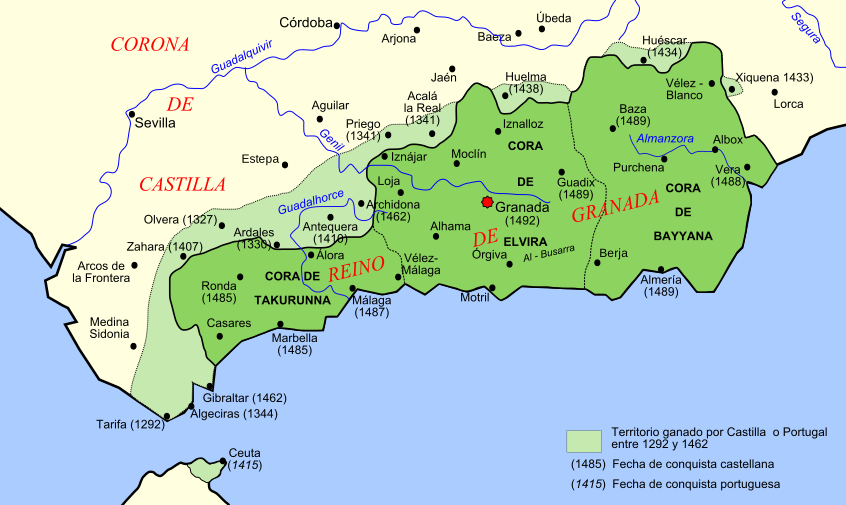
File:Reino de Granada.svg
The Emirate of Granada.  This is all that remained of Islamic Spain after Las Navas de Tolosa and the campaigns of Ferdinand III and James I.

Ferdinand, it is worth noting, founded the University of Salamanca, and was also a Third Order Franciscan.

St. Ferdinand III died in 1252, succeeded as King of Castile and Leon by his son Alfonso X (1252-1284).  His daughter, Eleanor, would be the wife of Edward I "the Longshanks" of England.

File:Pierre Dancart Alterpiece Seville.jpg
Pierre Dancart altarpiece in Seville Cathedral.

It was in the Cathedral of Seville that St. Ferdinand III would be buried (along with Christopher Columbus!).  Here is a link to the website of that Cathedral: http://www.catedraldesevilla.es/

For more on King St. Ferdinand III:
Old Catholic Encyclopedia: St. Ferdinand III

Patron Saints Index: St. Ferdinand III

Live well!

Wednesday, May 29, 2013

Fall of Constantinople, 1453AD

File:Siege constantinople bnf fr2691.jpg
The Siege of Constantinople.

On this day in 1453AD, the forces of Ottoman Sultan Mehmed II "the Conqueror" defeated the garrison of Byzantine Emperor Constantine XI and seized the great city of Constantinople.

As the centuries past, the Eastern Roman, or Byzantine Empire, had been greatly reduced in size.  By the 15th century, it faced crisis and final demise.  In 1448, Constantine XI (1448-1453) Palaeologus succeeded his brother John VIII (1425-1448), who had reached a union with Rome in 1439, as Emperor. For his part, Mehmed II (1451-1481) succeeded his father Murad as Ottoman Sultan a few years later in 1451.  His leadership would spell the end of the Byzantine Empire.  The union between Constantinople and Rome was announced in 1452 – just in time for the arrival of the Turkish grand army at Constantinople.  The city of Constantinople was a fortress at that time – two walls, the outer 25 feet high and 10 feet thick, the inner 40 feet tall and 20 feet thick with 60 ft. watchtowers at intervals.  The Turks, with a traitor Hungarian’s help, built a massive cannon – 27 feet long and slinging a 1,200 pound ball a mile, and requiring 60 oxen and 700 men to move it!  By March 1453, 80,000 Turks approached the Imperial city with this gun.  Emperor Constantine XI had a mere 4,983 able bodied men, and 2,000 foreigners, including allied troops, to defend the city.


File:Siege of Constantinople 1453 map-fr.svgA map of the siege of Constantinople, 6 April to 29 May 1453.

On 6 April, Mehmed II demanded surrender.  It was refused.  On 11 April, bombardment began [seven shots a day].  On 21 April, a tower fell, but the breach was repaired.  On 18 May, the Turks moved up a tower to protect men filling in the moat, but the Byzantines blew it up.  On 27 May, the cannon was finally moved to close range.  At 1:30AM on 29 May 1453, the Turks launched a massive assault.  Emperor Constantine XI, dressed in purple, led from the front.  He would disappear in the fighting.  The disaster was complete: A three day sack, 4,000 Christians killed, and 50,000 were seized and forced to pay ransom.  Constantinople, great capital of the Eastern Roman Empire was gone.  Europe was in shock.

This video presents a poignant lament of the fall of this great city, and its permanent loss to the Christian world:


Live well!

Tuesday, May 28, 2013

Augustine, Ethelbert, & Margaret Pole

Today, traditionally, is the feast of St. Augustine of Canterbury (+604), Apostle of England, as well as, in some places, the feast of Blessed Margaret Pole (+1541).


St. Augustine of Canterbury

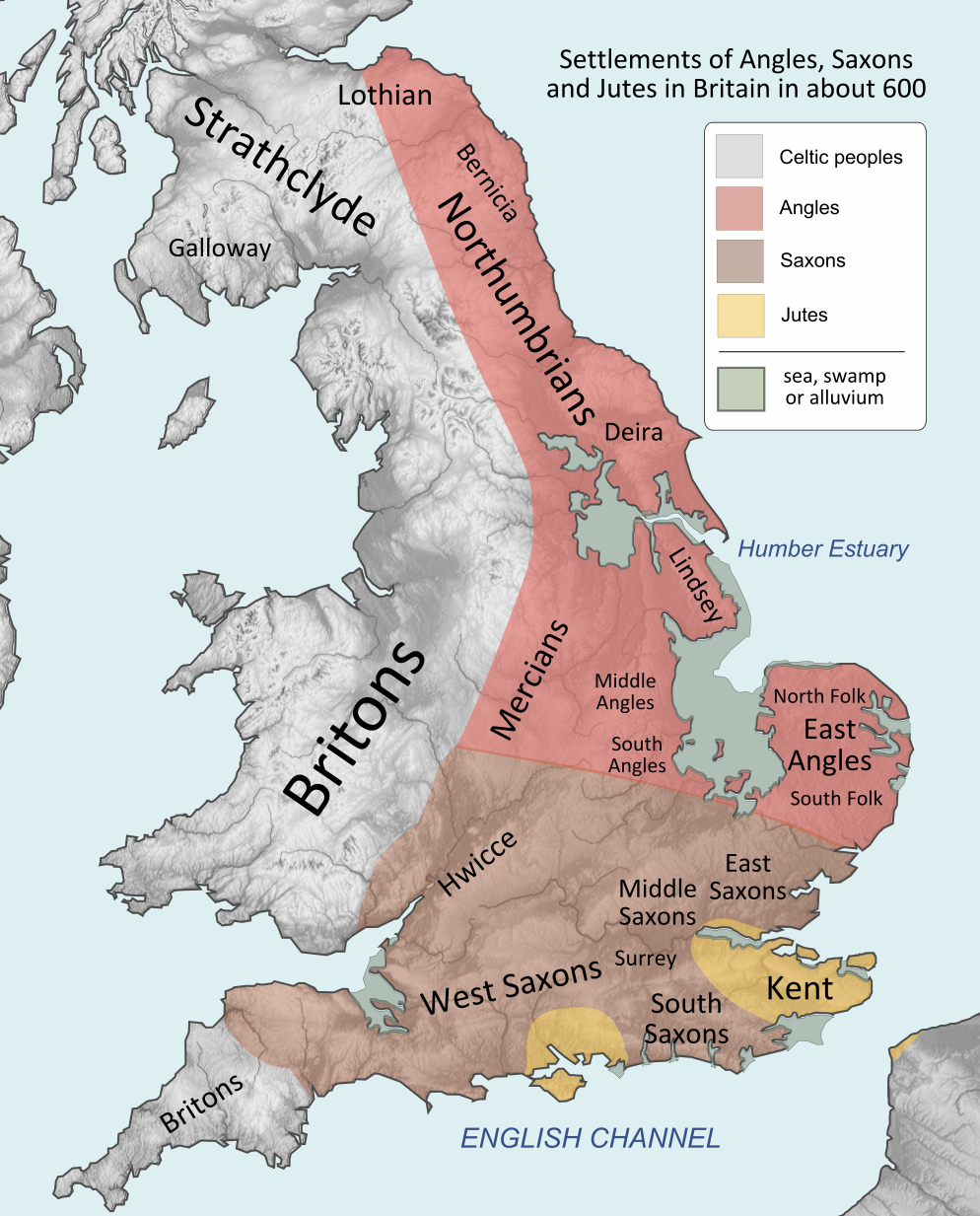
Of course, the province of Briton within the Roman Empire had already received the gospel long before St. Augustine of Canterbury was sent to Evangelize by Pope St. Gregory I "the Great" (reigned 590-604).  Nevertheless, with the coming of the Angles, Saxons, and Jutes, the Christian population was swept west, and these Germanic peoples were in dire need of hearing the Holy Gospel.  Pope St. Gregory sent St. Augustine of Canterbury from his monastery of St. Andrew in Rome, along with a number of companions that included St. Lawrence of Canterbury, to England.  They would arrive in 597AD.

File:Britain peoples circa 600.svg
Britain at the time of St. Augustine & St. Ethelbert.  Notice the Kingdom of Kent in the southeast -- a Kingdom of Jutes.

The kingdom to which they arrived was the Jutish Kingdom of Kent, where St. Ethelbert (+616AD) reigned as king.  St. Ethelbert was married to a Frankish wife, and was immediately receptive to the preaching of St. Augustine, though a pagan.  With his conversion, and baptism on Pentecost of 597AD, the Church won a great ally and patron, that supported St. Augustine in establishing not only the Archdiocese of Canterbury at the Kentish capital, but also the Diocese of London and that of Rochester.

When St. Augustine of Canterbury died in 604, he was succeeded by the second Archbishop of Canterbury, St. Lawrence of Canterbury (reigned, 604-619AD).

File:Aethelberht of Kent sculpture on Canterbury Cathedral.jpg
A statue of St. Ethelbert at Canterbury Cathedral.

For more on St. Augustine of Canterbury, you should note:
Old Catholic Encyclopedia: St. Augustine

Patron Saints Index: St. Augustine

Here are a couple links on St. Ethelbert:
Old Catholic Encyclopedia: St. Ethelbert

Today is also the feast of Blessed Margaret Pole, also of England, and of royal stock, but from rather later and different circumstances.

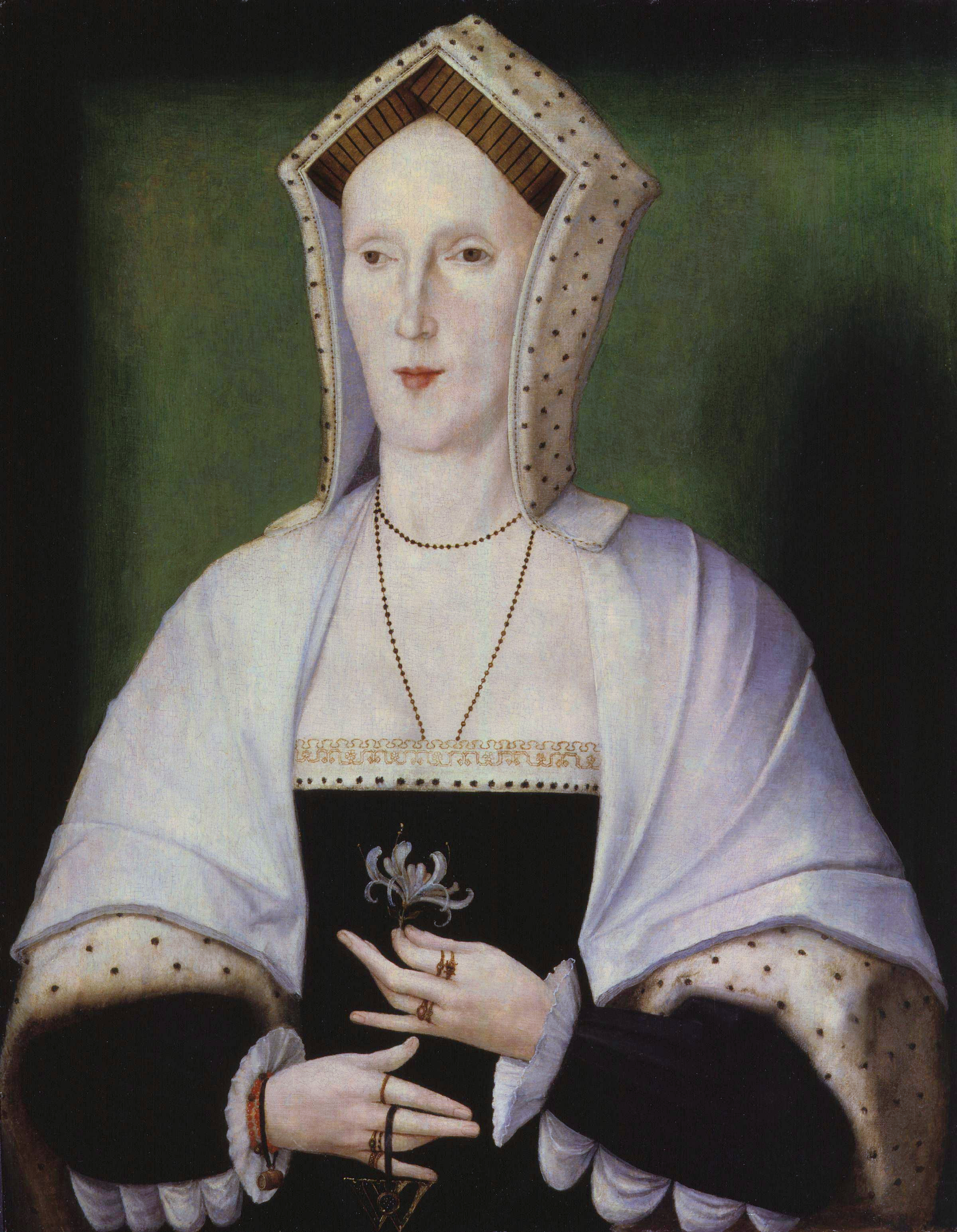
File:Unknown woman, formerly known as Margaret Pole, Countess of Salisbury from NPG retouched.jpg
A potrait, thought to be Blessed Margaret Pole

Margaret Pole, 8th Countess of Salisbury, was the daughter of George, 1st Duke of Clarence, younger brother of King Edward IV and older brother of King Richard III -- thus, she was of royal York & Plantagenet stock.  Indeed, she had a decent claim to the throne of England -- far stronger than that of King Henry VII, whose son would order her to be executed in 1541AD.  Her mother was Isabella Neville, the daughter of the powerful Richard Neville, 16th Earl of Warwick.  She was, then, of far nobler stock than the the first Tudor on the throne!

In 1533, Henry VIII succeeded in getting Thomas Cranmer appointed Archbishop of Canterbury, and he granted an annulment to Henry to put away his first wife, Catherine of Aragon, to marry Anne Boleyn, which he did that same year.  Pope Clement VII, of course, denied the legitimacy of such an annulment, and Henry VIII was named "Supreme Head of the Church in England," in 1534, requiring subjects to take the oath of supremacy.  This brought down several great saints as "traitors," such as St. Thomas More and St. John Fisher, Bishop of Rochester, in 1535.  There was further backlash, but the Pilgrimage of Grace, a rising in the north of England, met defeat in 1537.  King Henry VIII, of course, went through several wives during these years.

It was in 1541, however, that the old king finally ordered the execution of the faithful Catholic Margaret Pole, at least in part for the opposition of her son, Reginald.  It is said that it took 10 blows to finally execute her, as the axe-man was not a particularly good aim.

She would be beatified by Pope Leo XIII in 1886.  Her son, Reginald Pole, was a Cardinal of the Catholic Church (created a cardinal in 1537), Papal Legate to England, Chancellor of the University of Oxford, and was the last Catholic Archbishop of Canterbury, holding those posts under Queen Mary Tudor, from 1556-1558.

Here is an article on Blessed Margaret:
Old Catholic Encyclopedia: Blessed Margaret

Patron Saints Index: Blessed Margaret

Live well!

Monday, May 27, 2013

Mercury, Venus, Jupiter: Conjunction

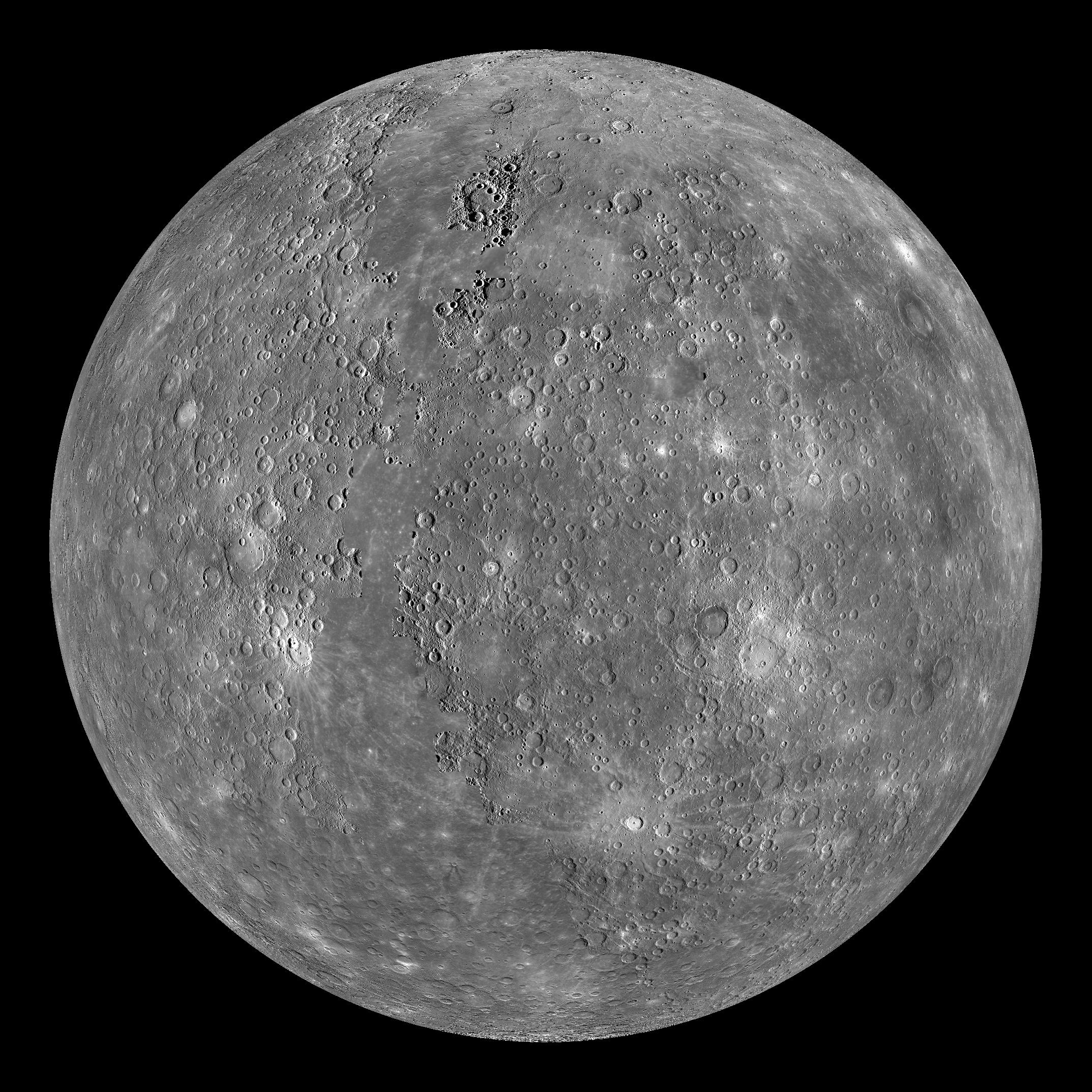
File:Mercury Globe-MESSENGER mosaic centered at 0degN-0degE.jpg
A composite photo of the planet Mercury taken by the probe MESSENGER.

Right now, there is a magnificent conjunction of three of the classical planets in the early evening sky -- Mercury, Venus, and Jupiter.  Of course, spotting Venus in the evening sky is little challenge, being so bright, and Jupiter is often a brilliant night-time object.  Mercury, however, is much more elusive.  Having all three together in front of the Constellation Taurus is not only rather rare, but it is truly the perfect chance to spot Mercury, as you have such excellent  points of reference to help you find it -- Venus and Jupiter!  In point of fact, the planet Mars is also in Taurus, but not visible with the other three, as it is obscured by the Sun.

Here is a map of their position in the Constellation Taurus: http://www.heavens-above.com/constellation.aspx?con=Tau&Session=kebgfbeamnejlkjmlaekjpaf

File:Ecliptic path.jpg
The apparent path of the Sun through the stars -- the Ecliptic, which runs through the Constellations of the Zodiac.

Of course, the various stars in the Constellations are at rather different distances, but are grouped together as they appear from our perspective on Earth.  The Sun and the Planets appear to drift through the Constellations passing along a set of particular areas known as the Zodiac.  The Zodiac, all of which save one, Libra, picture living creatures (hence a sort of Zoo), are those Constellations through which the path of the Sun (from our perspective), the Ecliptic, passes.  While classically, 12 Constellations fit this group, technically Ophiucus should be in the list, and Scorpius has rather scant frontage along the Ecliptic.

A Conjunction refers to the time when more than one planet appear in front of the same Constellation at the same time.  Planets come into Conjunction from time to time, but it is infrequent that three of the five classical, naked-eye, planets come into Conjunction with one another.  Hence the value of this appearance!

Again, now is the perfect time to spot the planet Mercury!

This article at Sky and Telescope Magazine's webpage will tell you all you need to know:
http://www.skyandtelescope.com/observing/highlights/The-May-June-2013-Planet-Dance-192020551.html

Live well!

Saturday, May 25, 2013

Pope St. Gregory VII


Today is the feast of the great Hildebrand, Pope St. Gregory VII, famous for his role in the Gregorian reforms of the 11th century, and a wonderful ally of Pope St. Leo IX and St. Peter Damian in this effort.

His pontificate was consumed with the struggle against the great abuses of the era -- abuses supported by the secular leadership of the time.  St. Gregory VII was resolute in his leadership.  A bit of historical background, then.

Cardinal Hildebrand was unanimously chosen to follow Pope Alexander II, and he took the name St. Gregory VII (1073-1084) in 1073.  His was to be a momentous pontificate: he would face a stubborn Emperor – the 22 year old Henry IV (reigned 1056-1105).  Gregory fought a triple headed serpent throughout his pontificate: simony, clerical incontinence, and lay investiture.  His enemies were many, and made up the leading men of Europe: especially Emperor Henry IV.  His allies, the monks of the Cluniac monasteries, the Italian Normans, the Saxons of Germany, and countess Matilda of Tuscany – a Lombard Italian noble.  Soon after becoming pope, Gregory held a synod at Rome – Lenten Synod of 1074 – which began the battle:

"Those who have been advanced to any grade of holy orders, or to any office, through simony, that is, by the payment of money, shall hereafter have no right to officiate in the holy church. Those also who have secured churches by giving money shall certainly be deprived of them. And in the future it shall be illegal for anyone to buy or to sell [any ecclesiastical office, position, etc.].
Nor shall clergymen who are married say mass or serve the altar in any way. We decree also that if they refuse to obey our orders, or rather those of the holy fathers, the people shall refuse to receive their ministrations, in order that those who disregard the love of God and the dignity of their office may be brought to their senses through feeling the shame of the world and the reproof of the people."

[Decree of Council at Rome 1074, [Mansi XX. P. 404], in Oliver J. Thatcher, and Edgar Holmes McNeal, eds., A Source Book for Medieval History, (New York: Scribners, 1905), pp. 134-135
From: http://www.fordham.edu/halsall/source/g7-reform1.html]

With regard to incontinence, often the people themselves drove out violators of the pope’s command.

The simony and investiture, however, were harder to eradicate than clerical incontinency.  The next year, 1075, Gregory held another synod, this one going after the most politically entrenched problem.  He proclaimed the deposition of anyone who was guilty of lay investiture.  The battle was set, for Henry IV (1056-1105) didn’t appreciate a papal letter urging his repentance.  Henry was a talented, but brash and immoral, young Emperor, who freely bought and sold church offices.  In December of 1075, Gregory warned and threatened the Emperor with excommunication if he didn’t reform and repent.  That Christmas 1075, while saying Mass at Santa Maria Maggiore, Gregory was attacked and kidnapped, but soon released, and he immediately returned to finish the Mass.  Henry’s reaction to the warning came in 1076, and it was to attempt to depose the pope, and send him a letter addressed to “Hildebrand, not Pope, but false monk.”  The German bishops supported their Emperor.  The dispute was clearly in earnest.  Not surprisingly, Gregory VII responded with excommunication:

"O St. Peter, chief of the apostles, incline to us, I beg, thy holy ears, and hear me thy servant whom thou has nourished from infancy, and whom, until this day, thou hast freed from the hand of the wicked, who have hated and do hate me for my faithfulness to thee. Thou, and my mistress the mother of God, and thy brother St. Paul are witnesses for me among all the saints that thy holy Roman church drew me to its helm against my will; that I had no thought of ascending thy chair through force, and that I would rather have ended my life as a pilgrim than, by secular means, to have seized thy throne . for the sake of earthly glory. And therefore I believe it to be through thy grace and not through my own deeds that it has pleased and does please thee that the Christian people, who have been especially committed to thee, should obey me. And especially to me, as thy representative and by thy favour, has the power been granted by God of binding and loosing in Heaven and on earth. On the strength of this belief therefore, for the honour and security of thy church, in the name of Almighty God, Father, Son and Holy Ghost, I withdraw, through thy power and authority, from Henry the king, son of Henry the emperor, who has risen against thy church with unheard of insolence, the rule over the whole kingdom of the Germans and over Italy. And I absolve all Christians from the bonds of the oath which they have made or shall make to him; and I forbid any one to serve him as king. For it is fitting that he who strives to lessen the honour of thy church should himself lose the honour which belongs to him. And since he has scorned to obey as a Christian, and has not returned to God whom he had deserted-holding intercourse with the excommunicated; practising manifold iniquities; spurning my commands which, as thou dost bear witness, I issued to him for his own salvation; separating himself from thy church and striving to rend it-I bind him in thy stead with the chain of the anathema. And, leaning on thee, I so bind him that the people may know and have proof that thou art Peter, and above thy rock the Son of the living God hath built His church, and the gates of Hell shall not prevail against it."

 [Gregory VII, Reg. III, No. 10 a, translated in Ernest F. Henderson, Select Historical Documents of the Middle Ages, (London: George Bell and Sons, 1910), 376-377
From: http://www.fordham.edu/halsall/source/g7-ban1.html]


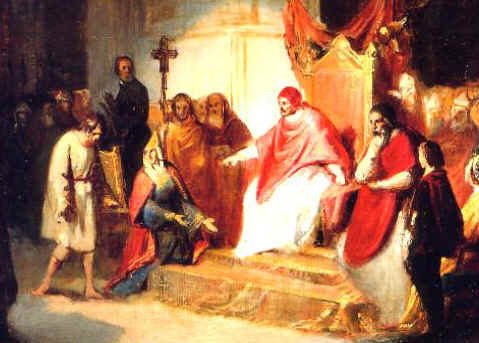
File:Canossa-three.jpg
Henry and Gregory at Canossa, by Carlo Emanuelle.

Gregory also released his subjects from their oaths of loyalty!  The nobles responded – meeting in October 1076, and, with the papal legates, proclaimed that Henry should present himself the next Candlemas 1077 to the Pope for judgment, and as an excommunicate, could not rule.  Henry made a memorable move – as the judgment in court would go badly for him – so he immediately went to the pope, and found him in the dead of winter at Canossa, in the Italy (Castle of Countess Matilda of Tuscany).  For three days the emperor, “in the snow, barefoot, in penitential garb, holding a candle,” sought the forgiveness of the pope.  Gregory wanted a court session, but could not refuse such a sign of repentance.  Henry IV received absolution and Holy Communion from the hand of the pope.  He promised to submit to the pope’s judgment, and allow the pontiff to come to Germany.

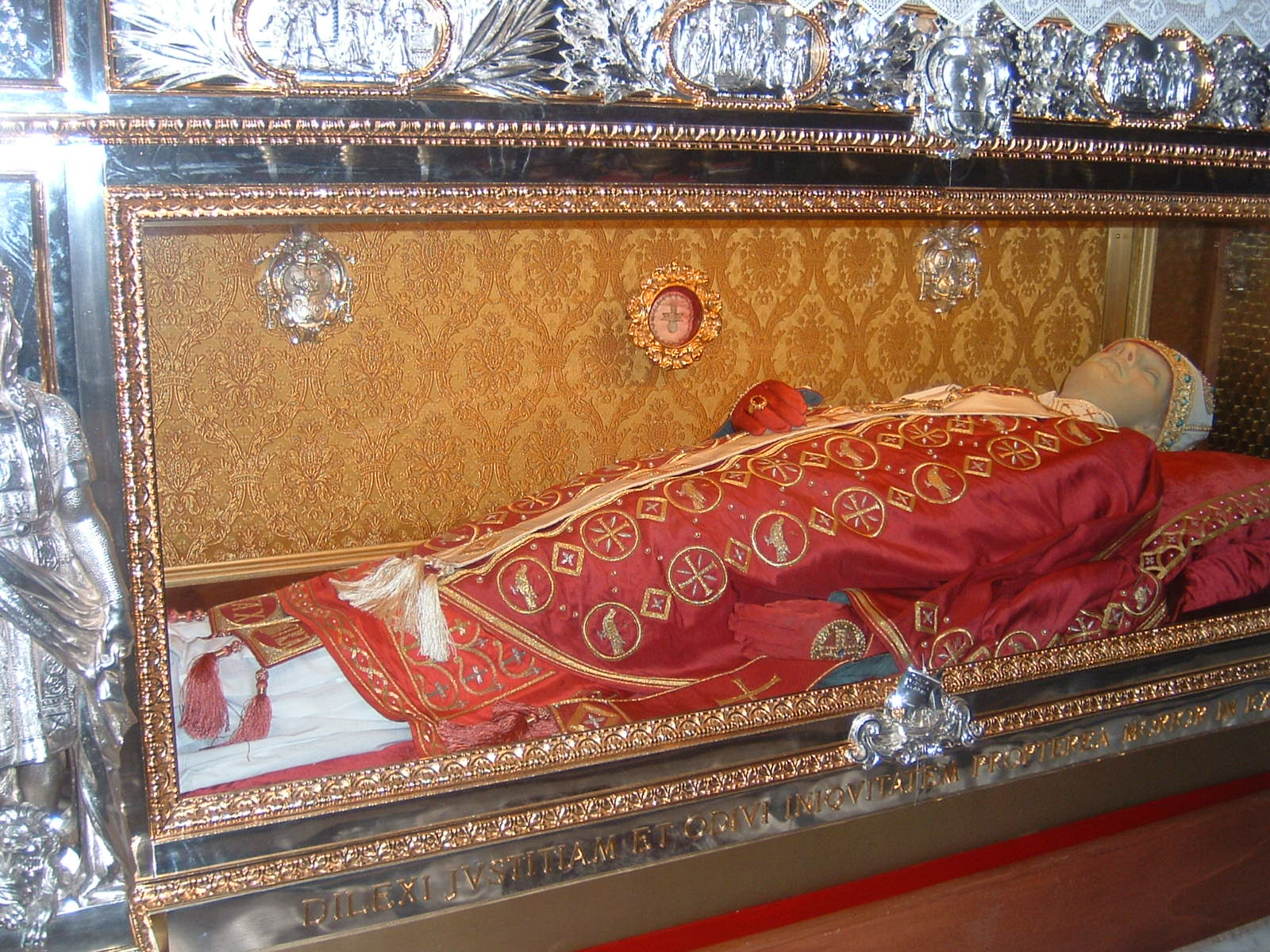
Henry, though, before he even left Italy, made alliances with Gregory’s enemies amongst the Lombards.  The German nobles, for their part, chose a new King of Germany: Duke Rudolph of Swabia (Claim 1077-1080).  A civil war followed, and Henry continued to trample the rights of the Church, earning him another excommunication in 1080!  This was met with Henry elevating an anti-pope from Ravenna: “Clement III” (1080-1100).  Rudolph was mortally wounded that October, and no one was left to challenge Henry in Germany.  Henry actually marched on Rome several times, and in 1084, chased the pope into refuge at Castel Sant’Angelo.  Though Robert Guiscard and the Italian Normans relieved the pope and drove Henry out, they ended up sacking the city, and Gregory was forced to flee.  He died at Salerno in May 1085: “Dilexi justitiam et odivi iniquitatem: propterea morior in exilio.”  The investiture struggle was not over yet, but the end was in sight.

For more of Pope St. Gregory VII, you should note:
Old Catholic Encyclopedia: St. Gregory VII

Patron Saints Index: St. Gregory VII

File:Salerno PopeGregoriousVIITomb.JPG
The coffin of Pope St. Gregory VII in Salerno, Italy.

St. Gregory VII is buried in the Cathderal of Salerno -- here is a link to their site: http://www.cattedraledisalerno.it/

Live well!

Friday, May 24, 2013

Le Bourgeois Gentilhomme of Moliere & Lully

 File:Le-bourgeois-gentilhomme.jpg 
Le Bourgeois Gentilhomme


In honor of the Holy Family Academy performance this evening of Le Bourgeois Gentilhomme by Moliere, it seems fitting to post a bit about this humorous play and its wonderful musical score by Jean-Baptiste Lully.

Moliere was born Jean-Baptiste Poquelin in Paris, France in 1622, receiving a rigorous education from the Jesuit College of Clermont.  Turning from a career in law or government service, as his father urged, he took the stage name of Moliere and pursued theatre.  He would rise to some fame and prominence, becoming a court playwright to King Louis XIV of France, the “Sun King.”

File:BourgeoisGentilhomme1688.jpg

Le Bourgeois Gentilhomme was first performed in 1670, and was accompanied by a musical score written by the accomplished composer Jean-Baptiste Lully.  Here is a clip of a selection of this music by Lully:


In this play, Le Bourgeois Gentilhomme, or the “Would-be Gentleman,” a successful but foolish tradesman – a bourgeois – dreams of being a noble gentleman.  In an effort to “climb the social ladder,” Mr. Jourdain employs many masters to teach him their various arts.  In these efforts, he is, in particular, preparing himself to meet the lovely Marchioness Dorimene.  Jourdain believes that the impoverished Count Dorante, his friend, has been courting her on his behalf, and gladly lends him large amounts of money.  Little does he know that Dorante has actually been courting Dorimene for himself.  Monsieur Jourdain, in the end, has made himself up into such a fool in his attempts to be a gentleman of quality that even the servant, Nicole, cannot stop laughing!
Meanwhile, Mr. Jourdain’s daughter, the beautiful Lucile, has fallen in love with an honest man of means, Cleonte, who asks for her hand in marriage.  Mr. Jourdain refuses him on the grounds that he is not from nobility.  This infuriates Madam Jourdain, who is the lady of the house.  Coveille, the resourceful servant of Cleonte, has a plan, however, to solve all their problems and put Mr. Jourdain in his place -- Cleonte will imitate a Turkish noble and promise Jourdain not only a noble son-in-law, but a title for himself.


                Moliere would die shortly after, in 1673AD, in Paris.

What a display ofculture and artistry was on display in the court of Louis XIV.

Live well!