Friday, June 24, 2022

Feast of the Sacred Heart of Jesus

Happy Solemnity of the Sacred Heart, on this third Friday after Pentecost!  This great celebration accords us with an opportunity to ponder the infinite mercy of Our Lord, Jesus Christ.


Il Sacro Cuore, AD1740 by Pompeo Batoni (+1787AD)

The traditional collect of the Feast gives us a good sense for today's focus:
O God, who in the Heart of Thy Son, wounded by our sins, dost mercifully bestow on us infinite treasures of love: grant, we beseech Thee, that whilst we render It the devout homage of our affection, we may also fulfill our duty of worthy satisfactions, Through the same Jesus Christ, Thy Son...

The traditional office of Matins also includes a splendid account of the Feast:

Among the wonderful developments of sacred teaching and piety, by which the plans of the divine Wisdom are daily made clear to the Church, hardly any is more manifest than the triumphant progress made by the devotion of the most Sacred Heart of Jesus. Very often indeed, during the course of past ages, Fathers, Doctors, and Saints have celebrated our Redeemer's love: and they have said, that the wound opened in the side of Christ was the hidden fountain of all graces. Moreover, from the Middle Ages onward, when the faithful began to show a more tender piety towards the most sacred Humanity of the Saviour, contemplative souls became accustomed to penetrate through that wound almost to the very Heart itself, wounded for the love of men. And from that time, this form of contemplation became so familiar to all persons of saintly life, that there was no country or religious order in which, during this period, witnesses to it were not to be found. Finally, during recent centuries, and most especially at that period when heretics, in the name of a false piety, strove to discourage Christians from receiving the most Holy Eucharist, the veneration of the most Sacred Heart began to be openly practised, principally through the exertions of St. John Eudes, who is by no means unworthily called the founder of the liturgical worship of the Sacred Hearts of Jesus and Mary.

But in order to establish fully and entirely the worship of the most Sacred Heart of Jesus, and to spread the same throughout the whole world, God himself chose as his instrument a most humble virgin from the order of the Visitation, St. Margaret Mary Alacoque, who even in her earliest years already had a burning love for the Sacrament of the Eucharist, and to whom Christ the Lord had very many times appeared, and was pleased to make known the riches and the desires of his divine Heart. The most famous of these apparitions was that in which Jesus revealed himself to her in prayer before the blessed Sacrament, shewed her his most Sacred Heart, and, complaining that in return for his unbounded love, he met with nothing but outrages and ingratitude from mankind, he ordered her to concern herself with the establishment of a new feast, on the Friday after the Octave of Corpus Christi, on which his Heart should be venerated with due honour, and that the insults offered him by sinners in the Sacrament of love should be expiated by worthy satisfaction. But there is no one who knoweth not how many and how great were the obstacles which the handmaid of God experienced, in carrying out the commands of Christ; but, endowed with strength by the Lord himself, and actively aided by her pious spiritual directors, who exerted themselves with an almost unbelievable zeal, up to the time of her death she never ceased faithfully to carry out the duty entrusted to her by heaven.

At length, in the year 1765, the Supreme Pontiff Clement XIII approved the Mass and Office in honour of the most Sacred Heart of Jesus; and Pius IX extended the feast to the universal Church. From then on the worship of the most Sacred Heart, like an overflowing river, washing away all obstacles, hath poured itself forth over all the earth, and, at the dawn of the new century, Leo XIII, having proclaimed a jubilee, decided to dedicate the whole human race to the most Sacred Heart. This consecration was actually carried out with solemn rites in all the churches of the Catholic world, and brought about a great increase of this devotion, leading not only nations but even private families to it, who in countless numbers dedicated themselves to the Divine Heart, and submitted themselves to its royal sway. Lastly, the Sovereign Pontiff Pius XI, in order that, by its solemnity, the feast might answer more fully to the greatly widespread devotion of the Christian people, raised the feast of the most Sacred Heart of Jesus to the rite of a double of the first class, with an octave; and moreover, that the violated rights of Christ, the supreme King and most loving Lord, might be repaired, and that the sins of the nations might be bewailed, he ordered that annually, on that same feast-day, there should be recited an expiatory form of prayer in all the churches of the Christian world.

These links give a wonderful overview of the devotion to the Sacred Heart of Jesus:
Old Catholic Encyclopedia: Sacred Heart

Fisheaters: Devotions to the Sacred Heart

Catholic News Agency: Sacred Heart

Here is a more recent reflection on the great feast by Dr. William Fahey: Falling in Love by Fahey

Certainly today, too, is a wonderful moment to read the Encyclical of Pope Pius XII, Haurietis Aquas, on Devotion to the Sacred Heart: Full Text: HAURIETIS AQUAS

Here are a few of the Cathedrals and Basilicas that bear the name of Sacred Heart:

First, the Basilica of the Sacred Heart in Atlanta, Georgia:
Sacred Heart Basilica, Atlanta, GA

The Cathedral of Richmond, Virginia:
Cathedral of the Sacred Heart, Richmond, VA

The Basilica-Cathedral of Newark, New Jersey:
Cathedral-Basilica of the Sacred Heart, Newark, NJ

Moving to France, and the famous Basilica du Sacre Coeur:
Basilica du Sacre Coeur

Belgium, too, has a splendid Basilica to the Sacred Heart, this in Brussels:
Basilica of the Sacred Heart, Brussels, Belgium

Finally, in Spain, in Barcelona:
Templo del Sagrado Corazon, Barcelona, Spain

Today, there is also the possibility of gaining a plenary indulgence:
--
"On the Solemnity of the Sacred Heart of Jesus, publicly recite the act of reparation Jesu dulcissime (a partial indulgence is granted for its use in other circumstances, such as private recitation."

The text of the prayer
"Most sweet Jesus, whose overflowing charity for men is requited by so much forgetfulness, negligence, and contempt, behold us prostrate before you, eager to repair by a special act of homage the cruel indifference and injuries to which your loving Heart is everywhere subjected.
Mindful, alas! That we ourselves have had a share in such great indignities, which we now deplore from the depths of our hearts, we humbly ask your pardon and declare our readiness to atone by voluntary expiation, not only for our own personal offenses, but also for the sins of those who, straying from the path of salvation, refuse in their obstinate infidelity to follow you, their Shepherd and Leader, or, renouncing the promises of their Baptism, have cast off the sweet yoke of your law.
We are now resolved to expiate each and every deplorable outrage committed against you; we are determined to make amends for the manifold offenses against Christian modesty in indecent dress and behavior, for all the foul seductions laid to ensnare the feet of the innocent, for the frequent violations of Sundays and holydays, and for the shocking blasphemies uttered against you and your Saints. We wish also to make amends for the insults to which your Vicar on earth and your priests are subjected, for the profanation, by conscious neglect or terrible acts of sacrilege, of the very Sacrament of your divine love, and lastly for the public crimes of nations who resist the rights and teaching authority of the Church which you have founded.
Would that we were able to wash away such abominations with our blood. We now offer, in reparation for these violations of your divine honor, the satisfaction you once made to your Eternal Father on the cross and which you continue to renew daily on our altars; we offer it in union with the acts of atonement of your Virgin Mother and all the saints and of the pious faithful on earth; and we sincerely promise to make recompense, as far as we can with the help of your grace, for all the neglect of your great love and for the sins we and others have committed in the past. Henceforth, we will live a life of unswerving faith, of purity of conduct, of perfect observance of the precepts of the Gospel and especially that of charity. We promise to the best of our power to prevent others from offended you and to bring as many as possible to follow you.
O loving Jesus, through the intercession of the Blessed Virgin Mother, our model of reparation, deign to receive the voluntary offering we make of this act of expiation; and by the crowning gift of perseverance keep us faithful unto death to our duty and the allegiance we owe to you, that we may all one day come to that happy home, where with the Father and the Holy Spirit you live and reign, for ever and ever. Amen."

Original Text from the USCCB's Handbook of Indulgences, quoted at this most useful link.
--

Here is the Latin of that same grant of an indulgence:
Plenaria indulgentia conceditur christifideli, qui in sollemnitate Sacr.mi Cordis Iesu, actum reparationis (Iesu dulcissime) publice recitaverit; in aliis rerum adiunctis indulgentia erit partialis:

Iesu dulcissime, cuius effusa in homines caritas, tanta oblivione, neglegentia, contemptione, ingratissime rependitur, en nos, ante conspectum tuum provoluti, tam nefariam hominum socordiam iniuriasque, quibus undique amantissimum Cor tuum afficitur, peculiari honore resarcire contendimus. 
Attamen, memores tantae nos quoque indignitatis non expertes aliquando fuisse, indeque vehementissimo dolore commoti, tuam in primis misericordiam nobis imploramus, parati, voluntaria expiatione compensare flagitia non modo quae ipsi patravimus, sed etiam illorum, qui, longe a salutis via aberrantes vel te pastorem ducemque sectari detrectant, in sua infidelitate obstinati, vel, baptismatis promissa conculcantes, suavissimum tuae legis iugum excusserunt. 
Quae deploranda crimina, cum universa expiare contendimus, tum nobis singula resarcienda proponimus: vitae cultusque immodestiam atque turpitudines, tot corruptelae pedicas innocentium animis instructas, dies festos violatos, exsecranda in te tuosque Sanctos iactata maledicta atque in tuum Vicarium ordinemque sacerdotalem convicia irrogata, ipsum denique amoris divini Sacramentum vel neglectum vel horrendis sacrilegiis profanatum, publica postremo nationum delicta, quae Ecclesiae a te institutae iuribus magisterioque reluctantur. 
Quae utinam crimina sanguine ipsi nostro eluere possemus! Interea ad violatum divinum honorem resarciendum, quam Tu olim Patri in Cruce satisfactionem obtulisti quamque cotidie in altaribus renovare pergis, hanc eamdem nos tibi praestamus, cum Virginis Matris, omnium Sanctorum, piorum quoque fidelium expiationibus coniunctam, ex animo spondentes, cum praeterita nostra aliorumque peccata ac tanti amoris incuriam firma fide, candidis vitae moribus, perfecta legis evangelicae, caritatis potissimum, observantia, quantum in nobis erit, gratia tua favente, nos esse compensaturos, tum iniurias tibi inferendas pro viribus prohibituros, et quam plurimos potuerimus ad tui sequelam convocaturos. Excipias, quaesumus, benignissime Iesu, beata Virgine Maria Reparatrice intercedente, voluntarium huius expiationis obsequium nosque in officio tuique servitio fidissimos ad mortem usque velis, magno illo perseverantiae munere, continere, ut ad illam tandem patriam perveniamus omnes, ubi Tu cum Patre et Spiritu Sancto vivis et regnas in saecula saeculorum. Amen. 
Cf., Enchiridion indulgentiarum
--

Most Sacred Heart of Jesus, have mercy on us!

Live well!

Thursday, June 23, 2022

Feast of the Nativity of St. John the Baptist

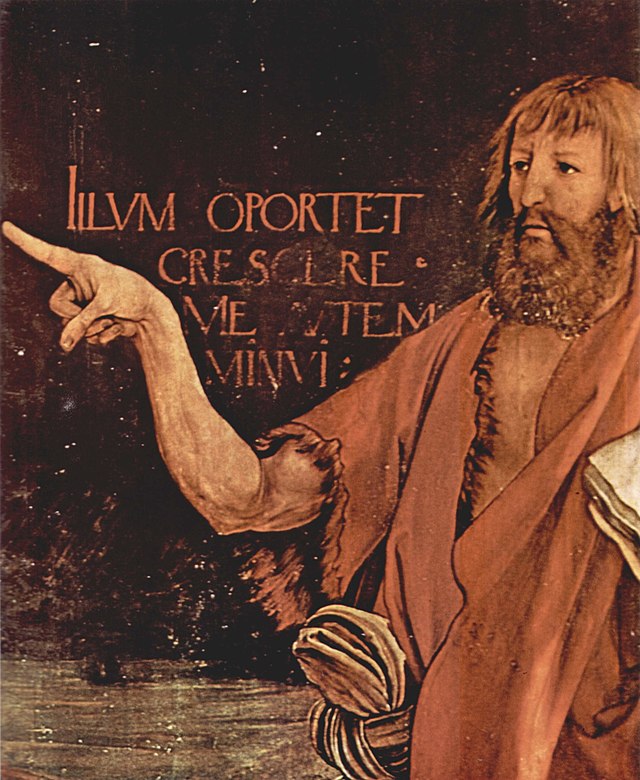
"Ipsum oportet crescere, me autem minui."  "He must increase, I must decrease." (John 3:30)

This statement embodies both St. John the Baptist and his sublime role in the salvation of mankind.  St. John was the forerunner, the "Vox clamantis in deserto : Parate viam Domini, rectas facite semitas ejus," "A voice of one crying in the desert: Prepare the way of the Lord; make straight his paths." (Mark 1:3) about whom our divine Lord said, " Amen I say to you, there has not risen among them that are born of women a greater than John the Baptist: yet he that is the lesser in the kingdom of heaven is greater than he." (Matthew 11:11)


St. John the Baptist by Titian, 1540AD.

St. John the Baptist is, as it were, the last character of the Old Testament, the final prophet, who, having "made straight the paths of the Lord" stepped aside in humility before his cousin, and Saviour.  From St. John we learn not only austerity and devotion to God, but humility and obedience.  His resolve in teaching the truth is, ultimately, a contributing factor to his execution by Herod.

Notably, we now know that Zechariah served in the Temple during September, putting John's Conception late in that month, and confirming the timing of the Annunciation of Christ in March (when Elizabeth was in her sixth month), and therefore the birth of St. John in June and of Jesus Christ in December...

For more on St. John the Baptist, be sure to check out:
Old Catholic Encyclopedia: St. John the Baptist

Patron Saints Index: St. John the Baptist

This Feast of St. John is associated with bonfires, owing to its proximity to the Summer Solstice.  Go ahead, have a St. John's fire!  Here is the blessing of fire traditional for this time:

"Lord God, almighty Father, the light that never fails and the source of all light, sanctify + this new fire, and grant that after the darkness of this life we may come unsullied to you who are light eternal; through Christ our Lord. All: Amen."

It is interesting to note that this feast is associated with the origin of musical notes:
"The Benedictine monk Guido d’Arezzo (c. 990-1050) introduced the now familiar syllables ut re mi fa sol la for the tones of the hexachord c to a… or, more modally, the tonic, supertonic, mediant, etc. of a major scale. The Guidonian syllables derive from the hymn for the feast of St. John the Baptist:
UT queant laxis
REsonare fibris
MIra gestorum
FAmuli tuorum,
SOLve polluti
LAbii reatum,
Sancte Ioannes (SI)."
[Cf., http://wdtprs.com/blog/2015/06/23-june-vigil-of-st-john-bonfires-and-witch-burnings-solstices-and-snails/]

For a list of other details and customs associated with the feast, you might note:
Fisheaters: St. John's Day

I would also like to recall a few places and Churches associated with St. John the Baptist:

In Italy, the first city is that of Florence, whose patron Saint is the great precursor of Our Lord, St. John the Baptist.  Buona festa, Firenze!


The Duomo of Florence, Tuscany.

The Basilica in Italy to which I refer is that of St. John Lateran in Rome, the Cathedral of the Bishop of Rome.  This Cathedral-Basilica, whose feast of 9 November, was originally dedicated to Our Divine Savior, but was also consecrated to both St. John the Baptist and St. John the Evangelist.  This link allows you to virtually visit the Pope's Cathedral: Archbasilica of St. John Lateran


The facade of St. John Lateran, in Rome, by Alessandro Galilei, 1735AD.
[CC BY 2.5, https://en.wikipedia.org/w/index.php?curid=9256006]

In North America, the Cathedral of the City of Savannah, Georgia, is named for St. John the Baptist:
Cathedral of St. John the Baptist

To conclude, we turn then to St. John's, the port town on the island of Newfoundland that was named for St. John the Baptist, and its cathedral is a basilica named for the very same.  St. John's is, indeed, a delightful situated city, as the following picture attests:

A view of the harbor of St. John's, Newfoundland, Canada.
[By Sébastien Blanchard - Own work, CC BY-SA 4.0, https://commons.wikimedia.org/w/index.php?curid=59766488]


Here is a link to the Cathedral-Basilica of St. John the Baptist, in St. John's:
Basilica-Cathedral of St. John the Baptist


Finally, I leave you with a great little video which artistically features the sights and scenes of modern St. John's, Newfoundland, a city with a 500 year history (you can see the Basilica-Cathedral on the hillside at 0:52 into this video):


Live well!

Tuesday, June 21, 2022

Illum oportet crescere... the Summer Solstice


St. John the Baptist, from the Isenheim Altarpiece, by Matthias Grunewald.

"Illum oportet crescere, me autem minui."

Today we reach the Summer Solstice -- which took place a precisely at 5:13AM this morning (Eastern Daylight Time).  This day, then, is the day in which daylight lasts the longest and summer begins in the Northern Hemisphere, and is gone the fastest and winter begins in the Southern.

For some excellent charts and information on length of days, sunset, sunrise, and the like, this site is splendid:
Gaisma

This site, too, allows you to customize your location and get a host of details on astronomical objects: Heavens Above

It is well to note the sort of pious religious connection to these events that was observed by the Medievals: the Summer Solstice falls near the Feast of St. John the Baptist (24 June), while the Winter Solstice is close to Christmas (25 December).  We know from Sacred Scripture that St. John the Baptist was, indeed, born six months before Our Lord.  Thus, the amount of daylight decreases from the Feast of St. John to Christmas, and increases from Christmas to the Feast of St. John.  This brings to mind the quotation of St. John the Baptist in Scripture, John 3:30: "Illum oportet crescere, me autem minui."  In our vulgar tongue: "He must increase: but I must decrease."

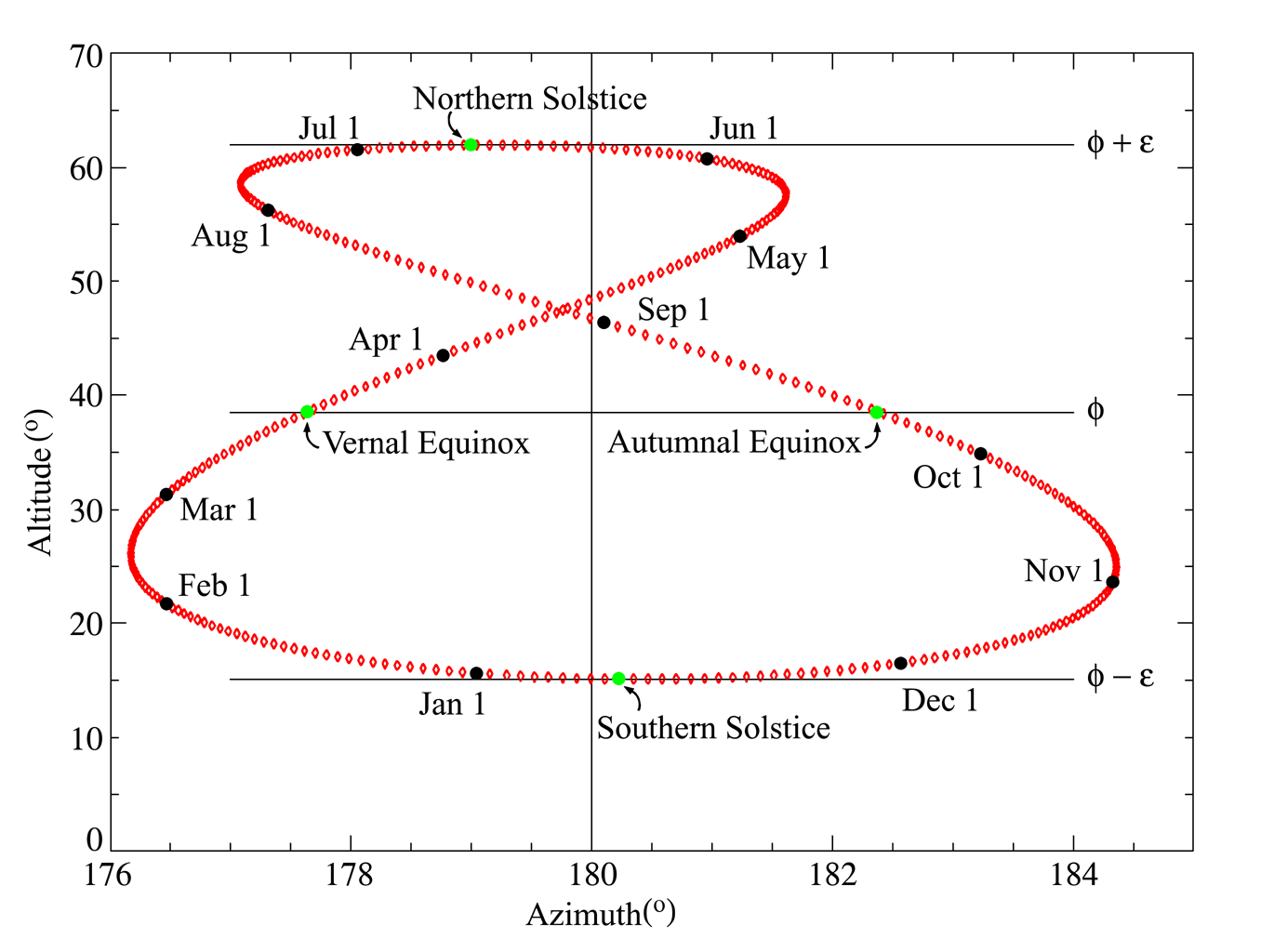
File:Analemma Earth.png
This chart show the analemma for Earth, showing the relative locations of the Sun at noon at the Greenwich Observatory in England.  Notice the change in both altitude and azimuth at the different points of the year.

What, exactly, is the solstice?

On this day, the Sun is directly overhead at real noon on the Tropic of Cancer.  In the days of old, the Sun would appear in front of the constellation Cancer on this day, hence the name of the line on the globe.  Thanks to the procession of the equinoxes, however, the sun is now in Gemini at the Summer Solstice.

As a side note, it is during this time of year that a Full Moon stays the lowest in the sky in the Northern Hemisphere, and reaches its highest point, in the Southern, this in terms of degrees from the horizon.

Why do we have a Summer Solstice, you ask?  Well, I am glad you did!  If the Earth sat directly upright on its axis, the Sun would always be directly overhead at noon on the equator, it would appear to move through the stars along the celestial equator, days would always remain the same length, and every day would be like the two equinox days in Spring and Fall.  As it happens, the Earth is tilted at about 23.5 degrees on its axis.  Thus, the sun appears to diverge as much as 23.5 degrees from the celestial equator in its apparent path through the stars (the ecliptic), and ends up being directly overhead up to 23.5 degrees north or south of the equator (the Tropics of Cancer and Capricorn) on the two solstice days.  This is the reason, of course, for our seasons.


File:North season.jpg
This diagram shows the positions of the Earth in relation to the sun at those four points -- the Summer solstice on the left, with the Northern Hemisphere tilted toward the Sun, and the Winter solstice on the right, with the Southern Hemisphere facing the Sun more directly, with the two equinoxes between, with the Hemispheres equally oriented to the Sun.


So, if we start at the vernal equinox in March, the sun is directly overhead at the equator at noon, and night and day are the same length.  From then until today, the summer solstice, the Sun appears to move slowly to the north both in the sky, setting a bit further north of west each day, and in its apparent path through the constellations of the zodiac.  This continues until the Sun reaches the solstice, where it stops, being directly overhead at 23.5 degrees north latitude (the Tropic of Cancer) at noon, and sitting about 23.5 degrees north of the celestial equator.  From that point, the sun drifts back south until reaching the equator once more at the autumnal equinox in September, going all the way to 23.5 degrees south at the Winter Solstice.

The reason for all of this is that as the Earth orbits the Sun the two hemispheres of the Earth take turns being tilted toward the Sun.  The following diagrams might help to illustrate what I am trying to articulate:

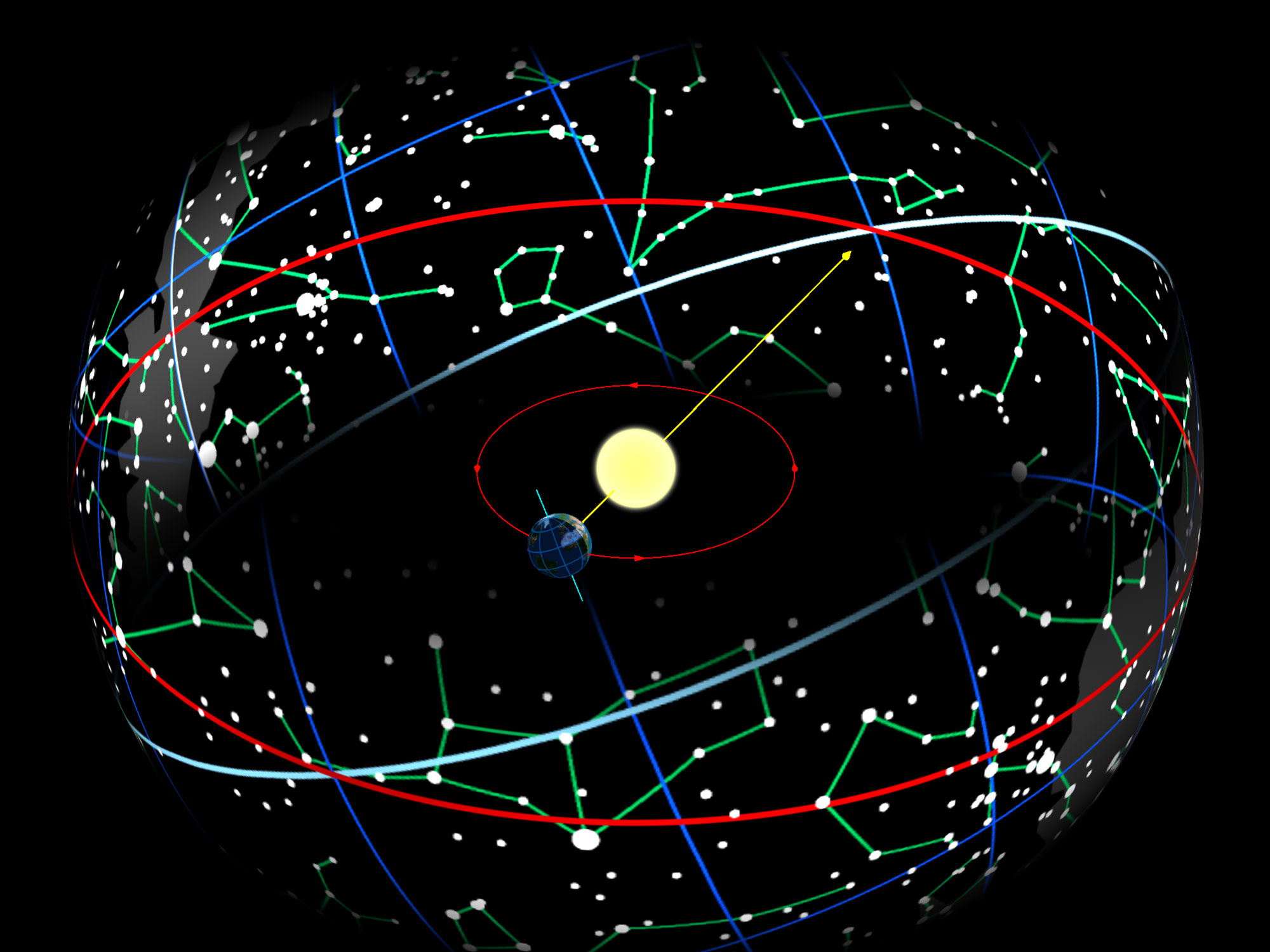
File:Ecliptic path.jpg
In this diagram, the sun appears to move against the background of the stars along the red line, the ecliptic, while the white line marks the celestial equator -- the imaginary line through space that is merely the extension of the Earth's equator.  The two points where the red and white lines are at greatest divergence are the solstices, while the two points where the red and white lines cross are the two equinoxes.  The yellow line shows what the sun would appear to be in front of from the Earth, the Constellation Pisces, at the vernal equinox.

I leave you, then, with the words of St. John the Baptist:  "Illum oportet crescere, me autem minui."   "He must increase: but I must decrease."

Live well!

Friday, June 17, 2022

Pride & Love

A view of a rainbow on the Navajo Reserve in Arizona [My photo]


One is hard pressed to make it far into the month of June without being confronted with images of a rainbow or slogans like "love is love" or "love wins."  It seems that, "The whole world groaned, and was astonished to find itself [LGBTQ+]."

Lacking in all of this enthusiasm and advocacy seems to be a measured consideration of what is being discussed and distinctions surely critical for the good of souls.  While some might argue it is only a matter of respecting all people, certainly the rhetoric of "pride" implies more than just that.

What is being celebrated during June?  Before we answer that, let us make some distinctions.

At the outset, I am assuming the human dignity of every individual person -- made in the image and likeness of God.  This means that I believe that every human being should be treated with respect and is created for ultimate union with God.  To quote the Catechism of the Catholic Church, "[Those with homosexual inclinations] must be accepted with respect, compassion, and sensitivity. Every sign of unjust discrimination in their regard should be avoided." (CCC2358)

That said, a distinction that is seemingly never made in our public square is that between a human person and their passions or inclinations.  People are not simply desire or inclinations.  Thanks to Original Sin, we all suffer concupiscence, or disordered passions.  We are all called to subject our desires to reason, and use our free will to reign in what is disordered or sinful.

The Catechism, drawing on the discussion of St. Thomas Aquinas on the subject, notes that, "The term 'passions' belongs to the Christian patrimony. Feelings or passions are emotions or movements of the sensitive appetite that incline us to act or not to act in regard to something felt or imagined to be good or evil." (CCC1763)  Further, "In themselves passions are neither good nor evil. They are morally qualified only to the extent that they effectively engage reason and will....It belongs to the perfection of the moral or human good that the passions be governed by reason." (CCC1767)

Hence, our passions, inclinations, and desires are, in themselves, not good or evil, but ordered or disordered.  A desire is either leading us, in accord with reason, toward some good, and it is then ordered, or away from the good and toward irrational and sinful actions, and is thus disordered.  The morality of the situation arises from what we choose with our will.  To find oneself experiencing a disordered passion is a temptation, but not a sin until you consent to it or act on it.

With our wounded natures, scarred by Original Sin, we all experience disordered passions; yet, we are called to restrain those passions in accord with reason and moral integrity.  Thanks be to God, we are not simply slaves to our passions.  We are all "born with" disordered desires, however.  I will not enter into a consideration of what range of desires are acquired or not; the morality of the action is not based on how I specifically came to have such desires.  That is, frankly, a distraction to the moral discussion.

I might find myself "in love" and experience desires in a range of situations: imagine a man "falling in love" with a woman not his wife, with someone else's wife, with a student of his, with a little child, with another man, with a sibling, or even with a goat.  I would submit that in every one of those cases, the individual who finds himself with those desires has a moral responsibility to restrain himself.  Every one of those desires is disordered; consenting to them or acting on them externally would be sinful and wicked.  Merely to experience those desires is not to sin, however; it is to be tempted.  To quote the Catechism: "Strong feelings are not decisive for the morality or the holiness of persons; they are simply the inexhaustible reservoir of images and affections in which the moral life is expressed. Passions are morally good when they contribute to a good action, evil in the opposite case. The upright will orders the movements of the senses it appropriates to the good and to beatitude; an evil will succumbs to disordered passions and exacerbates them. Emotions and feelings can be taken up into the virtues or perverted by the vices." (CCC1768)

Now, obviously those desires are not all equally disordered or disordered in the same way.  The first in the list, a man's desire for a woman not his wife, is at least directed toward something that might be made right: that man, gaining the consent of the woman and assuming no impediments, might marry her, placing those desires in a rightly ordered context.  Nevertheless, even that love might go astray if the man is, himself, already married or if the woman doesn't consent.  "Love" may be love, but adultery and rape are both morally wrong.  On the other hand, on the opposite extreme, there is no way for a desire for a goat to be rational, ordered, or morally right.  It matters not how strong the passion or how seemingly receptive the animal.

The degree to which the desire can never be rightly ordered, is the degree to which it is contrary to our nature and sinful if acted upon.  What does it mean for such desires to be ordered, in the first place?  Simply, it means in accord with reason and the natural purposes of the act.  In this context, we are speaking of acts involving the reproductive system of the human person.

"Sexuality affects all aspects of the human person in the unity of his body and soul. It especially concerns affectivity, the capacity to love and to procreate, and in a more general way the aptitude for forming bonds of communion with others.  Everyone, man and woman, should acknowledge and accept his sexual identity. Physical, moral, and spiritual difference and complementarity are oriented toward the goods of marriage and the flourishing of family life. The harmony of the couple and of society depends in part on the way in which the complementarity, needs, and mutual support between the sexes are lived out." (CCC2332-2333)

Our biological sex (leaving the term "gender" for linguistics; there are three in English, for instance, masculine, feminine, and neuter) -- our sexual identity -- is a profound aspect of who we, body and soul, are.  The complementary and fruitful pairing of male and female is profoundly meaningful and spiritually significant as a type of Christ and His Church.

Now, homosexual tendencies run afoul of the natural purposes of our sexual identity and the purpose of the reproductive act: "Homosexuality refers to relations between men or between women who experience an exclusive or predominant sexual attraction toward persons of the same sex. ... Basing itself on Sacred Scripture, which presents homosexual acts as acts of grave depravity, tradition has always declared that 'homosexual acts are intrinsically disordered.'  They are contrary to the natural law. They close the sexual act to the gift of life. They do not proceed from a genuine affective and sexual complementarity. Under no circumstances can they be approved." (CCC2357)

To call a homosexual relationship a "marriage" is to essentially redefine not only marriage and the purposes and meaning of sexuality, but also human nature itself.  It is to imply that either we lack immortal souls, so being animals without significant moral agency, we may do what we wish with ourselves; or to imply that we are only souls, whose bodies are accidental additions with which it matters not what we do.  If we are body and soul, however, we should governor ourselves with intellect and will, and our bodies really matter, for they are part of who and what we are.  Homosexual activity utterly lacks the possibility of fruitfulness -- it is not a proper utilization of the reproductive system -- and lacks the complementary nature and unity demanded by the marital act.

This is the reason that a marriage is to be exclusive between a single man and woman, and to be indissoluble: a marital union should be, by nature, fruitful and stable for the good of spouses and children (though there is no fault for those for whom such fertility and stability is naturally impossible; we don't blame the infertile or the widowed or abandoned).  To divorce the notion of marriage from the fruitfulness and good of children -- and their education -- is also to radically redefine the institution.  Contraception and no-fault divorce are contradictory to marriage, too, and crucial steps that clearly led us to a place where "marriage" is only about some sense of emotional and sexual attraction.  What an impoverished notion of marriage, indeed.

So, what do we make of "pride" month.  Taking the term pride in a positive sense, not in that of the capital sin, in what is pride being taken?  In a lifestyle based on acts "contrary to the natural law"?  In having a particular set of disordered desires?

Those who struggle with such homosexual desires, "are called to chastity. By the virtues of self-mastery that teach them inner freedom, at times by the support of disinterested friendship, by prayer and sacramental grace, they can and should gradually and resolutely approach Christian perfection." (CCC2359).  Like all others of the faithful, their dignity is in their being made in the image and likeness of God and, if they are Christians, in their baptism.  Associating identity with inclinations, especially those that are disordered, seems problematic at the least, and reductive of the person to their desires.  People are so much more than their desires!

Actual "pride" in a lifestyle founded on homosexual activity, to be sure, is destructive and hateful to a life of virtue and grace.  It is actually contrary to the dignity of those with such inclinations and it would be authentically uncharitable to encourage someone to indulge in such a lifestyle.  The "pride" celebration, of course, fails to make any distinctions, seemingly implying the acceptability and desirability of such actions.  That seems manifestly destructive to the good of individuals who might struggle with such inclinations.  In sum, even assuming the best, it is hard to reconcile the celebration of LGBTQ+ "Pride" with the authentic good of souls.


Live well!

Thursday, June 16, 2022

Corpus Christi: The Body of Christ


Today, the Thursday after Trinity Sunday, is the traditional date of the great Feast of Corpus Christi.  It seems a good moment to pause and reflect upon the Doctrine of the Blessed Sacrament.  It is, of course, Catholic and Orthodox belief, as it has been since the time of Christ, that the Blessed Sacrament is not merely a symbol of Christ, but is actually, truly and substantially, Christ Himself, but with the accidents, or appearances, of bread and wine remaining.  This change of substance without the accompanying change in accidents is called transubstantiation.  Before examining some texts from the Sacred Scriptures and from Christian history on the subject, you should note the following two links, and the Gregorian Chant Sequence of the Feast:

For more on the history of this great feast:
Old Catholic Encyclopedia: Corpus Christi

...for some more on the customs of the day:
Fisheaters: Corpus Christi

...and the Sequence for the Feast, Lauda Sion:


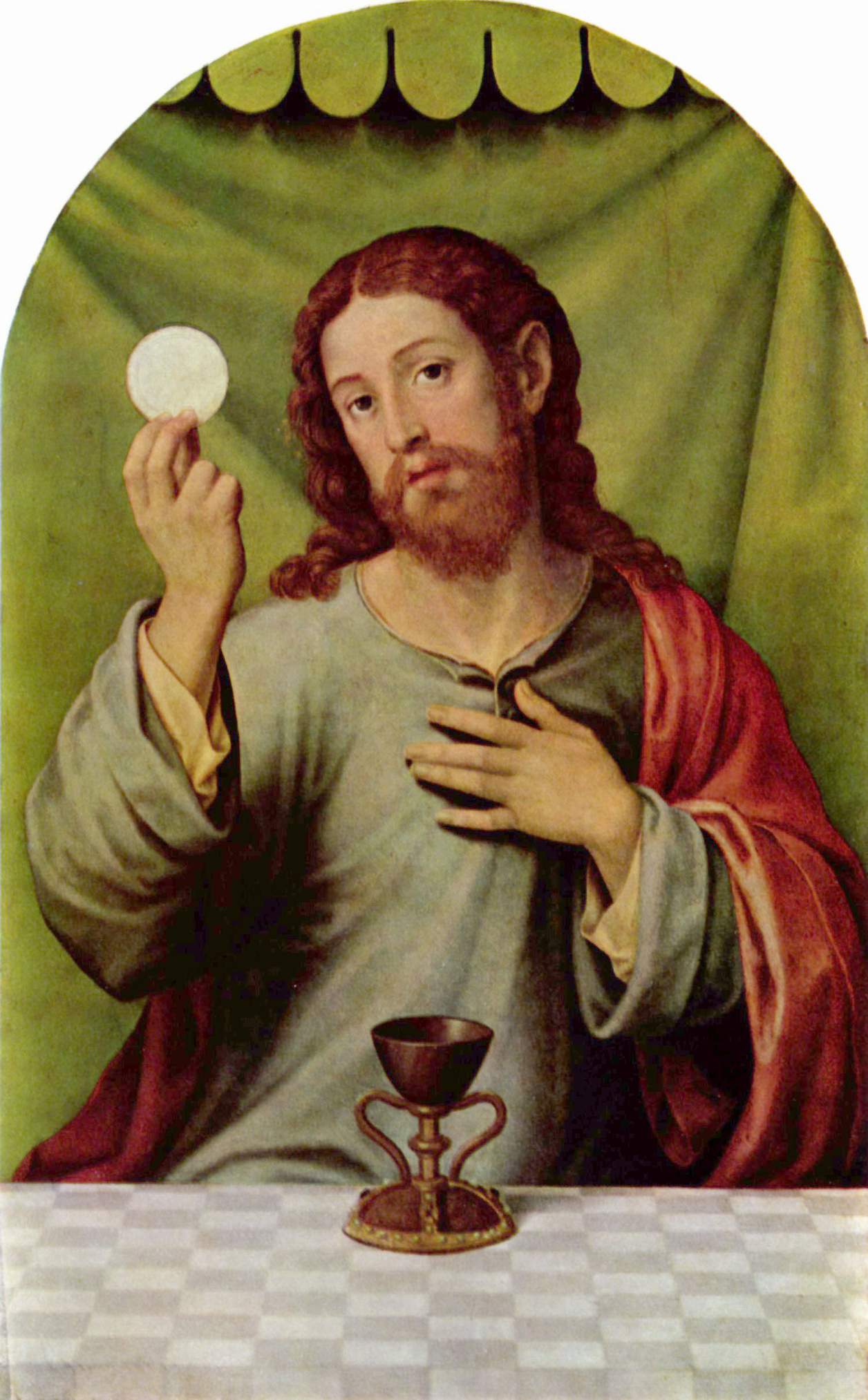
Christ with the Eucharist, by Vicente Juan Masip (+1545AD):

What basis in Scripture and in the history of Christian practice is there for this belief?  Let us take a look.

Turning first to the Holy Gospel according to St. Mark (14:22-24), we recall the Last Supper of Our Lord:
"And whilst they were eating, Jesus took bread; and blessing, broke, and gave to them, and said: Take ye.  This is my body.  And having taken the chalice, giving thanks, he gave it to them.  And they all drank of it.  And he said to them:  This is my blood of the new testament, which shall be shed for many."

Our Lord, Jesus Christ, had earlier given some discourse on this matter, as we find in the 6th Chapter of the Gospel according to St. John (6:53-56, 61, 67-69):
"The Jews therefore strove among themselves, saying: How can this man give us his flesh to eat?  Then Jesus said to them:  Amen I say unto you: except you eat the flesh of the Son of man, and drink his blood, you shall not have life in you.  He that eateth my flesh, and drinketh my blood, hath everlasting life: and I will raise him up in the last day.  For my flesh is meat indeed: and my blood is drink indeed…Many therefore of his disciples, hearing it said: This saying is hard, and who can hear it?…After this many disciples went back; and walked no more with him.  Then Jesus said to the twelve: Will you also go away?  And Simon Peter answered him:  Lord, to whom shall we go?  Thou hast the words of eternal life."

St. Paul, in his first letter to the Corinthians (11:26-29) gives further explanation into this most sublime doctrine and practice:
"For as often as you shall eat this bread, and drink the chalice, you shall shew the death of the Lord, until he come.  Therefore whosoever shall eat this bread, or drink the chalice of the Lord unworthily, shall be guilty of the body and of the blood of the Lord.  But let a man prove himself: and so let him eat of that bread, and drink of the chalice.  For he that eateth and drinketh unworthily, eateth and drinketh judgment to himself, not discerning the body of the Lord."

It should be no surprise, then, that considering the basis in Sacred Scripture, Christians from the beginning would hold to this Real Presence of Christ in Holy Communion:

St. Ignatius of Antioch, in his “Letter to the Smyrnaeans”  (ca. 110AD) writes: "They [“They” refers to “those who hold heterodox opinions on the grace of Jesus Christ which has come to us.”] abstain from the Eucharist and from prayer, because they do not confess that the Eucharist is the Flesh of our Savior Jesus Christ, Flesh which suffered for our sins and which the Father, in His goodness, raised up again."

St. Justin Martyr, in his “First Apology” (between A.D. 148-155) writes:
            “After the president has given thanks, and all the people have shouted their assent, those whom we call deacons give to each one present to partake of the Eucharistic bread and wine and water; and to those who are absent they carry away a portion.
            We call this food Eucharist; and no one else is permitted to partake of it, except one who believes our teaching to be true and who has been washed in the washing which is for the remission of sins and for regeneration, and is thereby living as Christ has enjoined.  For not as common bread nor common drink do we receive these; but since Jesus Christ our Savior was made incarnate by the word of God and had both flesh and blood for our salvation, so too, as we have been taught, the food which has been made into the Eucharist by the Eucharistic prayer set down by Him, and by the change of which our blood and flesh is nourished, is both the flesh and the blood of that incarnated Jesus.
            The Apostles, in the Memoirs which they produced, which are called Gospels, have thus passed on that which was enjoined upon them: that Jesus took bread and, having given thanks, said, ‘Do this in remembrance of Me; this is My Body.’  And in like manner, taking the cup, and having given thanks, He said, ‘This is my Blood.’  And He imparted this to them only.”

St. Cyprian of Carthage, in his “Letter of Cyprian to a certain Cecil” (ca. 250AD) writes:
Also in the priest Melchisedech we see the Sacrament of the Sacrifice of the Lord prefigured…
 The order certainly is that which comes from his sacrifice and which comes down from it; because Melchisedech was a priest of the Most High God; because he offered bread; and because he blessed Abraham.  And who is more a priest of the Most High God than our Lord Jesus Christ, who, when He offered sacrifice to God the Father, offered the very same which Melchisedech had offered, namely bread and wine, which is in fact His Body and Blood!”
 “…nor is the Sacrifice of the Lord celebrated with a legitimate consecration unless our offering and sacrifice corresponds with the passion…I wonder, indeed, whence this practice has come, that, contrary to evangelic and apostolic tradition, in certain places water alone, which cannot signify the Blood of Christ, is offered in the cup of the Lord.”

The great St. Athanasius, Doctor and defender of the Divinity of Christ writes, before 373AD, in his “Sermon to the Newly Baptized”:
"But after the great and wonderful prayers have been completed, then the bread is become the Body, and the wine the Blood, of our Lord Jesus Christ.  And again: Let us approach the celebration of the mysteries.  This bread and this wine, so long as the prayers and supplications have not taken place, remain what they are.  But after the great prayers and holy supplications have been sent forth, the Word comes down into the bread and wine — and thus is His Body confected."

St. Hilary of Poitiers, writing in 356-359AD, in the work "The Trinity," clearly explains:
"As to the reality of His Flesh and Blood, there is no room left for doubt, because now, both by the declaration of the Lord Himself and by our own faith, it is truly Flesh and it is truly Blood."

St. Cyril of Alexandria, too, bears witness writing in “Commentaries on Matthew” (after A.D. 428):
He states demonstratively: ‘This is My Body,’ and ‘This is My Blood,’ lest you might suppose the things that are seen are a figure.  Rather, by some secret of the all-powerful God the things seen are transformed into the Body and Blood of Christ, truly offered in sacrifice in which we, as participants, receive the life-giving and sanctifying power of Christ.”

I omit a great many other documents, letters, and teachings that manifest the same belief throughout the early centuries of the Church.  Indeed, moving to the 11th century, we find a man, Berengarius, that dared deny what Christians had always held, and he was required by Pope St. Gregory VII in 1079AD to assent to the following statement of belief if he wished to be reconciled to the Church:
"I, Berengarius, believe interiorly and profess publicly that the bread and wine, which are placed on the altar, through the mystery of the sacred prayer and the words of our Redeemer are substantially changed into the true, proper, and life-giving flesh and blood of our Lord Jesus Christ.  After the consecration it is the true body of Christ…"

It is interesting to note that St. Thomas Aquinas refers to this Berengarius, who lived a thousand years after Christ as he "who had been the first deviser of this heresy," the heresy being a denial of the Real Presence of Christ.


The decrees of Ecumenical Councils of the Church, then, merely echo constant Christian belief:

From the Council of Florence (1438-1445AD), presided over by Pope Eugene IV:
"It is by the power of these words that the substance of bread is changed into the body of Christ, and the substance of wine into his blood.  This change takes place in such a way that the whole Christ is present under the species of bread and the whole Christ is present under the species of wine."

From the 13th session of the Council of Trent (1551AD), presided over by Pope Julius III:
"To begin with, the holy council teaches and openly and straightforwardly professes that in the blessed sacrament of the Holy Eucharist, after the consecration of the bread and wine, our Lord Jesus Christ, true God and man, is truly, really, and substantially contained under the perceptible species of bread and wine"

From Trent to this very day, the constant belief in the life-giving words of Christ, in the veracity of Sacred Scripture, and the integrity of constant Christian faith, are adhered to by Catholics and Orthodox.  Hence, this day, in particular, we give thanks for this awesome gift, and the blessing of the virtue of Faith.  This sublime teaching is also bound with the Sacrament of Holy Orders and Apostolic Succession. That, however, we will leave for another day.

St. Thomas Aquinas, in his magnificent Summa Theologiae, III, Q. 75, A. 1, gives an excellent summary of the Doctrine, referring to some of the very texts above:

"I answer that, The presence of Christ's true body and blood in this sacrament cannot be detected by sense, nor understanding, but by faith alone, which rests upon Divine authority. Hence, on Luke 22:19: "This is My body which shall be delivered up for you," Cyril says: "Doubt not whether this be true; but take rather the Saviour's words with faith; for since He is the Truth, He lieth not."

Now this is suitable, first for the perfection of the New Law. For, the sacrifices of the Old Law contained only in figure that true sacrifice of Christ's Passion, according to Hebrews 10:1: "For the law having a shadow of the good things to come, not the very image of the things." And therefore it was necessary that the sacrifice of the New Law instituted by Christ should have something more, namely, that it should contain Christ Himself crucified, not merely in signification or figure, but also in very truth. And therefore this sacrament which contains Christ Himself, as Dionysius says (Eccl. Hier. iii), is perfective of all the other sacraments, in which Christ's virtue is participated.

Secondly, this belongs to Christ's love, out of which for our salvation He assumed a true body of our nature. And because it is the special feature of friendship to live together with friends, as the Philosopher says (Ethic. ix), He promises us His bodily presence as a reward, saying (Matthew 24:28): "Where the body is, there shall the eagles be gathered together." Yet meanwhile in our pilgrimage He does not deprive us of His bodily presence; but unites us with Himself in this sacrament through the truth of His body and blood. Hence (John 6:57) he says: "He that eateth My flesh, and drinketh My blood, abideth in Me, and I in him." Hence this sacrament is the sign of supreme charity, and the uplifter of our hope, from such familiar union of Christ with us.

Thirdly, it belongs to the perfection of faith, which concerns His humanity just as it does His Godhead, according to John 14:1: "You believe in God, believe also in Me." And since faith is of things unseen, as Christ shows us His Godhead invisibly, so also in this sacrament He shows us His flesh in an invisible manner.

Some men accordingly, not paying heed to these things, have contended that Christ's body and blood are not in this sacrament except as in a sign, a thing to be rejected as heretical, since it is contrary to Christ's words. Hence Berengarius, who had been the first deviser of this heresy, was afterwards forced to withdraw his error, and to acknowledge the truth of the faith." 
[cf., http://www.newadvent.org/summa/4075.htm#article1]

Live well!

Sunday, June 12, 2022

Trinity Sunday

Today, the Sunday after Pentecost, is the great feast of Trinity Sunday, when we pause, and in a particular way, ponder the mystery of the Holy Trinity -- one God in three divine Persons, Father, Son, and Holy Spirit.

The Holy Trinity by Guido Reni.  
This magnificent painting is found at SS. Trinita dei Pellegrini, in Rome.

On this great feast, we might note, in the first place, the great commission of Our Lord, Jesus Christ (Matthew 28:18-20):
"28:18 And Jesus coming, spoke to them, saying: All power is given to me in heaven and in earth. 19 Going therefore, teach all nations: baptizing them in the name of the Father and of the Son and of the Holy Ghost. 20 Teaching them to observe all things whatsoever I have commanded you. And behold I am with you all days, even to the consummation of the world."


Second, the profound collect of the feast:
"O Almighty and everlasting God, who hast enabled Thy servants, in confessing the true Faith, to acknowledge the glory of the eternal Trinity, and in the power of Majesty to adore its Unity: we beseech Thee, that by steadfastness in the same Faith, we may ever be defended against all adversity..."


Next, from the text of the Summa Theologiae of St. Thomas Aquinas (+1274AD), from the Prima Pars, Question 30, Article 2, a reflection on the nature of the Holy Trinity, and the necessity of three persons:
"I answer that, As was explained above, there can be only three persons in God. For it was shown above that the several persons are the several subsisting relations really distinct from each other. But a real distinction between the divine relations can come only from relative opposition. Therefore two opposite relations must needs refer to two persons: and if any relations are not opposite they must needs belong to the same person. Since then paternity and filiation are opposite relations, they belong necessarily to two persons. Therefore the subsisting paternity is the person of the Father; and the subsisting filiation is the person of the Son. The other two relations are not opposed to either of these, but are opposed to each other; therefore these two cannot belong to one person: hence either one of them must belong to both of the aforesaid persons; or one must belong to one person, and the other to the other. Now, procession cannot belong to the Father and the Son, or to either of them; for thus it would follows that the procession of the intellect, which in God is generation, wherefrom paternity and filiation are derived, would issue from the procession of love, whence spiration and procession are derived, if the person generating and the person generated proceeded from the person spirating; and this is against what was laid down above (27, 3 and 4). We must frequently admit that spiration belongs to the person of the Father, and to the person of the Son, forasmuch as it has no relative opposition either to paternity or to filiation; and consequently that procession belongs to the other person who is called the person of the Holy Ghost, who proceeds by way of love, as above explained. Therefore only three persons exist in God, the Father, the Son, and the Holy Ghost."
New Advent: Summa I, Q. 39, A. 2


Of course, while St. Thomas Aquinas, the Angelic Doctor, attempts to explain some aspects of the Holy Trinity, it remains a mystery beyond the created intellect of man!  There have been many analogies, of course, to try to express the mystery of the Trinity, such as St. Patrick's clover.  One of my favorite analogies for the Trinity is from arithmetic: 1 x 1 x 1 = 1.


You might consult these links for more information on the doctrine and the feast:
Catechism of the Catholic Church: On the Trinity, #232-267

Old Catholic Encyclopedia: Trinity

Old Catholic Encyclopedia: Trinity Sunday

Fisheaters: Trinity Sunday

Traditionally, at the hour of Prime on this day, the Symbolum Athanasium was said, which is, as follows:
""Whosoever willeth to be saved, before all things it is necessary that he hold the Catholic faith.
Which faith except every one do keep whole and undefiled, without doubt he shall perish eternally.
Now the Catholic faith is this, that we worship one God in Trinity, and Trinity in Unity.
Neither confounding the Persons, nor dividing the substance.
For there is one Person of the Father, another of the Son, and another of the Holy Ghost.
But the Godhead of the Father, of the Son, and of the Holy Ghost is one, the Glory Equal, the Majesty Co-Eternal.
Such as the Father is, such is the Son, and such is the Holy Ghost.
The Father Uncreated, the Son Uncreated, and the Holy Ghost Uncreated.
The Father Infinite, the Son Infinite, and the Holy Ghost Infinite. The Father Eternal, the Son Eternal, and the Holy Ghost Eternal.
And yet they are not three Eternals, but one Eternal.
As also they are not three Uncreated, nor three Infinites, but One Uncreated, and One Infinite.
So likewise the Father is Almighty, the Son Almighty, and the Holy Ghost Almighty.
And yet they are not three Almighties, but One Almighty.
So the Father is God, the Son God, and the Holy Ghost God.
And yet they are not three Gods, but One God.
So the Father is Lord, the Son Lord, and the Holy Ghost Lord.
And yet they are not three Lords, but One Lord.
For, like as we are compelled by Christian truth to acknowledge every Person by Himself to be God and Lord, so are we forbidden by the Catholic Religion to say, there be three Gods or three Lords.
The Father is made of none, neither created, nor begotten.
The Son is of the Father alone: not made, nor created, but begotten.
The Holy Ghost is of the Father, and the Son: not made, nor created, nor begotten, but proceeding.
So there is One Father, not three Fathers; one Son, not three Sons; one Holy Ghost, not three Holy Ghosts.
And in this Trinity is nothing afore or after, nothing is greater or less; but the whole three Persons are Co-Eternal together, and Co-Equal.
So that in all things, as is aforesaid, the Unity in Trinity, and the Trinity in Unity is to be worshipped.
He therefore that willeth to be safe, let him thus think of the Trinity.
But it is necessary to eternal salvation, that he also believe faithfully the Incarnation of our Lord Jesus Christ.
The right Faith therefore is, that we believe and confess, that our Lord Jesus Christ, the Son of God, is God and man.
God, of the Substance of the Father, Begotten before the worlds: and Man, of the substance of His mother, born in the world.
Perfect God, Perfect Man, of a reasoning soul and human flesh subsisting.
Equal to the Father as touching His Godhead, inferior to the Father as touching His Manhood.
Who, although He be God and Man, yet He is not two, but One Christ.
One, however, not by conversion of the Godhead into Flesh, but by taking of the Manhood into God.
One altogether, not by confusion of Substance, but by Unity of Person.
For as the reasoning soul and flesh is one man, so God and man is One Christ.
Who suffered for our salvation, descended into hell, rose again the third day from the dead.
He ascended into heaven, He sitteth on the right hand of the Father, God Almighty, from whence He shall come to judge the quick and the dead.
At whose coming all men shall rise again with their bodies, and shall give account for their own works.
And they that have done good shall go into life eternal, but they that have done evil into eternal fire.
This is the Catholic Faith, which except a man believe faithfully and firmly, he cannot be safe.""


Finally, a selection, the Credo, from the Trinity Mass of Wolfgang Amadeus Mozart (+1796AD), written for this very Sunday:


Blessed be the Holy Trinity, and undivided Unity!  We will give glory to Him, because He hath shown His mercy to us! (Introit of Trinity Sunday)

Live well!

Octave of Pentecost: Gift of Fear


Monument of Pope Alexander VII by Gianlorenzo Bernini


Today, which is Trinity Sunday, and the Octave day of Pentecost, we conclude our consideration of the Gifts of the Holy Spirit by looking at: the Gift of the Fear of the Lord.

The Catechism, referring to Isaiah, lists the Gifts thus: "The seven gifts of the Holy Spirit are wisdom, understanding, counsel, fortitude, knowledge, piety, and fear of the Lord." (CCC1831)

St. Thomas Aquinas notes that fear is among three of the gifts that belong especially to the "appetite," rather than directly to reason: "For, seeing that of the seven gifts...three [belong] to the appetite, viz. fortitude, piety and fear" (STh, I-II, q. 68, a. 1)


Of the Gift of Fear, the Angelic Doctor says, "the gifts of the Holy Ghost are certain habitual perfections of the soul's powers, whereby these are rendered amenable to the motion of the Holy Ghost, just as, by the moral virtues, the appetitive powers are rendered amenable to the motion of reason. Now for a thing to be amenable to the motion of a certain mover, the first condition required is that it be a non-resistant subject of that mover, because resistance of the movable subject to the mover hinders the movement. This is what filial or chaste fear does, since thereby we revere God and avoid separating ourselves from Him. Hence, according to Augustine (De Serm. Dom. in Monte i, 4) filial fear holds the first place, as it were, among the gifts of the Holy Ghost, in the ascending order, and the last place, in the descending order." (STh, II-II, q. 19, a. 9)  Further, he mentions of this gift in his introduction to the gifts that, "The appetitive power [is perfected] against inordinate lust for pleasures, by 'fear.'" (STh, I-II, q. 68, a. 4)

John of St. Thomas, for his own part, especially associates this gift with the cardinal virtue of temperance, noting that, "....the gift of fear is that fear which is filial and chaste, since it is founded upon charity, reveres God as Father and dreads to be separated from Him by sin...the gift of fear corresponds to temperance, and yet it produces its effect in a way far greater than termperance. There are no difficulties about the fact that the formal aspect of fear is distinct from that of temperance. From a reverence for God and a flight from sin fear proceeds to repress the rising passions which deviate from reason, especially licentiousness." (Gifts of the Holy Spirit, Ch. VI, 47 & 48)

St. Thomas Aquinas associates the Gift of Fear with the theological virtue of Hope.  John of St. Thomas notes this, in his Introduction to the Summa Theologiae: "...the Gift of the Holy Spirit corresponding to hope [is], namely, the gift of fear. This is a filial fear, Saint Thomas explains, and is to be distinguished from mundane or servile fear, which is contrary to it, since mundane fear is evil, fearing to lose worldly things even when they are against God...servile fear fears to lose God because of punishment, but filial fear because of himself and because of guilt." (Commenting on STh, II-II, q. 19 of Aquinas)

St. Augustine of Hippo, in On the Sermon on the Mount, associates the Gift of Fear with the first Beatitude, explaining, "The fear of God corresponds to the humble, of whom it is here said, Blessed are the poor in spirit, i.e. those not puffed up, not proud: to whom the apostle says, Be not high-minded, but fear; i.e. be not lifted up." (Book I, chapter 4, 11)

St. Thomas Aquinas explains, thus: "Poverty of spirit properly corresponds to fear. Because, since it belongs to filial fear to show reverence and submission to God, whatever results from this submission belongs to the gift of fear. Now from the very fact that a man submits to God, it follows that he ceases to seek greatness either in himself or in another but seeks it only in God. For that would be inconsistent with perfect subjection to God, wherefore it is written (Ps. 19:8): "Some trust in chariots and some in horses; but we will call upon the name of . . . our God." It follows that if a man fear God perfectly, he does not, by pride, seek greatness either in himself or in external goods, viz. honors and riches. In either case, this proceeds from poverty of spirit, in so far as the latter denotes either the voiding of a puffed up and proud spirit, according to Augustine's interpretation (De Serm. Dom. in Monte i, 4), or the renunciation of worldly goods which is done in spirit, i.e. by one's own will, through the instigation of the Holy Spirit, according to the expounding of Ambrose on Lk. 6:20 and Jerome on Mt. 5:3." (STh, II-II, q. 19, a. 12)

John of St. Thomas associates the Beatitude of the poverty of spirit with a rather obvious detachment from material goods: "The first beatitude, poverty of spirit, removes the inordinate love of riches, so that man will not place his heart or his happiness in them."  As it is not paired with a Gift of the Holy Spirit, the eighth Beatitude is worth mention, too, as it is treated in the same paragraph by John of St. Thomas: "The eighth beatitude, 'blessed are those who suffer persecutions,' removes desires of human favor and applause."  (Gifts of the Holy Spirit, Ch. IX, 3)

Hence, for John of St. Thomas, the Beatitudes systematically perfect man in the different aspects of his nature:
"3. The first three beatitudes and the last one are related to the eliminating of false happiness...The first beatitude, poverty of spirit, removes the inordinate love of riches, so that man will not place his heart or his happiness in them. The second, 'blessed are the meek,' removes the inordinate passions of the irascible part of the soul, so that men will not place their end in winning victory and taking vengeance on their enemies. The third, 'blessed are those who mourn,' removed the inordinate passions of delight and joy in which many, 'whose god is their stomach,' place their last end. The eighth beatitude, 'blessed are those who suffer persecutions,' removes desires of human favor and applause....
4. The fourth and fifth beatitudes are ordained to the attainment of true beatitude through the works of the active life. The fourth beatitude is a thirst and hunger after justice -- a giving to each his due with a burning heart. The fifth beatitude, 'blessed are the merciful,' gives justice and mercy and alms to friends, neighbours, foreigners and enemies.
5. The sixth and seventh beatitudes are ordered to the attainment of beatitude through the contemplative life. The sixth beatitude is the cleansing of the heart through purity. Without it contemplation is impossible. 'Blessed are the pure of heart.' The peace which surpasses all sense and inebriates the spirit is a work of justice -- 'Blessed are the peacemakers.'"
(Gifts of the Holy Spirit, Ch. IX, 3-5)

On this Trinity, let us pray for the Gift of Fear and poverty of Spirit!

Veni, Sancte Spiritus!  Live well!