Saturday, June 11, 2022

Ember Sat after Pentecost: Gift of Piety

Pieta by Michaelangelo


Today, what is traditionally the Ember Saturday after Pentecost, we move to a consideration of the sixth of the Gifts of the Holy Spirit: the Gift of Piety.

For more on what is meant by an Ember Day, you might note: Ars bene moriendi: Ember Days?

The Catechism, referring to Isaiah, lists the Gifts thus: "The seven gifts of the Holy Spirit are wisdom, understanding, counsel, fortitude, knowledge, piety, and fear of the Lord." (CCC1831)

St. Thomas Aquinas notes that piety is among three of the gifts that belong especially to the "appetite," rather than directly to reason: "For, seeing that of the seven gifts...three [belong] to the appetite, viz. fortitude, piety and fear" (STh, I-II, q. 68, a. 1)


Of the Gift of Piety, the sixth listed, the Angelic Doctor says, "As by the virtue of piety man pays duty and worship not only to his father in the flesh, but also to all his kindred on account of their being related to his father so by the gift of piety he pays worship and duty not only to God, but also to all men on account of their relationship to God." (STh, II-II, q. 121, a. 1, ad 3)  Further, he mentions of this gift in his introduction to the gifts that, "The appetitive power, in matters touching a man's relations to another, is perfected by 'piety.'" (STh, I-II, q. 68, a. 4)

John of St. Thomas adds that, "The gift of piety...honors and magnifies God for His own sake, regardless of whether He bestows good or evil. In a sort of nakedness and annihilation of self it gazes upon the divine magnitude itself and for itself, saying with the Psalmist, O magnify the Lord with me and let us extol his name together, that is, let us adore Him not for what He has given us, nor according to the measure of His gifts, but for Himself and in Himself....the very nature of the git of piety demands that it be extended to men as children of God, since it implies a reverence for the majesty of God, not according to the measure of His blessings but according to the greatness of His glory." (Gifts of the Holy Spirit, Ch. VI, 11 & 20)

St. Thomas Aquinas associates the Gift of Piety with the cardinal virtue of Justice.  John of St. Thomas explains, in his Introduction to the Summa Theologiae, "Alone of the Gifts of the Holy Spirit, piety involves what is owed to another, considering God as father, and all the faithful as brothers according to the spirit of adoption. Under this formality he covers universally everything which involves the note of debt." (Commenting on STh, II-II, q. 121 of Aquinas)

St. Augustine of Hippo, in On the Sermon on the Mount, associates the Gift of Piety with the second Beatitude, explaining, "Piety corresponds to the meek: for he who inquires piously honours Holy Scripture, and does not censure what he does not yet understand, and on this account does not offer resistance; and this is to be meek: whence it is here said, Blessed are the meek." (Book I, chapter 4, 11)

St. Thomas Aquinas explains, thus: "the second beatitude has a certain congruity with piety, inasmuch as meekness removes the obstacles to acts of piety." (STh, II-II, q. 121, a. 2)

John of St. Thomas associates the Beatitude of the meek with a removal of the irascible appetite: "The second, 'blessed are the meek,' removes the inordinate passions of the irascible part of the soul, so that men will not place their end in winning victory and taking vengeance on their enemies. " (Gifts of the Holy Spirit, Ch. IX, 3)

On this Ember Saturday after Pentecost, let us pray for the Gift of Piety, that we might give what is just to God and neighbor, and restrain our irascible appetites with meekness!

Veni, Sancte Spiritus!  Live well!

Friday, June 10, 2022

Ember Fri after Pentecost: Gift of Knowledge


Detail from the Altar of the Chair by Gianlorenzo Bernini


Today, what is traditionally the Ember Friday after Pentecost, we move to a consideration of the fifth of the Gifts of the Holy Spirit: the Gift of Knowledge.

For more on what is meant by an Ember Day, you might note: Ars bene moriendi: Ember Days?

The Catechism, referring to Isaiah, lists the Gifts thus: "The seven gifts of the Holy Spirit are wisdom, understanding, counsel, fortitude, knowledge, piety, and fear of the Lord." (CCC1831)

St. Thomas Aquinas notes that knowledge is among four of the gifts that belong especially to reason, rather than to the will: "For, seeing that of the seven gifts, four belong to the reason, viz. wisdom, knowledge, understanding and counsel." (STh, I-II, q. 68, a. 1)


Of the Gift of Knowledge, the fifth listed, the Angelic Doctor says, "two things are requisite in order that the human intellect may perfectly assent to the truth of the faith: one of these is that he should have a sound grasp of the things that are proposed to be believed, and this pertains to the gift of understanding, as stated above: while the other is that he should have a sure and right judgment on them, so as to discern what is to be believed, from what is not to be believed, and for this the gift of knowledge is required...Hence the knowledge of Divine things is called 'wisdom,' while the knowledge of human things is called 'knowledge,' this being the common name denoting certitude of judgment, and appropriated to the judgment which is formed through second causes. Accordingly, if we take knowledge in this way, it is a distinct gift from the gift of wisdom, so that the gift of knowledge is only about human or created things" (STh, II-II, q. 9, a. 1 & 2)  Further, he mentions of this gift in his introduction to the gifts that, "In order to judge aright...the practical reason [is perfected] by 'knowledge.'" (STh, I-II, q. 68, a. 4)

John of St. Thomas adds that, "The gift of knowledge likewise belongs to mystical and loving knowledge. The knowledge mentioned in Scripture is not just any sort of knowledge. It is the spirit of knowledge, the knowledge of the saints, since it is found only in those who are in the state of grace. Founded upon a motion of the Holy Spirit, it moves the mind not by a pure and naked light manifesting exterior truths, but by an internal experience, by a sort of loving and supernatural connaturality to the things that it judges." (Gifts of the Holy Spirit, Ch. IV, 56)

St. Thomas Aquinas associates the Gift of Knowledge with the theological virtue of Faith, for as John of St. Thomas summarizes in his Introduction to the Summa Theologiae, "Faith does not judge discursively the things proposed for belief...but assents out of obedience to the testimony of God. Similarly the gift of understanding does not make a judgment by discussing a thing in its causes but only penetrates and grasps the thing itself. Therefore the gift of knowledge is distinguished from both because it judges of things to be believed according to some cause or merit of credibility, and this pertains to the judgment of discretion or discussion. It differs from the gift of wisdom because of the means or cause through which it judges, for it pertains to wisdom to judge through the supreme and highest cause, but knowledge judges through a lesser cause. If then one judges and discerns the things to be believed out of some union or connaturality with God, that is the gift of wisdom, and it corresponds with charity...[i]f he judges of things to be believed by way of a kind of union with God as revealing in time, he discerns what has been revealed from what has not, and what is to be believed from what is not. He is said to have knowledge, because he judges according to some termporal effect, not simply according to affectivity." (Commenting on STh, II-II, q. 9 of Aquinas)

St. Augustine of Hippo, in On the Sermon on the Mount, associates the Gift of Knowledge with the Beatitude "Blessed are those who mourn," explaining that, "Knowledge corresponds to those that mourn who already have found out in the Scriptures by what evils they are held chained which they ignorantly have coveted as though they were good and useful." (Book I, chapter 4, 11)

St. Thomas explains, "Man rejoices in the very consideration of truth; yet he may sometimes grieve for the thing, the truth of which he considers: it is thus that sorrow is ascribed to knowledge." (STh, II-II, q. 9, a. 4, ad 2)

John of St. Thomas associates this third beatitude with a kind of perfecting of our concupiscible appetites: "The third, 'blessed are those who mourn,' removed the inordinate passions of delight and joy in which many, 'whose god is their stomach,' place their last end." (Gifts of the Holy Spirit, Ch. IX, 3)

On this Ember Friday after Pentecost, let us pray for the Gift of Knowledge, and that we might mourn so as to be comforted!

Veni, Sancte Spiritus!  Live well!

Thursday, June 9, 2022

Thurs after Pentecost: Gift of Fortitude


Statue of Longinus by Gianlorenzo Bernini


Today, what is traditionally the Thursday after Pentecost, we move to a consideration of the fourth of the Gifts of the Holy Spirit: the Gift of Fortitude.

The Catechism, referring to Isaiah, lists the Gifts thus: "The seven gifts of the Holy Spirit are wisdom, understanding, counsel, fortitude, knowledge, piety, and fear of the Lord." (CCC1831)

St. Thomas Aquinas notes that fortitude, is among three of the gifts that belong especially to the "appetite," rather than directly to reason: "For, seeing that of the seven gifts...three [belong] to the appetite, viz. fortitude, piety and fear" (STh, I-II, q. 68, a. 1)


Of the Gift of Fortitude, the fourth listed, the Angelic Doctor says, "man's mind is moved by the Holy Ghost, in order that he may attain the end of each work begun, and avoid whatever perils may threaten. This surpasses human nature: for sometimes it is not in a man's power to attain the end of his work, or to avoid evils or dangers, since these may happen to overwhelm him in death. But the Holy Ghost works this in man, by bringing him to everlasting life, which is the end of all good deeds, and the release from all perils. A certain confidence of this is infused into the mind by the Holy Ghost Who expels any fear of the contrary. It is in this sense that fortitude is reckoned a gift of the Holy Ghost. " (STh, II-II, q. 139, a. 1)  Further, he mentions of this gift in his introduction to the gifts that, "The appetitive power... in matters touching himself, it is perfected by 'fortitude' against the fear of dangers." (STh, I-II, q. 68, a. 4)

John of St. Thomas adds that, "The gift of fortitude, however, clothes the virtue from above, so that God seems to cast aside human infirmity and apparently operates in the soul according to His own power....the virtue of fortitude differs from the gift of fortitude in the degree that human strength differs from divine. The virtue of fortitude is regulated in a human way prescribed by prudence, while the gift enjoys the full scope of the divine impulse and is moved by the power of God." (Gifts of the Holy Spirit, Ch. VI, 30 & 31)

St. Thomas Aquinas associates the Gift of Fortitude, rather obviously, with the cardinal virtue of the same name, Fortitude.  John of St. Thomas explains, in his Introduction to the Summa Theologiae, "Having explained the parts of fortitude, he treats of the gift corresponding to it, which is called the gift of fortitude, by which one is moved by the Holy Spirit to sustain or face certain arduous matters, which exceed human capacity, relying on divine help alone." (Commenting on STh, II-II, q. 139 of Aquinas)

St. Augustine of Hippo, in On the Sermon on the Mount, associates the Gift of Fortitude with one of the Beatitudes, explaining, "Fortitude corresponds to those hungering and thirsting: for they labour in earnestly desiring joy from things that are truly good, and in eagerly seeking to turn away their love from earthly and corporeal things: and of them it is here said, Blessed are they which do hunger and thirst after righteousness." (Book I, chapter 4, 11)

St. Thomas explains this connection between beatitude and gift thus: "there is a certain congruity between them, because, as stated, fortitude is about difficult things. Now it is very difficult, not merely to do virtuous deeds, which receive the common designation of works of justice, but furthermore to do them with an unsatiable desire, which may be signified by hunger and thirst for justice." (STh, II-II, q. 139, a. 2)

John of St. Thomas associates the Beatitudes focused on justice and mercy with the active live; fitting, indeed, for the Gift of Fortitude: "The fourth and fifth beatitudes are ordained to the attainment of true beatitude through the works of the active life. The fourth beatitude is a thirst and hunger after justice -- a giving to each his due with a burning heart. The fifth beatitude, 'blessed are the merciful,' gives justice and mercy and alms to friends, neighbours, foreigners and enemies." (Gifts of the Holy Spirit, Ch. IX, 4)

On this Thursday after Pentecost, let us pray for the Gift of Fortitude, that we might have the strength to hunger and thirst after justice and righteousness -- that we might be marked by magnanimity!

Veni, Sancte Spiritus!  Live well!

Wednesday, June 8, 2022

Ember Wed of Pentecost: Gift of Counsel


Statue of St. Peter by Arnulfo di Cambio

Today, what is traditionally Ember Wednesday of Pentecost, we move to a consideration of the third of the Gifts of the Holy Spirit: the Gift of Counsel.

For more on what is meant by an Ember Day, you might note: Ars bene moriendi: Ember Days?

The Catechism, referring to Isaiah, lists the Gifts thus: "The seven gifts of the Holy Spirit are wisdom, understanding, counsel, fortitude, knowledge, piety, and fear of the Lord." (CCC1831)

St. Thomas Aquinas teaches that counsel is among four of the gifts that belong especially to reason, rather than to the will: "For, seeing that of the seven gifts, four belong to the reason, viz. wisdom, knowledge, understanding and counsel." (STh, I-II, q. 68, a. 1)


Of the Gift of Counsel, the third listed, the Angelic Doctor says, "Since, however, human reason is unable to grasp the singular and contingent things which may occur, the result is that 'the thoughts of mortal men are fearful, and our counsels uncertain' (Wis. 9:14). Hence in the research of counsel, man requires to be directed by God who comprehends all things: and this is done through the gift of counsel, whereby man is directed as though counseled by God, just as, in human affairs, those who are unable to take counsel for themselves, seek counsel from those who are wiser." (STh, II-II, q. 52, a. 1)  Further, he mentions of this gift in his introduction to the gifts that, "Accordingly, for the apprehension of truth, the speculative reason is perfected by 'understanding'; the practical reason, by 'counsel.'" (STh, I-II, q. 68, a. 4)

John of St. Thomas adds that, "The gift of counsel does have a certitude from the Holy Spirit, not indeed that of faith, but a prudential certitude founded upon the motion of the Holy Spirit...The Holy Spirit wishes to prove that the spirit is from God. He also wishes to have a man proceed humbly without presuming that of himself he can order all things which belong to the gift of counsel. The counsel of God is especially a counsel of humility and examination. Hence a person should not be led by a private spirit, but by one which has been examined." (Gifts of the Holy Spirit, Ch. V, 23)

St. Thomas Aquinas associates the Gift of Counsel with the cardinal virtue of Prudence, both, obviously, involve a practical judgment of what ought to be done.  John of St. Thomas, in his Introduction to the Summa Theologiae, does explain why the gift is called counsel, rather than prudence: "The Gift of the Holy Spirit corresponding to prudence is the gift of counsel. It is called the gift of counsel rather than of prudence because the chief act of prudence is to command, which implies to move rather than to be moved. The Gifts of the Holy Spirit, however, make a man responsive to movement by the Holy Spirit rather than moving, and this is why it is called the gift of counsel rather than prudence." (Commenting on STh, II-II, q. 52 of Aquinas)


St. Augustine of Hippo, for his part, in On the Sermon on the Mount, associates the Gift of Counsel with the Beatitude "Blessed are the Merciful," explaining that, "Counsel corresponds to the merciful: for this is the one remedy for escaping from so great evils, that we forgive, as we wish to be ourselves forgiven; and that we assist others so far as we are able, as we ourselves desire to be assisted where we are not able: and of them it is here said, Blessed are the merciful." (Book I, chapter 4, 11)

St. Thomas explains, "Counsel is properly about things useful for an end. Hence such things as are of most use for an end, should above all correspond to the gift of counsel. Now such is mercy, according to 1 Tim. 4:8, 'Godliness [pietas] is profitable to all things.' Therefore the beatitude of mercy specially corresponds to the gift of counsel, not as eliciting but as directing mercy." (STh, II-II, q. 52, a. 4)

John of St. Thomas associates the Beatitudes focused on justice and mercy with the active live; fitting, indeed, for the Gift of Counsel: "The fourth and fifth beatitudes are ordained to the attainment of true beatitude through the works of the active life. The fourth beatitude is a thirst and hunger after justice -- a giving to each his due with a burning heart. The fifth beatitude, 'blessed are the merciful,' gives justice and mercy and alms to friends, neighbours, foreigners and enemies." (Gifts of the Holy Spirit, Ch. IX, 4)

On this Ember Wednesday after Pentecost, let us pray for the Gift of Counsel, and that we might be merciful!

Veni, Sancte Spiritus!  Live well!

Tuesday, June 7, 2022

Pentecost Tuesday: Gift of Understanding

Image result for dove bernini baldacchino
View from below of the Dove in the Baldacchino of Bernini and the Dome of St. Peter's Basilica.


Today, what is traditionally Pentecost Tuesday, we move to a consideration of the second of the Gifts of the Holy Spirit: the Gift of Understanding.

The Catechism, referring to Isaiah, lists the Gifts thus: "The seven gifts of the Holy Spirit are wisdom, understanding, counsel, fortitude, knowledge, piety, and fear of the Lord." (CCC1831)

St. Thomas Aquinas notes that understanding, like wisdom, is among four of the gifts that belong especially to reason, rather than to the will: "For, seeing that of the seven gifts, four belong to the reason, viz. wisdom, knowledge, understanding and counsel." (STh, I-II, q. 68, a. 1)


Of the Gift of Understanding, the second listed, the Angelic Doctor says, "Since, however, human knowledge begins with the outside of things as it were, it is evident that the stronger the light of the understanding, the further can it penetrate into the heart of things. Now the natural light of our understanding is of finite power; wherefore it can reach to a certain fixed point. Consequently man needs a supernatural light in order to penetrate further still so as to know what it cannot know by its natural light: and this supernatural light which is bestowed on man is called the gift of understanding." (STh, II-II, q. 8, a. 1)  Further, he mentions of this gift in his introduction to the gifts that, "for the apprehension of truth, the speculative reason is perfected by 'understanding.'" (STh, I-II, q. 68, a. 4)

John of St. Thomas adds that, "St. Thomas states that the apprehension of truth which is related to the speculative discovery pertains to the gift of understanding...the gift of understanding quickens and perfects the mind, so that it may proceed without confusion and error. For this purpose the Holy Spirit illumines the soul. Consequently the beatitude which corresponds to the gift of understanding is cleanness of heart." (Gifts of the Holy Spirit, Ch. III, 3 & 13)

St. Thomas Aquinas associates the Gift of Understanding with the theological virtue of Faith, for as John of St. Thomas summarizes in his Introduction to the Summa Theologiae, "Since assenting to what is to be believed is the chief act of faith, and these exceed the natural light, being supernatural things, man must be given a light to penetrate and grasp them, as well as the strength or ability to judge and discern them...such penetration and understanding is a Gift of the Holy Spirit when one understands by union or connaturality with the very things revealed or with the revelation itself, as had be the movement of the Holy Spirit." (Commenting on STh, II-II, q. 8 of Aquinas)  Worthy of note, for later, that power of judging mentioned here fits with another gift, for he notes, "the gift of knowledge...judges of things to be believed according to some cause or merit of credibility."  More on that later this octave!

Like the Gift of Wisdom, St. Thomas is confident that, "unless the human intellect be moved by the Holy Ghost so far as to have a right estimate of the end, it has not yet obtained the gift of understanding, however much the Holy Ghost may have enlightened it in regard to other truths that are preambles to the faith. Now to have a right estimate about the last end one must not be in error about the end, and must adhere to it firmly as to the greatest good: and no one can do this without sanctifying grace; even as in moral matters a man has a right estimate about the end through a habit of virtue. Therefore no one has the gift of understanding without sanctifying grace." (St. Thomas Aquinas, STh, II-II, q. 8, a. 5)

St. Augustine of Hippo, in On the Sermon on the Mount, associates the Gift of Understanding with the Beatitude "Blessed are the Pure of Heart," explaining that, "Understanding corresponds to the pure in heart, the eye being as it were purged, by which that may be beheld which eye has not seen, nor ear heard, and what has not entered into the heart of man: and of them it is here said, Blessed are the pure in heart. " (Book I, chapter 4, 11)

St. Thomas explains, "For cleanness is twofold. One is a preamble and a disposition to seeing God, and consists in the heart being cleansed of inordinate affections: and this cleanness of heart is effected by the virtues and gifts belonging to the appetitive power. The other cleanness of heart is a kind of complement to the sight of God; such is the cleanness of the mind that is purged of phantasms and errors, so as to receive the truths which are proposed to it about God, no longer by way of corporeal phantasms, nor infected with heretical misrepresentations: and this cleanness is the result of the gift of understanding." (STh, II-II, q. 8, a. 7)

For his part, John of St. Thomas associates both the sixth and this seventh beatitude to the life of contemplation, a fitting place for both wisdom and understanding: "The sixth and seventh beatitudes are ordered to the attainment of beatitude through the contemplative life. The sixth beatitude is the cleansing of the heart through purity. Without it contemplation is impossible. 'Blessed are the pure of heart.' The peace which surpasses all sense and inebriates the spirit is a work of justice -- 'Blessed are the peacemakers.'" (Gifts of the Holy Spirit, Ch. IX, 5)

On this Pentecost Tuesday, let us pray for the Gift of Understanding, and for the Purity of Heart that should go with it!

Veni, Sancte Spiritus!  Live well!

Monday, June 6, 2022

Pentecost Monday: Gift of Wisdom

Image result for holy spirit window st peter's basilica
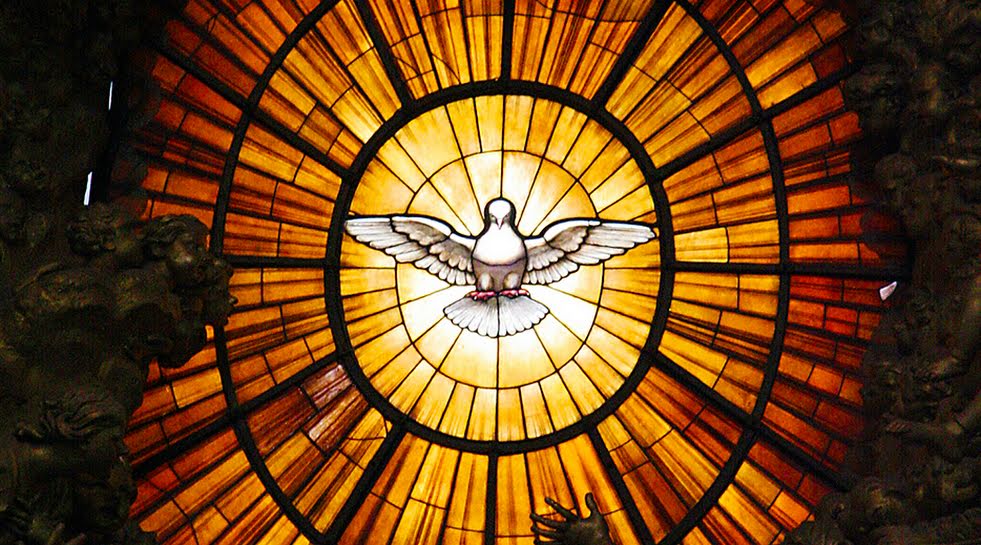
Window of the Holy Spirit, part of the Altar of the Chair, by Gianlorenzo Bernini


Traditionally, the great feast of Pentecost, owing to its supreme importance and solemnity, was observed as an octave.  Today, then, is traditionally Pentecost Monday.  Why the octave of Pentecost Octave was suppressed in the revised Latin calendar is not clear to me, nor is it the focus of this post.

Having noted the general definition of the Gifts of the Holy Spirit yesterday, it seems opportune to examine each of them, and, especially, note their relationship to the Beatitudes, as understood by the Doctors of the Church.  We will then begin with that first mentioned in Isaiah 11, and which is the most sublime: the Gift of Wisdom.

The Catechism, referring to Isaiah, lists the Gifts thus: "The seven gifts of the Holy Spirit are wisdom, understanding, counsel, fortitude, knowledge, piety, and fear of the Lord." (CCC1831)

St. Thomas Aquinas notes that wisdom is among four of the gifts that belong especially to reason, rather than to the will: "For, seeing that of the seven gifts, four belong to the reason, viz. wisdom, knowledge, understanding and counsel." (STh, I-II, q. 68, a. 1)

Of the Gift of Wisdom, the first listed, the Angelic Doctor says, "it belongs to the wisdom that is an intellectual virtue to pronounce right judgment about Divine things after reason has made its inquiry, but it belongs to wisdom as a gift of the Holy Ghost to judge aright about them on account of connaturality with them." (STh, II-II, q. 45, a. 2)  Further, he mentions of this gift in his introduction to the gifts that, "In order to judge aright, the speculative reason is perfected by 'wisdom.'" (STh, I-II, q. 68, a. 4)

John of St. Thomas adds that, "the gift of wisdom does not judge from any knowledge derived from study and reasoning about causes or even by a light which manifests them in themselves. It judges from a connaturality and union with the supreme cause which is possessed as it were through experience." (Gifts of the Holy Spirit, Ch. IV, 4.)

St. Thomas Aquinas associates the Gift of Wisdom with the theological virtue of Charity, for as John of St. Thomas summarizes in his Introduction to the Summa Theologiae, "This is essentially in intellect, because it implies judgment concerning divine things through the highest cause, not only as involving assent to believed things (which pertains to faith), but a discretionary judgment through a kind of experience of the divine (which does not pertain to faith). It has its root and foundation in the will and charity, because to judge through the highest causes takes place in two ways. In one way from principles illumined and acquired by intellect, and this is the mode of human wisdom, which is not a gift. In another way by union and connaturality with the highest cause itself, God, as it were by taste and savor, as it is said in Psalm 33:9, 'Taste and see,' where sight arises from taste and savor." (Commenting on STh, II-II, q. 45 of Aquinas)

It is obvious, then, that to have such a connatural knowledge of God through the Gift of Wisdom, union with God is essential, for, "the wisdom of which we are speaking presupposes charity. Now charity is incompatible with mortal sin, as shown above. Therefore it follows that the wisdom of which we are speaking cannot be together with mortal sin." (St. Thomas Aquinas, STh, II-II, q. 45, a. 4)

Interestingly, St. Augustine of Hippo, in his work, On the Sermon on the Mount, associates the Gift of Wisdom with one of the Beatitudes: "Wisdom corresponds to the peacemakers, in whom all things are now brought into order, and no passion is in a state of rebellion against reason, but all things together obey the spirit of man, while he himself also obeys God: and of them it is here said, 'Blessed are the peacemakers.'" (Book I, chapter 4, 11)

St. Thomas explains, "Now a peacemaker is one who makes peace, either in himself, or in others: and in both cases this is the result of setting in due order those things in which peace is established, for "peace is the tranquillity of order," according to Augustine (De Civ. Dei xix, 13). Now it belongs to wisdom to set things in order, as the Philosopher declares (Metaph. i, 2), wherefore peaceableness is fittingly ascribed to wisdom." (STh, II-II, q. 45, a. 6)

For his part, John of St. Thomas associates both the sixth and this seventh beatitude to the life of contemplation, a fitting place for wisdom: "The sixth and seventh beatitudes are ordered to the attainment of beatitude through the contemplative life. The sixth beatitude is the cleansing of the heart through purity. Without it contemplation is impossible. 'Blessed are the pure of heart.' The peace which surpasses all sense and inebriates the spirit is a work of justice -- 'Blessed are the peacemakers.'" (Gifts of the Holy Spirit, Ch. IX, 5)

On this Pentecost Monday, let us pray for the Gift of Wisdom, and, if necessary, get ourselves back in the state of grace, so that we might make peace, starting with ourselves!

Veni, Sancte Spiritus!  Live well!

Sunday, June 5, 2022

Pentecost & Gifts of the Holy Spirit: Veni Sancte Spiritus

Pentecost (AD1732), by Jean Restout (+AD1768)

Today is Pentecost Sunday -- the novena from the Ascension is now complete, and we are Fifty Days from Easter Sunday!

We read in Sacred Scripture, Acts Chapter 2, about this day:
 And when the days of the Pentecost were accomplished, they were all together in one place: And suddenly there came a sound from heaven, as of a mighty wind coming, and it filled the whole house where they were sitting. And there appeared to them parted tongues as it were of fire, and it sat upon every one of them: And they were all filled with the Holy Ghost, and they began to speak with divers tongues, according as the Holy Ghost gave them to speak.

This Feast, also known as Whitsunday, is rich with meaning and custom, and some more details may be found here:
Fisheaters: Pentecost

For more information: Old Catholic Encyclopedia: Pentecost

On this day, a plenary indulgence can be received for the recitation of the Veni, Creator Spiritus in either a church or oratory:


VENI, Creator Spiritus,
mentes tuorum visita,
imple superna gratia
quae tu creasti pectora.
COME, Holy Spirit, Creator blest,
and in our souls take up Thy rest;
come with Thy grace and heavenly aid
to fill the hearts which Thou hast made.
Qui diceris Paraclitus,
altissimi donum Dei,
fons vivus, ignis, caritas,
et spiritalis unctio.
O comforter, to Thee we cry,
O heavenly gift of God Most High,
O fount of life and fire of love,
and sweet anointing from above.
Tu, septiformis munere,
digitus paternae dexterae,
Tu rite promissum Patris,
sermone ditans guttura.
Thou in Thy sevenfold gifts are known;
Thou, finger of God's hand we own;
Thou, promise of the Father, Thou
Who dost the tongue with power imbue.
Accende lumen sensibus:
infunde amorem cordibus:
infirma nostri corporis
virtute firmans perpeti.
Kindle our sense from above,
and make our hearts o'erflow with love;
with patience firm and virtue high
the weakness of our flesh supply.
Hostem repellas longius,
pacemque dones protinus:
ductore sic te praevio
vitemus omne noxium.
Far from us drive the foe we dread,
and grant us Thy peace instead;
so shall we not, with Thee for guide,
turn from the path of life aside.
Per te sciamus da Patrem,
noscamus atque Filium;
Teque utriusque Spiritum
credamus omni tempore.
Oh, may Thy grace on us bestow
the Father and the Son to know;
and Thee, through endless times confessed,
of both the eternal Spirit blest.
Deo Patri sit gloria,
et Filio, qui a mortuis
surrexit, ac Paraclito,
in saeculorum saecula.
Amen.
Now to the Father and the Son,
Who rose from death, be glory given,
with Thou, O Holy Comforter,
henceforth by all in earth and heaven.
Amen.
Preces Latinae.org: Veni Creator

Nota bene: "§ 1. Plenaria indulgentia conceditur christifideli qui, in ecclesia vel oratorio, devote interfuerit sollemni cantui vel recitationi

1° hymni Veni, Creator, vel prima anni die ad divinam opem pro totius anni decursu implorandam; vel in sollemnitate Pentecostes;"
Enchiridion indulgentiarum

Here is a beautiful setting of the same hymn by the great Palestrina:


Today you might also enjoy the chant of the Sequence of Pentecost, Veni Sancte Spiritus:


The original location of this event -- the coming of the Holy Spirit upon the Apostles and Our Lady -- is the Cenacle on Mount Zion.  It sits just outside the walls of Jerusalem to the south, and was the same location as the Last Supper.

Today, in Rome, flower petals are showered down from the dome of the Pantheon: Climbing the Pantheon's Dome on Pentecost - EWTN Vaticano

Traditionally this great feast is observed with an Octave, and this article presents some wonderful details and history on that: Pentecost Octave: Where art thou?

Today is a marvellous day to consider the Gifts of the Holy Spirit, and a link to the question of St. Thomas Aquinas in his Summa Theologiae on these great Gifts: STh, I-II, question 68

The Gifts are remarkable and deserve to be better know!  The Catechism notes that,
"1830 The moral life of Christians is sustained by the gifts of the Holy Spirit. These are permanent dispositions which make man docile in following the promptings of the Holy Spirit.
1831 The seven gifts of the Holy Spirit are wisdom, understanding, counsel, fortitude, knowledge, piety, and fear of the Lord. They belong in their fullness to Christ, Son of David. They complete and perfect the virtues of those who receive them. They make the faithful docile in readily obeying divine inspirations."
Catechism of the Catholic Church: Virtues and Gifts

St. Thomas Aquinas, for his part, teaches in the Summa Theologiae, I-II, q. 68, a. 1:
"Now it is manifest that human virtues perfect man according as it is natural for him to be moved by his reason in his interior and exterior actions. Consequently man needs yet higher perfections, whereby to be disposed to be moved by God. These perfections are called gifts, not only because they are infused by God, but also because by them man is disposed to become amenable to the Divine inspiration...for those who are moved by Divine instinct, there is no need to take counsel according to human reason, but only to follow their inner promptings, since they are moved by a principle higher than human reason. This then is what some say, viz. that the gifts perfect man for acts which are higher than acts of virtue."
St. Thomas Aquinas, Summa Theologiae, I-II, q. 68, a. 1.

Pope St. John Paul II said of the gifts: "In order to be authentically formative, study needs to be constantly accompanied by prayer, meditation, and the invocation of the gifts of the Holy Spirit: wisdom, understanding, counsel, fortitude, knowledge, piety, and the fear of the Lord. Saint Thomas Aquinas explains how, with the gifts of the Holy Spirit, a person's whole spiritual being becomes responsive to God's light, not only the light of knowledge but also the inspiration of love. I have prayed for the gifts of the Holy Spirit since my youth and I continue to do so.-- Gift and Mystery, pgs. 92-93."

Finally, St. Augustine of Hippo, in his On the Sermon on the Mount, notes the correspondence between the Gifts of the Holy Spirit and the Beatitudes:
"Hence also the sevenfold operation of the Holy Ghost, of which Isaiah speaks, seems to me to correspond to these stages and sentences [of the Beatitudes]. But there is a difference of order: for there the enumeration begins with the more excellent, but here with the inferior. For there it begins with wisdom, and closes with the fear of God: but the fear of the Lord is the beginning of wisdom. And therefore, if we reckon as it were in a gradually ascending series, there the fear of God is first, piety second, knowledge third, fortitude fourth, counsel fifth, understanding sixth, wisdom seventh. 
The fear of God corresponds to the humble, of whom it is here said, Blessed are the poor in spirit, i.e. those not puffed up, not proud: to whom the apostle says, Be not high-minded, but fear; i.e. be not lifted up.
Piety corresponds to the meek: for he who inquires piously honours Holy Scripture, and does not censure what he does not yet understand, and on this account does not offer resistance; and this is to be meek: whence it is here said, Blessed are the meek.
Knowledge corresponds to those that mourn who already have found out in the Scriptures by what evils they are held chained which they ignorantly have coveted as though they were good and useful.
Fortitude corresponds to those hungering and thirsting: for they labour in earnestly desiring joy from things that are truly good, and in eagerly seeking to turn away their love from earthly and corporeal things: and of them it is here said, Blessed are they which do hunger and thirst after righteousness.
Counsel corresponds to the merciful: for this is the one remedy for escaping from so great evils, that we forgive, as we wish to be ourselves forgiven; and that we assist others so far as we are able, as we ourselves desire to be assisted where we are not able: and of them it is here said, Blessed are the merciful. Understanding corresponds to the pure in heart, the eye being as it were purged, by which that may be beheld which eye has not seen, nor ear heard, and what has not entered into the heart of man: and of them it is here said, Blessed are the pure in heart. 
Wisdom corresponds to the peacemakers, in whom all things are now brought into order, and no passion is in a state of rebellion against reason, but all things together obey the spirit of man, while he himself also obeys God: and of them it is here said, Blessed are the peacemakers."
St. Augustine of Hippo, On the Sermon on the Mount, Book I, chapter 4.11.

Of course, unless you live in the state of grace, you are not able to receive these precious Gifts of the Holy Spirit -- and how can you then see the world as it is?

Today also happens to be the patronal feast of the school of this blogger:
Holy Spirit Preparatory School, Atlanta, Georgia

Veni Sancte Spiritus!  Come Holy Spirit!

Happy Pentecost!

Live Well!