Sunday, December 27, 2015

Feast of St. John the Apostle & Evangelist


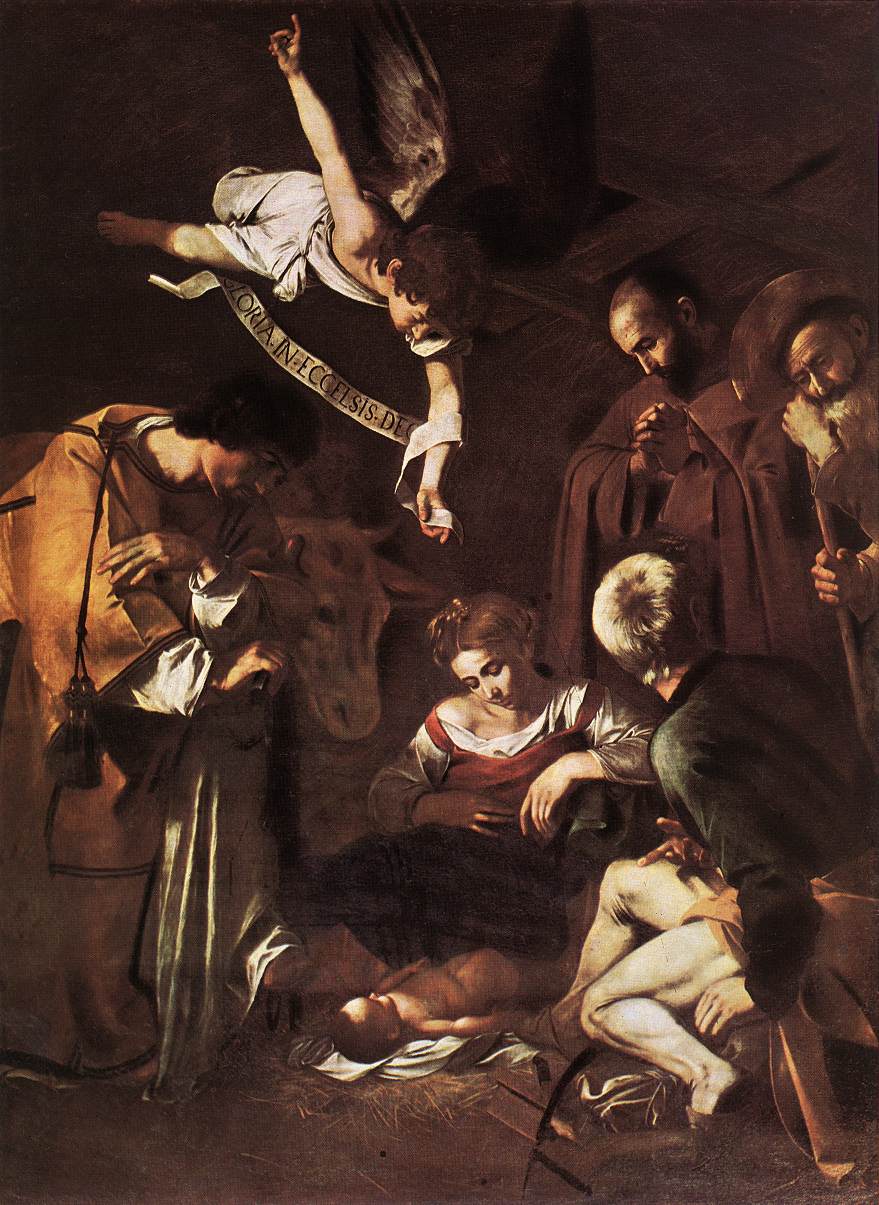
File:Michelangelo Merisi da Caravaggio - Nativity with St Francis and St Lawrence - WGA04193.jpg
Nativity with San Francesco e San Lorenzo by Caravaggio.

Dum medium silentium tenerent omnia, et nox in suo cursu medium iter haberet, omnipotens Sermo tuus, Domine, de coelis a regalibus sedibus venit.

While all things were in quiet silence and the night was in the midst of her course, Thine Almighty Word, O Lord, leaped down from heaven from Thy royal throne. (Wisdom 18:14-15)

Today is the Sunday within the Octave of Christmas.  Traditionally, on this day, the faithful pause for some theological consideration of the mysteries of the season.  My missal notes, "the sacred liturgy, in revealing to us the supernatural Sonship of our Lord Jesus Christ, which affects our souls more especially at this time of Christmas, makes the Divinity under the aspect of Fatherhood resplendent in our eyes."

In the revised calendar, these considerations are brought into focus with a celebration of the Holy Family -- which this blog will do on its traditional date.


Today, 27 December, is the third day of the Christmas Octave, and the Feast of St. John the Apostle and Evangelist.

He, the brother of St. James, was one of the sons of Thunder, and was known as the "Beloved" Apostle.  He, with St. Peter and St. James had a prominent role as one of the leading Apostles.  Of course, St. John is also notable for having been entrusted with the Blessed Virgin Mary at the Crucifixion: "Behold your mother."  He wrote not only the Holy Gospel according to St. John, but three Epistles and the book of Revelation.  The last of the Apostles to die, and the only one to actually escape martyrdom (though it was not from a lack of trying on persecutors' part).

For more on St. John, you might check out these links:
Old Catholic Encyclopedia: St. John the Evangelist

Catholic Saints Info: St. John the Apostle

Seasonal Customs (Fisheaters): Feast of St. John

Merry Christmas and live well!

Saturday, December 19, 2015

Rules of Etiquette for Gentlemen

 
A Top Hat.


This blogger some years ago wrote a guide to proper etiquette for gentlemen which the gentle reader might enjoy or find edifying, and which is presented below:


COLE'S RULES OF ETIQUETTE FOR GENTLEMEN


A short guide to acting as a proper gentleman


Introduction


                The author’s intent in writing these guidelines is to educate men on how they ought to act as gentlemen in everyday circumstances.  With great disappointment, I perceive that chivalry has almost completely disappeared in our society.  Some of these noble customs can be easily incorporated into the habits of the typical man.  A true gentleman is more than just one in his external actions, however, but in every aspect of his life.  He should strive for the good, live his faith, fulfill his duties with care, and avoid giving offense.  Men: to act as true gentlemen is a challenge.  To you ladies: you should expect and require that you be treated with the respect that is demanded by virtue of that which you are, a lady.

Chapter I: Greetings & Farewells

Section 1: When walking past or greeting someone, a gentleman should address another with some polite and respectful salutation.  "Good (time of day)" is always appropriate, as is "Greetings."  "Howdy" or "Hello" may be used in less formal situations.  "What’s up," and "Hey" are to be avoided.  The use of the other person’s name is always very good, so long as the first name is not employed when speaking to a superior.  Superiors can be greeted using their title:  "Good morning, Doctor."  Clerics should always be addressed by their ecclesiastical title, even if they hold an academic degree.  In certain circumstances, it is acceptable to use a person’s name by itself.  "Sir" or "ma'am" may be used in quite a variety of situations, especially when addressing a superior. When encountering a group of ladies or gentlemen, he should address a greeting to the whole group, such as "Good evening, ladies," rather than address each individually.

Section 2: It is always appropriate to introduce someone with the phrase, "May I present…?"  The correct reply upon meeting someone for the first time is "How do you do?"  The younger man is always presented to the older, and the gentleman to the lady.  It is then the lady or superior who offers his or her hand first.

Section 3: When bidding farewell, such statements as, "Fare [thee] well," "Have a pleasant/good (time of day)," "Good-bye," "Godspeed," and "Good Night," are all suitable and to be used frequently.

Chapter II: Rules of the Hat

Section 1: When greeting a lady, the removal of the hat with a slight bow of the head is suitable.  This should also be used when greeting a superior.  When greeting his equal, a touch of the right hand to the hat brim, or a tip thereof is always in order.

Section 2: A gentleman generally should not wear a hat indoors, except in stores, public buildings, or lobbies.  He should also remove his hat when praying, or when he is speaking to a lady.  If a gentleman is speaking to a lady while in inclement weather, or walking with her, however, it is permissible for him to replace his hat after the initial greeting.


Chapter III: Attire & Appearance

Section 1: A gentleman should always dress in a manner that conveys the respect he should have for himself and those around him.  The same applies to the cleanliness and order of his room, belongings, and person.  A gentleman’s dress should befit the activity he is undertaking, regardless of the dress of his peers or whether he is seen.

Section 2: In addition, a gentleman should hold himself in a dignified manner at all times.  Thus, he should have good posture, and avoid lounging around or slouching.

Chapter IV: Conversation

Section 1: A gentleman should always act as such in conversation.  Needless to say, he should avoid any conversation that would constitute a near occasion of sin, or lack taste or decency, as he would the plague.  When he speaks with a superior or with a lady, the gentleman ought to address the other with such respect as they deserve. 

Section 2: He should also endeavor to speak well and use proper grammar, avoiding slang and nonstandard speech.

Section 3: In addition, the gentleman ought not dominate conversations, but seek to engage all.

Section 4: Finally, he would do well to avoid raising his voice, even if he is extremely distressed.

Chapter V: Dining

Section 1: A gentleman should always act in a restrained, mature, and mannerly fashion while eating.  This is all the more the case in the presence of ladies or superiors. 

Section 2: A gentleman should seek the permission of those already seated before joining them.

Section 3: He should always thank those who serve his meal. 

Section 4: If he rises to obtain something, he should always make certain that no one else is in need of anything.

Section 5: A gentleman should take care never to reach over others during a meal.

Section 6: At the close of the meal, a gentleman should thank whoever cleans up, and be ready himself to assist in cleaning.

Section 7: When a gentleman is taking a lady to a meal, he ought to pay for it, provided circumstances suggest or allow for this.  In group situations, however, no such obligation exists.


Chapter VI: “Acts of Assistance”

Section 1: The gentleman must never keep a lady waiting, and should strive to be punctual with all of his appointments.

Section 2: A gentleman should always be sensitive to the comfort of ladies.  He ought to offer his chair if needed, coat if she may be cold, or umbrella if the weather is inclement.

Section 3: A gentleman should always open doors for ladies, including those of cars.  He should also let ladies and superiors precede him when passing through doorways or entering buildings, unless the way must first be prepared.

Section 4: It is commendable to walk a lady to her destination; of course, he ought to obtain her permission to do so.  The gentleman should, as a rule, walk with a lady or his superior on his right.  Nevertheless, the gentleman should always place himself between a lady or superior and any hazard or annoyance.

Section 5: A gentleman generally should not stop a lady who is walking in order to talk with her.  If he wishes to speak, he should simply ask her permission to join her in walking.  He should take care that he is not keeping a lady in uncomfortable weather.

Section 6: If a gentleman perceives that a lady is carrying something heavy, he should assist her in carrying it.

Section 7: If a lady drops anything, a gentleman should always pick it up and return it to her promptly.

Section 8: If circumstances permit, a seated gentleman should rise to greet or speak with a lady or superior.  He should return to his place only after the lady or superior has been seated.

Section 9: If a gentleman is asked for a favor, he should endeavor to comply, especially if the request comes from a lady, so long as it is possible and/or reasonable to do so.  He must also take care not to be overbearing in offering assistance if it is not desired.


Nota bene: These short rules of etiquette are by no means exhaustive in their scope, and are merely a guideline.  As a further reference, Emily Post’s Etiquette in Society, in Business, in Politics and at Home of 1922 is a valuable resource.  It is available on-line at: Etiquette in Society, in Business, in Politics and at Home by Emily Post
Edition of: © 5.X.2007.

This guide is a revision of the original “Cole’s Rules of Etiquette for Gentlemen,” Sixth Edition, that was written for the men of Christendom College in Front Royal, Virginia.

I would like to thank all those who submitted suggestions for this guide, particularly Professor Jenislawski and a certain Latin professor who will remain nameless.  In particular, I thank Draper Warren for the formatting of this guide and for his enthusiastic support.

Live well!

Thursday, September 24, 2015

Saint Junipero Serra

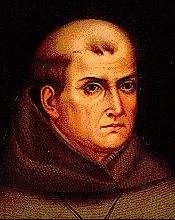
Juniperro-serra.jpg

Just yesterday, Pope Francis canonized St. Junipero Serra, the 18th-century Franciscan missionary famous for his leadership in establishing the California missions, at the Basilica of the National Shrine of the Immaculate Conception in Washington, DC.

The life of Saint Junipero Serra is a remarkable one that begins in Palma, on the island of Majorca, Spain, where he was born in 1737.  Spanish was actually his second language, growing up in a family that spoke the Majorcan dialect of Catalan.  He joined the Franciscans at the age of 17, and departed for the missions in the New World in 1749.


Statue of St. Junipero Serra in statuary hall in the US Capitol Building.

Despite the ill-effects of a mosquito bite that left him with a swollen leg and his asthma, Saint Junipero served as a missionary and inquisitor in the areas around Mexico City and Guadalajara until his appointment to the California coast in 1768.  Previously missionary territory of the Jesuits, their expulsion by King Charles III opened the area to the Franciscans.  This originally meant simply Baja California in what is now Mexico, but under the direction of Serra, missions would be founded in what is now the State of California.

It was on the California coast, where St. Junipero Serra worked from 1768 until his death in 1784, that he did his most famous work of founding a string of missions up the California coast.  The foundation of the mission at San Diego in 1769 was certainly a great moment in his ministry.

Serra poured out his life to bring the Gospel to the natives of California, often in conflict with civil authorities with far less concern for the good of the locals to whom the missions ministered.  Although his attitude towards the locals, his confidence that they were in need of Christianity and civilization, and his support of a mission system which did much to discipline the native communities, mean that he is a figure of some controversy, it is not without reason that Pope Francis fast-tracked his canonization.  St. Junipero Serra embodies a selfless missionary ideal, and shows clearly that cultural and religious relativism is not compatible with Catholicism and Truth!

For a good article on some of the complexities of the era, you should read: National Catholic Register: Father Junipero Serra's Canonization Provides Chance to Set Record Straight

Mission San Carlos Borromeo de Carmelo
Mission San Carlos: Burial Place of St. Junipero Serra.
["MissionCarmelSEGL2". Licensed under CC BY-SA 3.0 via Commons]


Dying in 1784, St. Junipero Serra is buried at Mission San Carlos Borromeo at Carmel, California, a mission he founded in 1770 south of San Francisco.

For for a brief summary and other details you might note:
Catholics Saints Info: Junipero Serra

For more detailed and comprehensive information on his life:
Official Site, Archdiocese of Los Angeles and Pontifical Commission for Latin America


The Interior of Mission San Carlos
["Mission San Carlos Borromeo de Carmelo (Carmel, CA) - basilica interior, nave" by Nheyob - Own work. Licensed under CC BY-SA 3.0 via Commons]

To visit the official website of his burial place, you might note:
Official Site of the Carmel Mission

Live well!

Wednesday, July 8, 2015

A letter: Confederate Symbols and Honoring Veterans


Confederate Rebel Flag.svg First National flag of the Confederate States of America
Left: The Battle Flag of the Confederate Army of Tennessee.
Right: The First National Flag of the Confederacy, the "Stars and Bars."


The Confederate battle flag was not a civil flag of the Confederacy (though its design was incorporated into the 2nd and 3rd national flags), but a battle flag for Confederate forces.   In a square shape, it was the flag of the Army of Northern Virginia, and as a rectangle, the flag of the Army of Tennessee.  During the war itself, the flag obviously symbolized the armed forces of the Confederate States.

It would become incorporated in the emblem of the Sons of Confederate Veterans in the 1890s; not unexpectedly, as it was a military flag, and the organization sought to commemorate military service.

Later, in the 20th century, the flag was used as a symbol of Southern resistance in the era of racial integration and the Civil Rights movement.

Hence, there are some racists that have used, and do use, the flag, to symbolize racism and white supremacy.  Others use it as a symbol of regional pride and autonomy.  Still others, like the Sons of Confederate Veterans, use it to honor those that sacrificed much for their home states.  Even the Anti-Defamation league, not an organization sympathetic to the memory of Confederate soldiers, notes regarding the flag: "because of the continued use of the flag by non-extremists, one should not automatically assume that display of the flag is racist or white supremacist in nature.  The symbol should only be judged in context." (Cf., ADL: Confederate Flag)

Like the era from which it came, the Confederate Battle Flag is a complex symbol.


Flag of Georgia
Flag of the State of Georgia.


In light of the recent controversy and calls for a kind of purge of symbols associated with the Southern Confederacy, I wrote this letter to my elected officials here in the State of Georgia:

-------------------------------
Dear ------,

Greetings.  I hope this finds you well.

In the summer of 1864, my great-great grandfather, Thomas J. Cole, a lad of 16 years of age from Butts County, Georgia, joined the 3rd Georgia Reserve regiment.  He had never been far from his family’s farm in Middle Georgia – a family farm that did not include any slaves.  That same summer the State of Georgia was being invaded by the armies of US General William T. Sherman.  My great-great grandfather responded to the call of the State of Georgia in that moment of crisis.  While Thomas J. Cole never saw combat action, he did lose a leg to infection and gangrene. [Cf., William Marvel, Andersonville: The Last Depot, pgs. 209-210]

Today I hear calls for the Confederate battle flag and other symbols of the Southern Confederacy to be removed even from Confederate war memorials and cemeteries.  I hear folks call anyone associated with the Southern Confederacy a traitor and a racist.

I am painfully aware of the complex history of a symbol like the Confederate battle flag.  I know that it has been and is used by bigots and hateful men as a symbol of their warped world-view.  I also know that the flag has been and is used by honorable men remembering the sacrifices of their forefathers to home and state.  Indeed the Anti-Defamation League notes on its website: “because of the continued use of the flag by non-extremists, one should not automatically assume that display of the flag is racist or white supremacist in nature.  The symbol should only be judged in context.”  In sum, it is a complex symbol that has to be judged in context.

Regardless of the complexity of certain symbols, however, and the connection of the institution of slavery to the history of the Southern Confederacy, I believe the State of Georgia has a solemn responsibility to honor and defend the selfless service of men like my great-great grandfather.  He was not a slave-owner, and neither was his father.  He responded to a call for help from this state, served with honor, and lost a leg in service to Georgia.  He, while just a boy, responded to Georgia in her moment of need; surely the State of Georgia must continue to honor him, and others like him, who gave life and limb for their home.

We must reject the legacy of slavery and racism that has surely tainted the history of Georgia and the United States.  At the same time, we cannot ignore honor and sacrifice on behalf of this state, even if the cause is not all that it might have been or all that we would wish it to be today.  My great-great grandfather did what this state asked in a moment of crisis; will Georgia today call him a traitor for his service?

I appreciate your service to the State of Georgia, and trust that you will do what you can to ensure that the honor of men like my great-great grandfather doesn’t suffer from this frenzy to demonize everyone and everything associated with the Southern Confederacy.

Very Respectfully,
--------------------------

I think it might be worthwhile to include the account of my great-great grandfather, as told in the book I cited in my letter.

Here is the account from "Andersonville: The Last Depot," by William Marvel (pgs. 209-210):
"Nor were the prisoners the only victims. Sixteen-year-old Thomas J. Cole joined the 3rd Georgia Reserves during Rousseau's cavalry raid, in July [1864]. He had never wandered far from his father's farm in Butts County, midway between Macon and Atlanta, and shoes had never served as part of his daily wardrobe. He arrived at Andersonville with a pair of brogans on, however, and they irritated an insignificant scratch on his left foot, just below the ankle. The nearest he ever came to the stockade was the sentry box, and he did not approach the prisoners' hospital at all, but, just before the evacuation of prisoners began, his foot turned so sore that he had to be relieved from duty. A week later his comrades carried him from his tent over to Sumter Hospital -- the parallel pair of two-story barracks buildings alongside the railroad. In seven weeks the wound had grown to look like a carbuncle, but ten days in the hospital transformed it into a gaping, putrid lesion four inches in diameter. The flesh dropped away to reveal his ankle joint, his lower leg started to swell and ulcerate, and he wailed piteously whenever the doctors tried to touch it.


Cole would survive, however. He would live into the twentieth century and raise five children, but he would have to sacrifice the leg in order to save the rest of his hide."

Live well!

Thursday, April 9, 2015

150th Anniversary of Lee at Appomattox


Grant and Lee at Appomattox by Tom Lovell.

Happy Easter Thursday!

Today, 9 April, in 1865, Confederate General Robert E. Lee surrendered his force, the Army of Northern Virginia, at Appomattox Court House, Virginia to the combined Union armies (Meade's Army of the Potomac & Ord's Army of the James, with Sheridan commanding the cavalry) under the command of General U.S. Grant.

This famous surrender occurred only after Lee's army had retreated from Petersburg, Virginia following the collapse of the siege there on 2 April 1865.  Grant vigorously pursued Lee, with General Sheridan particularly notable for the effectiveness of his pursuit and his timing in preventing Lee from turning his army south to join that of Confederate General Joseph Johnston.


Appomattox Campaign, 2-9 April 1865.  "Appomattox Campaign Overview" Map by Hal Jespersen,www.posix.com/CW. Licensed under CC BY 3.0 via Wikimedia Commons

On 9 April 1865, at the Battle of Appomattox Court House, Lee instructed General John B Gordon of Georgia to try to break out their position past what they thought were Union lines of only cavalry; this, in hopes of reaching Lynchburg, Virginia.  The appearance of the Union V Corps (and Ord's troops, as well) shattered any hopes of a breakout; with the Union II Corps (with the VI coming up) blocking Longstreet's Corps at New Hope Church to the east, surrender became inevitable.

For more on this battle, you should consult:
NPS Battle Summary: Appomattox Court House, VA

Civil War Home: Appomattox

Civil War Trust: Appomattox Court House

At 3PM, then, on 9 April, Palm Sunday of that year, General Robert E. Lee signed the surrender terms agreed to with General Ulysses Grant in the parlor of the home of Wilmer McLean in Appomattox Court House.  McLean famously moved to Appomattox from Yorkshire in Prince William County where his house had been used during the two Battles of Manassas.

The site of the surrender is commemorated at Appomattox Court House National Historical Park, whose official site you can find here:
Appomattox Court House National Historical Park

Robert E. Lee issued this final order to his men the following day:
"The Last Order of General Robert E. Lee, C. S. Army, 
Commanding Army of Northern Virginia.
GENERAL ORDERS No. 9.
HDQRS. ARMY OF NORTHERN VIRGINIA,
April 10, 1865.
        After four years of arduous service, marked by unsurpassed courage and fortitude, the Army of Northern Virginia has been compelled to yield to overwhelming numbers and resources. I need not tell the brave survivors of so many hard-fought battles, who have remained steadfast to the last, that I have consented to the result from no distrust of them. But, feeling that valor and devotion could accomplish nothing that could compensate for the loss that must have attended the continuance of the contest, I determined to avoid the useless sacrifice of those whose past services have endeared them to their countrymen.
        By the terms of the agreement officers and men can return to their homes and remain until exchanged. You will take with you the satisfaction that proceeds from the consciousness of duty faithfully performed; and I earnestly pray that a merciful God will extend to you his blessing and protection.
        With an increasing admiration of your constancy and devotion to your country, and a grateful remembrance of your kind and generous considerations for myself, I bid you all an affectionate farewell.
 R. E. LEE, General"

Joshua Chamberlain - Brady-Handy.jpgJbgordon.jpg
Left: Union Gen. J. L. Chamberlain; Right: Confederate Gen. J. B. Gordon

The official stacking of arms and surrender of the army would take place on 12 April, with Union Brigadier General Joshua L. Chamberlain of Maine receiving the capitulation of the Confederate Army from Major General John B. Gordon of Georgia.  Both of those men would go on to be governors of their respective states.

The surrender of Robert E. Lee and his Army of Northern Virginia marked the collapse of the Confederate war effort and Southern hopes of independence from the United States.  The other Southern military units would rather quickly capitulate (notably that of Joseph Johnston at Durham Station, NC on 26 April 1865), and the difficult period of Reconstruction would soon begin.

As this event, among other things, marks the end of the brilliant and admirable military career of Robert E. Lee (1807-1870), I think it worth pausing a moment to recall the man.

File:Robert E Lee in 1863.png


His father a leader in the American Revolution, "Light Horse" Harry Lee, and his mother a member of the distinguished Carter family of Virginia, Lee certainly had notable bloodlines.

More than this, however, was his own talent and character.  Lee's remarkable military career is well known, with his great victories, such as that at Second Manassas and Chancellorsville.  He was loved by his men, feared and respected by his foes, gracious in victory and humble in defeat.

This speaks to his character.  Lee was a devout Episcopalian, who took his faith, and, in particular, his duties, very seriously.  Indeed, just as duty might be said to partly define what a gentleman is, so it defined Robert E. Lee.  There are any number of stories that attest to his great sense of duty and honor.

It was this sense of duty that caused him to remain loyal to his home state of Virginia with the coming of the war, despite the fact that he was no zealot for secession.  When offered command of the armed forces of the Commonwealth of Virginia, his speech to the Convention at Richmond on 23 April 1861 was brief, but very much in character:
"Mr. President and Gentlemen of the Convention: Deeply impressed with the solemnity of the occasion on which I appear before you, and profoundly grateful for the honour conferred upon me, I accept the position your partiality has assigned me, though I would greatly have preferred your choice should have fallen on one more capable.  Trusting to Almighty God, an approving conscience, and the aid of my fellow citizens, I will devote myself to the defense and service of my native State, in whose behalf alone would I have ever drawn my sword."

After the war, he would serve as President of Washington College, now Washington & Lee University, in Lexington, Virginia, where he is buried.

Here is a short biography of Lee:
Civil War Home: Robert E. Lee

He was born at Stratford Hall, Westmoreland County, Virginia:
Stratford Hall Official Site

He lived for many years with his wife, Mary Anna Randolph Custis, (great-granddaughter of Martha Custis Washington by the first lady's first husband) at the Arlington House, in the county now named for it.  This home is on a magnificent bluff overlooking Washington, DC, and was, of course, seized by the federal government to be used as a cemetery, now Arlington National Cemetery.  The Lee family was later reimbursed for what was determined to be wrongful seizure.  The house itself is now designated as the Robert E. Lee Memorial:
NPS: Arlington House

Finally, Robert E. Lee is buried in the chapel of Washington & Lee University:
W&L Chapel

To close then and return to our own time, here is the Gregorian chant introit for this Easter Thursday, as we continue the celebration of the Easter Octave:


Surrexit Dominus vere, alleluia!

Happy Easter!  Live well!

Tuesday, February 10, 2015

Feast of St. Scholastica, OSB


[Saint Scholastica]

Today is the feast of the great St. Scholastica, the sister of the monastic founder, St. Benedict.  She died, a virgin and foundress of the Benedictine Nuns in 543AD.

St. Scholastica is invoked for good weather, owing to the account of her last visit with her brother, St. Benedict, described thus by Pope St. Gregory I the Great:
"Scholastica, the sister of Saint Benedict, had been consecrated to God from her earliest years. She was accustomed to visiting her brother once a year. He would come down to meet her at a place on the monastery property, not far outside the gate. One day she came as usual and her saintly brother went with some of his disciples; they spent the whole day praising God and talking of sacred things. As night fell they had supper together. Their spiritual conversation went on and the hour grew late. The holy nun said to her brother, “Please do not leave me tonight; let us go on until morning talking about the delights of the spiritual life.” “Sister,” he replied, “What are you saying? I simply cannot stay outside my cell.” When she heard her brother refuse her request, the holy woman joined her hands on the table, laid her head on them and began to pray. As she raised her head from the table, there were such brilliant flashes of lightning, such great peals of thunder and such a heavy downpour of rain that neither Benedict nor his brethren could stir across the threshold of the place where they had been seated. Sadly, he began to complain. “May God forgive you, sister. What have you done?” “Well, she answered, “I asked you and you would not listen; so I asked my God and he did listen. So now go off, if you can, leave me and return to your monastery.” So it came about that they stayed awake the whole night, engrossed in their conversation about the spiritual life. Three days later, Benedict was in his cell. Looking up to the sky, he saw his sister’s soul leave her body in the form of a dove, and fly up to the secret places of heaven. Rejoicing in her great glory, he thanked almighty God with hymns and words of praise. He then sent his brethren to bring her body to the monastery and lay it in the tomb he had prepared for himself."

She is, today, buried in the great Benedictine Monastery of Monte Cassino along with St. Benedict.  You can visit their site here: Monte Cassino Monastery, Italy

For more:
Patron Saints Index: St. Scholastica

Live well!

Sunday, March 30, 2014

Bellarmine on Last Rites (16)


Today is Laetare Sunday, named, of course, for the first words of the Introit of the Mass for this day.  This Sunday is one of muted rejoicing in the midst of the penitential season of Lent; festive rose vestments can be worn, the organ can be more freely used, and several other disciplines are relaxed on this Sunday that falls just beyond the mid-point of Lent.  We are more than half-way to Easter from our start on Ash Wednesday!  Rejoice!


Read more about Laetare Sunday here:
Old Catholic Encyclopedia: Laetare Sunday


Fisheaters: Laetare Sunday


St. Robert Bellarmine, S.J. (+1621), Jesuit, Cardinal, and Doctor of the Church, wrote Ars bene moriendi, the Art of Dying Well, in 1619AD. Today I continue my presentation of this work, as I plan each Sunday, which now brings us to Chapter 16, on the Sacrament of Extreme Unction, or Last Rites.  While one would expect a brief account here, St. Robert magnificently describes the role of the five senses in the moral life -- recalling the anointing of the Sacrament that symbolizing the purifications of those senses.  Excellent, and challenging, advice is contained in this final installment of mine.


St. Robert Bellarmine (+1621AD)

------

CHAPTER XVI. THE SIXTEENTH PRECEPT, ON THE SACRAMENT OF EXTREME UNCTION

 
THERE now remains the last sacrament to speak of, Extreme Unction; from this may be derived most useful lessons, not only for our last hour, but for the whole course of our life For in this Sacrament are anointed all those parts of the body in which the five senses reside, and in the anointing of each of them it is said: "May our Lord forgive thee whatever thou mayest have committed by thy sight, hearing, &c." Hence we see, that these senses are as it were five gates, through which all kinds of sin can enter into the soul. If then we carefully guard these gates, we shall easily avoid a multitude of sins, and therefore shall be enabled to live well and die well.


We will now speak briefly on guarding these five gates. That the eye is a gate through which enter sins against chastity, our Saviour teaches us when He says: "But I say to you, that whosoever shall look upon a woman to lust after her, hath already committed adultery with her in his heart. And if thy right eye scandalize thee, cut it off, and cast it from thee. For it is expedient for thee that one of thy members should perish, rather than that thy whole body go into hell." (St. Matthew v. 28.) We know that the old men who saw Susanna naked, were immediately inflamed with evil desires of lust, and in consequence suffered a miserable death. We know also how David, the particular friend of God, from merely seeing Bethsabee washing herself, fell into adultery, and from that into murder, and innumerable other evils.


Reason itself convinces us of this truth; for the beauty of a woman compels, in a manner, a man to love her; and the beauty of a man compels the woman: nor does this love rest till it ends in carnal embraces, on account of the concupiscence derived to us from original sin. This evil the holy apostle Paul deplores, where he says: "But I see another law in my members fighting against the law of my mind, and captivating me in the law of sin, that is in my members. Unhappy man that I am, who shall deliver me from the body of this death ? The grace of God by Jesus Christ our Lord." (Epist. To Romans, vii. 23.)


What remedy is there against so grievous a temptation? The remedy is quick and easy with the assistance of God, if we wish to make use of it. St. Augustine mentions a remedy in his 109th Epistle, which contains rules for monks; the holy father thus speaks: " If you cast your eyes upon any one, fix them upon no one." A simple glance of the eyes is almost impossible to be avoided; but it cannot strike the heart, except it be continued upon the object. Wherefore, if we do not designedly accustom ourselves to look upon a beautiful woman, and should by chance cast our eyes upon one, and then quickly turn them aside, there will be no danger to us; for truly does St. Augustine remark, that not in the glance, but in the dwelling upon the object, is the danger. Hence holy Job says: "I made a covenant with my eyes, that I would not so much as think upon a virgin." (chap, xxxi.) He does not say, " I have made a covenant" not to look, but " not so much as to think" upon a virgin: this means, I will not look too long upon a virgin, lest the sight should penetrate my heart, and I should begin to think of her beauty, and gradually to desire to speak with her, and then embrace her. He then gives the best reason a most holy man could give: "For what part would God from above have in me?" As if he intended to say: God is my chief Happiness and my Inheritance, my greatest good, than whom nothing more excellent can be imagined: but God loves only the chaste and just. To the same purpose are the words of our Lord: " If thy eye scandalize thee, pluck it out;" that is, so use it as if you did not possess it; and so accustom your eyes to refrain from sinful objects, as if you were blind. Now they who from their youth are careful in this respect, will not find much difficulty in avoiding other vices: but they who are not so careful, will find a difficulty; though by the grace of God, they can be enabled to change their life, and to avoid this most dangerous snare.

But some one may perhaps reply: Why did God create such beautiful men and women, if He did not wish us to look at them, and admire them? The answer is easy and two-fold. God created male and female for marriage; for thus He spoke in the beginning: "It is not good for man to be alone: let us make him a help like unto himself." Man does not require the aid of the woman, except in bringing forth and educating children, as we have already proved from St. Augustine. But man and wife would not easily agree, nor willingly live together their life-time, unless beauty had a share in producing love. Since, therefore, the woman was made beautiful that she might be loved by her husband, she cannot be loved by another with a carnal love; wherefore it is said in the law: " Thou shalt not covet thy neighbour’s wife;" and to husbands the apostle speaks: "Husbands love your wives."

There are many good and beautiful things, which ought not to be desired but by those only with whom they agree. The use of meat and wine is good for those in health, but not always to those who are ill. So in the same manner after the resurrection, the beauty of men and women may be safely loved by all of us, for then we shall not possess the carnal concupiscence under which we now groan. Wherefore we must not be surprised in being permitted to admire the beauty of the sun, and moo, and stars, and flowers, which do not nourish concupiscence; and in not being allowed to gaze with pleasure on beautiful men and women, because the sight might perhaps increase or nourish carnal concupiscence.


After the sense of sight comes that of hearing, which ought to be no less diligently guarded than the former. But with the ears the "tongue" must be joined, which is the instrument of speech: for words, whether good or bad, are not heard except when pronounced first by the tongue. And as the tongue, unless most carefully guarded, is the cause of many evils, therefore does St. James say: " He that offends not in word, the same is a perfect man: " and a little further: " Behold how small a fire what a great wood it kindleth! And the tongue is a fire, a world of iniquity." (chap. iii. 5.)

In this passage the Apostle teaches us three things. First, that to guard the tongue carefully is a most difficult thing; and therefore that there are few, and those only perfect men, who know effectually how to do this. Secondly, that from an evil tongue, the greatest injuries and mischief may arise in a very short time. This is explained by a comparison taken from a spark, which unless immediately extinguished, can consume a whole forest. Thus, one word incautiously spoken, may excite suspicions of another s guilt, from which quarrels, contentions, strifes, homicides, and the ruin of a whole family may arise. St. James, in fine, teaches that an evil tongue is not merely an evil thing in itself alone, but that it includes a multitude of evils; therefore he calls it a “world of iniquity."


For by its means, nearly all crimes are either devised, as adulteries and thefts; or perpetrated, as perjuries and false testimonies; or defended, as when the impious excuse the evil they have committed, or pretend to have done the good they did not.


And again, the evil tongue may justly be called "a world of iniquity," because by the tongue man sins against God by blasphemy or perjury; against his neighbour by detraction and back-biting; and against himself, by boasting of good works which he has not done in reality; and by asserting that he did not do the evil things which he did. In addition to the testimony of St. James, I will add that of the prophet David: " Lord, deliver my soul from wicked lips, and a deceitful tongue." (Psalm cxix.)

If this holy king was fearful of a wicked and deceitful tongue, what ought private individuals to do; and much more, if they are not only private, but poor, weak, and obscure ? The prophet adds: "What shall be given to thee, or what shall be added to thee, to a deceitful tongue?" The words are obscure on account of the peculiarity of the Hebrew structure; but the sense appears to be this: Not without cause do I fear a wicked and deceitful tongue, because it is such a great evil that no other can be added to it. The prophet proceeds: “The sharp arrows of the mighty, with coals that lay waste." In these words, by an elegant comparison, he declares how great an evil a deceitful tongue is; for the prophet compares it to a fiery arrow shot by a strong hand. Arrows strike at a distance, and with such quickness, that they can scarcely be avoided. Then arrows to which the deceitful tongue is compared, are said to be sent forth by a strong hand. Thirdly, it is added, that these arrows are sharp, that is, they are well polished and sharpened by a skilful workman. In fine, it is said, that they are like unto desolating coals, that is, fiery, so that they can " lay waste " any thing, however strong and hard:  hence, a wicked and deceitful tongue is not so much like unto the arrows of men, as to the arrows of heaven .lightning, which nothing can resist. This description of the prophet, of a wicked and deceitful tongue, is such, that no evil can be imagined greater.


But that the truth may be more clearly understood, I will mention two examples from Scripture. The first, that of the wicked Doƫg the Idumean, who accused the priest Achimelech to king Saul, of having conspired with David against him: this was a downright calumny and imposture. But because Saul, at that time, was not well disposed towards David, he easily believed everything, and ordered that not only the priest Achimelech should be killed immediately, but all the other priests, in number about eighty-five, who had not committed the least offence against the king. But Saul, not content with this slaughter, ordered those to be slain also who dwelt in the city nobe; and not only did his cruelty extend to men and women, but even to children, and infants, and animals. Of this wicked and deceitful tongue of Doƫg, it is probable that David spoke in the psalm mentioned above, part of which I explained. From this example we may learn, how productive of evil is a deceitful and wicked tongue.


The other example I will take from the gospel of St. Mark: When the daughter of Herodias danced before Herod the Tetrarch and his courtiers, she gained his favour to such a degree that he swore before all the company, he would give the girl whatever she asked, though it were half his kingdom. But the daughter first asked her mother Herodias what she should demand; she told her to ask for the head of St. John the Baptist. This was demanded, and soon was the head of the Baptist brought in on a dish. What crimes were there here! The mother sinned most grievously, in requesting a most unjust thing; Herod sinned no less grievously, by ordering a most innocent man to be killed, who was the precursor of our Lord and "more than a prophet," than whom no greater had arisen among those born of women: and without his cause being heard, without judgment, at the time of a solemn banquet, the demand of the girl was granted! But let us hear the punishment, as we have seen the evils of the crime. Herod being a short time after deprived of his government by the emperor Gains, was sent into perpetual banishment. Thus he who swore that he would give away half of his kingdom, exchanged that kingdom for perpetual exile, as Josephus mentions in his "Antiquities." The daughter of Herodias, whose dancing was the cause of St. John s death, crossing some ice, it broke under her and she fell in with her whole body except her head, which being cut from the body, rolled about on the ice; thus all might see what was the cause of her miserable death. In fine, Herodias herself soon died broken-hearted, and followed her daughter to the torments of hell. Nicephorus Callistus relates this tragedy in his History. Behold, what crimes and what punishment followed the rash and foolish oath taken by Herod the Tetrarch.


We will now mention the remedies which prudent men are accustomed to use against sins of the tongue. The holy prophet David, in the beginning of the xxxviii. Psalm, speaks of the remedy he used; “I said: I will take heed to my ways, that I sin not with my tongue." This means, that I may guard against sins of the tongue, I will carefully mind my ways; for I will neither speak, nor think, nor do anything, unless I first examine and weigh what I am about to do or speak.


These are the paths by which men walk in this life. Wherefore the remedy against evil words, and not only against these, but against deeds also, and thoughts, and desires, is to think beforehand on what we are about to do, or speak, or desire. And this is the character of men, not to do anything rashly, but to consider what is to be done; and if it agree with sound reason, to do it; but if not, not to do it. And what we say of actions, may be applied to speech, desires, and other works of a rational being. But if all cannot consider beforehand on what they are about to do or speak, certainly there can be no prudent man, desirous of his eternal salvation, who will not every morning of each day, before he commences his business, approach to God in prayer, and beg of Him to direct his ways, his actions, his words, desires, and thoughts, to the greater glory of God, and the salvation of his own soul. Then, at the close of the day, before he lies down to sleep, he should examine his conscience and ask himself, whether he has offended God in thought, word, or deed; and if he shall find that he has committed any sin, especially a mortal one, let him not dare to close his eyes in sleep, before he first reconcile himself to God by true repentance, and make a firm resolution so to guard his ways, as not to offend in word, or deed, or desire.


With regard to the sense of “hearing," a few remarks must be made. When the tongue is restrained by reason from uttering evil words, nothing can injure the sense of hearing. There are four kinds of words, against which in particular the sense of hearing must be closed, lest through it evil words should enter the heart and corrupt it.


The first are words against Faith, which human curiosity often listens to with pleasure: and yet if these penetrate the heart, they deprive it of Faith, which is the root and beginning of all good. Now no words of infidels are more pernicious than those which deny, either the providence of God, or the immortality of the soul: for such assertions make men not merely heretics, but atheists, and thus open the door to all kinds of wickedness. Another class of evil words regards detraction, which is eagerly listened to, but which destroys fraternal charity. Holy David, who was a man according to God’s own heart, says in the Psalms: " Instead of making me a return of love, they detracted me: but I gave myself to prayer." And since detraction is often heard at table, St. Augustine placed these verses over his dining-table:
"Quisquis amat dictis absentftm rodero vitam,
Hanc mensam iiidignam noverit esse sibi."
“This board allows no vile detractor place,
Whose tongue doth love the absent to disgrace."
The third species of evil words consists in flattery, which is willingly heard by men; and yet it produces pride and vanity, the former of which is the queen of vices, and is most hateful to God. A fourth kind consists in using immodest and amatory words in lascivious songs: to the lovers of this world nothing is sweeter, though nothing can be more dangerous than such words and songs. Lascivious songs are the songs of sirens’, who enchant men, and then plunge them into the sea and devour them.


Against all these dangers there is a salutary remedy, to keep with good company, but most carefully to avoid evil company. Men, when in the presence of those whom they have either not seen before, or with whom they are not familiar, have not the boldness to detract their neighbour, or to make use of heretical, or flattering, or lascivious expressions. Wherefore Solomon, in the beginning of Proverbs, thus expresses his first precept: "My son, hear the instructions of thy father, &c “My son, if sinners shall entice thee, consent not to them. If they shall say: Come with us, let us lie in wait for blood, let us hide snares for the innocent without cause: let us swallow him up alive like hell, and whole as one that goeth down into the pit. We shall find all precious substance, and shall fill our houses with spoils. Cast in thy lot with us, let us all have one purse. My son, walk not thou with them, restrain thy foot from their paths. For their feet run to evil, and make haste to shed blood. And they themselves lie in wait for their own blood, and practise deceits against their own souls. (chap. i. 10, &c.) This advice of a most wise man, affords an easy remedy, to keep the sense of hearing from being corrupted by evil words; especially if we add the words of our Lord, who has said: “A man’s enemies shall be they of his own household."


The third sense is our smell, of which nothing can be said, for it relates to odours that possess little power in corrupting the soul; and the odours of flowers are harmless.


I come therefore to the fourth sense, the sense of taste. The sins that enter the soul and corrupt it by this gate, are two fold, gluttony and drunkenness; from these many other sins follow. Against these vices we have the admonition of our Lord in St. Luke: " Take heed to yourselves, lest perhaps your hearts be overcharged with surfeiting and drunkenness, etc." Another admonition is given by St. Paul, in his Epistle to the Romans: " Let us walk honestly as in the day: not in rioting and drunkenness." These two sins are numbered in the Holy Scriptures with other grievous crimes, as St. Paul mentions: “Now the works of the flesh are manifest, which are, fornication, uncleanness, immodesty, luxury, idolatry, witchcrafts, enmities, contentions, emulations, wraths, quarrels, dissensions, sects, envies, murders, drunkenness, revellings, and such like. Of the which I foretell you, as I have foretold to you, that they who do such things shall not obtain the kingdom of God."

(Manifesta autem sunt opera carnis quae sunt fornicatio inmunditia luxuria, idolorum servitus veneficia inimicitiae contentiones

aemulationes irae rixae dissensiones sectae, Invidiae homicidia ebrietates comesationes et his similia quae praedico vobis sicut

praedixi quoniam qui talia agunt regnum Dei non consequentur) (Epistle to .Galatians, v. 19, 20 &21)


But this is not the only punishment of such sins: for they also deaden the soul, so as to make it totally unfit for the contemplation of heavenly things. This our Saviour teaches us; and St. Basil in his sermon on " Fasting," illustrates it by two very apt comparisons. The first is taken from the sun and  from vapours: "As those thick vapours which rise from damp and wet places, cover the heavens with clouds and prevent the rays of the sun from reaching us; so also from surfeiting and drunkenness, smoke and vapour as it were rise within us, that obscure our reason, and deprive us of the rays of divine light." The other comparison is taken from smoke and bees. "As bees are expelled from their hives by smoke, so also the wisdom of God is expelled by revellings and drunkenness; and this wisdom is, as it were, like a bee in our soul, producing the honey of virtue, of grace, and every heavenly consolation." Moreover, drunkenness injures the health of the body also. A doctor named Antiphanes, most skillful in his  profession, asserted, as Clement of Alexandria informs us in the second book of his "PƦdagogus," that almost the only cause of every disease was, too much food and drink. On the other hand, St. Basil tells us, that he thought "Abstinence" might be called the parent of health. And indeed physicians in general, in order to restore health to a diseased body, always order their patient to abstain from meat and wine. Again drunkenness and revellings not only injure the health of the soul and body, but also our domestic interests: how many from being rich have become poor; how many from masters have become servants, and all by drunkenness! This vice also deprives many poor people of the alms of the rich; for they who are not content with moderate meat and drink, easily spend their whole substance upon their own pleasures, so that nothing remains for their needy brethren: thus are the words of the Apostle fulfilled: "And one indeed is hungry, and another is drunk."


We will now mention some remedies. The example of the saints may serve as one remedy against these sins. I omit the hermits and monks whom St. Jerome mentions in his Epistle (De CustodiĆ¢ Virginitatis) to Eustochius; he tells her, that amongst them anything "cooked" was a luxury. I will not dwell on St. Ambrose, who, as Paulinus mentions in his life, fasted every day except Sundays and solemn festivals. I will not speak of St. Augustine, who, as Possidius testifies, used only herbs and legumes at his table, and had meat only for strangers and guests. But if we attentively consider how the Lord of all things was Himself in want, when in the desert he undertook to feed the multitude, we shall doubtless soon acquire "Sobriety." God, who alone is powerful, alone wise, alone bountiful, and who could and who wished to provide in the best manner possible for His beloved people, for forty years rained down upon them only Manna, and gave them water from a rock. Manna was food not much differing from flour mixed with honey, as we are told in the book of Exodus. Behold how moderately our most wise God fed and nourished His people; their food, cake; their drink, water; and yet all continued to enjoy good health, until they began to long after flesh. Christ Jesus, the Son of God, after the example of His Father, “in whom are hid all the treasures of wisdom and knowledge,” when He feasted so many thousands of the people, placed before them only a few loaves and fishes, and water for drink. And not only when our Saviour was yet in the world, did He give His hearers such a repast, but after His resurrection also, when " all power had been given unto Him in heaven and on earth," meeting His disciples on the seashore, He feasted them on bread and fish alone, and this very frugally. O how different are the ways of God from the ways of men! The King of heaven and earth rejoices in simplicity and sobriety, and is chiefly solicitous to fill, enrich, and exhilarate the soul. But men prefer listening to their concupiscence and their enemy the devil before God. Thus we may say with the Apostle, that the god of carnal men is "their belly." The sense of " touch" comes next, which of all the senses is the most lively and fleshy, by which many sins enter to defile our own soul as well as the souls of others; such as the works of the flesh, which St. Paul enumerates when he says: " Now the works of the flesh are manifest, which are fornication, uncleanness, immodesty," &c. By these three words the Apostle includes all kinds of impurities. Nor is there any necessity to dwell more at length on these sins, which the faithful ought rather to be ignorant of, and the names of which ought never to be heard amongst them. Thus does St. Paul speak in his Epistle to the Ephesians: "But fornication and all uncleanness, let it not be so much as named amongst you as becometh saints” Against all these crimes the following seem to me to be the remedies, and they are such as physicians use to cure the sick. First, they begin with fasting or abstinence, they forbid the patients meat and wine. So must every one do the same who is given to luxury, he must abstain from eating and drinking too much.


This the Apostle prescribes to Timothy: “Use a little wine for thy stomachs sake, and thy frequent infirmities.” (1st to Timothy 23.) That is, use wine on the account of the weakness of your stomach, but only moderately to avoid drunkenness, for in much wine is luxury. Again, physicians give bitter medicine, bleed the body, make incisions, and do other things painful to nature. So did the saints say with the Apostle, “But I chastise my body and bring it into subjection, lest perhaps when I have preached to others, I myself should become a cast-away." (1st Epistle to Corinth, chap. ix. 27.) Hence the ancient hermits and anchorets led a life quite opposed to the pleasures and delight of the flesh, in fastings and watchings, lying on the ground in sackcloth and chastisements; and this they did, not so much through hatred to their body, as to the concupiscences of the flesh.


I will mention one example out of many. St. Jerome mentions in the life of St. Hilarian, that when he felt himself tempted by impure thoughts, he thus addressed his body: "I will not let you kick, nor will I feed you with corn, but with chaff; I will tame you by hunger and thirst; I will load you with heavy weights, and accustom you to heat and cold, so that you shall think more of food than of pleasure." Again: in order to exercise the body, physicians prescribe walking, playing at ball, or any other like exercise; so also in order to preserve the health of the soul, we ought, if truly desirous of our salvation, to spend some time every day in meditating on the mysteries of our redemption, or the four last things, or some other pious subjects. And if we cannot of ourselves furnish subjects for meditation, we should spend some time in reading the Holy Scriptures, the Lives of the Saints, or some other good book.


In fine, a powerful remedy against temptations of the flesh and all sins of impurity, is to fly idleness; for no one is more exposed to such temptations, than he who has nothing to do, who spends his time in gazing at people put of the window, or in chatting with his friends, & c. But on the contrary, none are more free from impure temptations, than those who spend the whole day in agricultural labours and in other arts. for our example in this respect, our Saviour chose poor parents, that by His own labour He might procure food for them; and before He began the labours of his mission, He allowed Himself to be called the Son of a carpenter, whom He assisted in his work. It was said of Him, “Is not this the carpenter, the Son of Mary?" I may add, that working men and peasants should be content with their lot, since the wisdom of God chose that state for Himself, His Mother, and His reputed Father; not because they stood in need of such remedies, but that they might admonish us to fly idleness, if we wish to avoid many sins.

------

Thus ends my presentation of the great work of St. Robert Bellarmine, the Art of Dying Well (Ars bene moriendi).  If you wish to review the full text, you can find it here: http://goodcatholicbooks.org/pdf/bellarmine_art-of-dying-well.pdf

Live well.