Monday, May 14, 2012

Thoughts on Family

Essential to the survival to any society is the family.  In our times it is, of course, under an attack on many levels.  It is all the more essential to ponder what the family is, what it should be, and the particular threats that must be combated.

In pursuing these things, it is always splendid to recall or discover the counsels of the wise on the subject.  Sacred Scripture, especially the counsel of our Divine Lord and the letters of St. Paul, give us the most powerful advice -- the inspired Word of God could do no less. 

Of the writings of the early fathers of the Church, preeminent are the writings of the Patriarch of Constantinople, and Doctor of the Church, St. John Chrysostom (+407AD).  For example, his commentary on Ephesians, Chapter 5: http://www.newadvent.org/fathers/230120.htm

More recently, the Popes have clearly echoed the constant Christian teaching in their encyclical letters and other addresses.  Worthy of note is the great encyclical letter of Pope Pius XI, Casti Connubii, On Christian Marriage (1930AD): http://www.papalencyclicals.net/Pius11/P11CASTI.HTM

Pope Pius XI's essential reading was a follow-up on the earlier letter by Pope Leo XIII, Arcanum, On Christian Marriage (1880AD): http://www.papalencyclicals.net/Leo13/l13cmr.htm

Most recently, Pope Benedict XVI, on 9 March 2012, addressed a group of American Bishops on the very subject: http://www.vatican.va/holy_father/benedict_xvi/speeches/2012/march/documents/hf_ben-xvi_spe_20120309_us-bishops_en.html

In this address, he specifically mentions a contemporary American issue:
"In this regard, particular mention must be made of the powerful political and cultural currents seeking to alter the legal definition of marriage. The Church’s conscientious effort to resist this pressure calls for a reasoned defense of marriage as a natural institution consisting of a specific communion of persons...Defending the institution of marriage as a social reality is ultimately a question of justice, since it entails safeguarding the good of the entire human community and the rights of parents and children alike."

The Congregation of the Doctrine of the Faith actually commented further on this issue in 2003, under Bl. John Paul II, in a document entitled Considerations Regarding Proposals to Give Legal Recoginition to Unions between Homosexual Persons, signed by Prefect Cardinal Ratzinger: http://www.vatican.va/roman_curia/congregations/cfaith/documents/rc_con_cfaith_doc_20030731_homosexual-unions_en.html

Finally, in pondering this important issue raised by the Holy Father, it might be worth noting and reading this article that defends the traditional natural law position using only secular arguments, The Secular Case Against Gay Marriage by Adam Kolasinski:
http://tech.mit.edu/V124/N5/kolasinski.5c.html,
from the American College of Pediatricians, Homosexual Parenting: Is It Time For Change?:
http://www.acpeds.org/Homosexual-Parenting-Is-It-Time-For-Change.html,
and, finally, this on certain statistical differences between homosexual and heterosexual households from the Family Research Council: http://www.frc.org/get.cfm?i=IS04C02

Live well!

File:Giotto - Scrovegni - -11- - Marriage of the Virgin.jpg
Marriage of the Virgin, by Giotto (ca. 1300AD)

Sunday, May 13, 2012

The Old City of Jerusalem

Few cities have had the historical and spiritual importance of Jerusalem.  It also seems that for as many different eras that it has played a role, it has occupied slightly different ground.

The original city of David was located on a site just south of the Temple Mount.  During the time of Christ, the city walls contained the Temple Mount and Mount Zion to the South.  In essence, then, the city of Jerusalem was Mount Zion with the modern Armenian and Jewish Quarters -- with the Christian and Muslim Quarters being outside the walls.

Over time, the city shifted to the north, where it was during the Byzantine and Crusader period.  This new footprint of the city included the Church of the Holy Sepulchre, http://www.holysepulchre.custodia.org/, and the modern Christian and Muslim Quarters.


By the time Suleiman the Maginificient had the present walls constructed in the 1530sAD, Mount Zion was now definitively excluded from the walled city.  All of this can make it rather difficult to get a sense of what the city was like at any given time.


The current Old City of Jerusalem

In any event, here is a sort of walking tour of the Old City as it is today -- recall that the Christian Quarter is in the NW, Muslim Quarter NE, Armenian Quarter SW, and Jewish Quarter SE.  The video is arranged, not geographically, but by the time of day of the visit.  Enjoy a Sunday afternoon walk!


Finally, this virtual tour of the Church of the Holy Sepulchre is fantastic:
http://www.holysepulchre.custodia.org/custom/virtualtour/index_en.htm

Saturday, May 12, 2012

BugGuide

As the weather is now more consistently spring-like and warm in the Northern Hemisphere, the world around again teems with the terrestrial arthropods -- insects, arachnids, milipedes, centipedes, and even the isopods.

This website, http://bugguide.net/node/view/15740, is a good resource for those trying to learn more about these critters.  It has an excellent collection of images, and for those that are registered, it is also possible to get your own photos identified.  Enjoy!

Friday, May 11, 2012

State Opening of Parliament

This week, on 9 May 2012, in London, Queen Elizabeth II presided over the State Opening of Parliament.  This occasion provides a splendid taste of the pomp and circumstance of the British monarchy.

The video clip here includes the Queen's arrival in the chamber of the House of Lords, the summoning of the House of Commons by the Gentleman Usher of the Black Rod (the Lords' Sergeant), the Commons processing to the Queen, led by the Sergeant-at-Arms (with the mace) and the Speaker, and finally the Queen's address to Parliament.  Notice, too, that upon their arrival in the chamber of the House of Lords, the Speaker, John Bercow, is directly in front of the Prime Minister, David Cameron, and Leader of the Opposition, Ed Miliband.

Wednesday, May 9, 2012

Address of Pope Benedict XVI on Education

This last weekend, on 5 May, his holiness, Pope Benedict XVI addressed the American Bishops of regions X-XIII (i.e., the bishops of AR, OK, TX, CA, NV, HI, AK, ID, MT, OR, WA, AZ, CO, NM, UT, and WY).  The occasion was their ad limina visit to the Holy See at the Vatican.

In his address, Benedict XVI discussed, in particular, the issue of education, in what was a splendid and timely message.  The full text is to be found here: http://www.vatican.va/holy_father/benedict_xvi/speeches/2012/may/documents/hf_ben-xvi_spe_20120505_us-bishops_en.html

Some highlights, which make up a sizable portion of the address, include:
"Important efforts are also being made to preserve the great patrimony of America’s Catholic elementary and high schools, which have been deeply affected by changing demographics and increased costs, while at the same time ensuring that the education they provide remains within the reach of all families, whatever their financial status."

"On the level of higher education...much remains to be done, especially in such basic areas as compliance with the mandate laid down in Canon 812 for those who teach theological disciplines."

"It is no exaggeration to say that providing young people with a sound education in the faith represents the most urgent internal challenge facing the Catholic community in your country."

"It follows that the question of Catholic identity, not least at the university level, entails much more than the teaching of religion or the mere presence of a chaplaincy on campus."

"In every aspect of their education, students need to be encouraged to articulate a vision of the harmony of faith and reason capable of guiding a life-long pursuit of knowledge and virtue. As ever, an essential role in this process is played by teachers who inspire others by their evident love of Christ, their witness of sound devotion and their commitment to that sapientia Christiana which integrates faith and life, intellectual passion and reverence for the splendor of truth both human and divine."

"In a period of great cultural change and societal displacement not unlike our own, Augustine pointed to this intrinsic connection between faith and the human intellectual enterprise by appealing to Plato, who held, he says, that “to love wisdom is to love God” (cf. De Civitate Dei, VIII, 8). The Christian commitment to learning, which gave birth to the medieval universities, was based upon this conviction that the one God, as the source of all truth and goodness, is likewise the source of the intellect’s passionate desire to know and the will’s yearning for fulfilment in love."

"At the present moment of your nation’s history, this is the challenge and opportunity awaiting the entire Catholic community, and it is one which the Church’s educational institutions should be the first to acknowledge and embrace."

What a joy it would be if the oldest Catholic university in the United States, Georgetown, were to take the lead in responding to the Holy Father's call...

Tuesday, May 8, 2012

150th Anniversary of the Battle of McDowell, VA

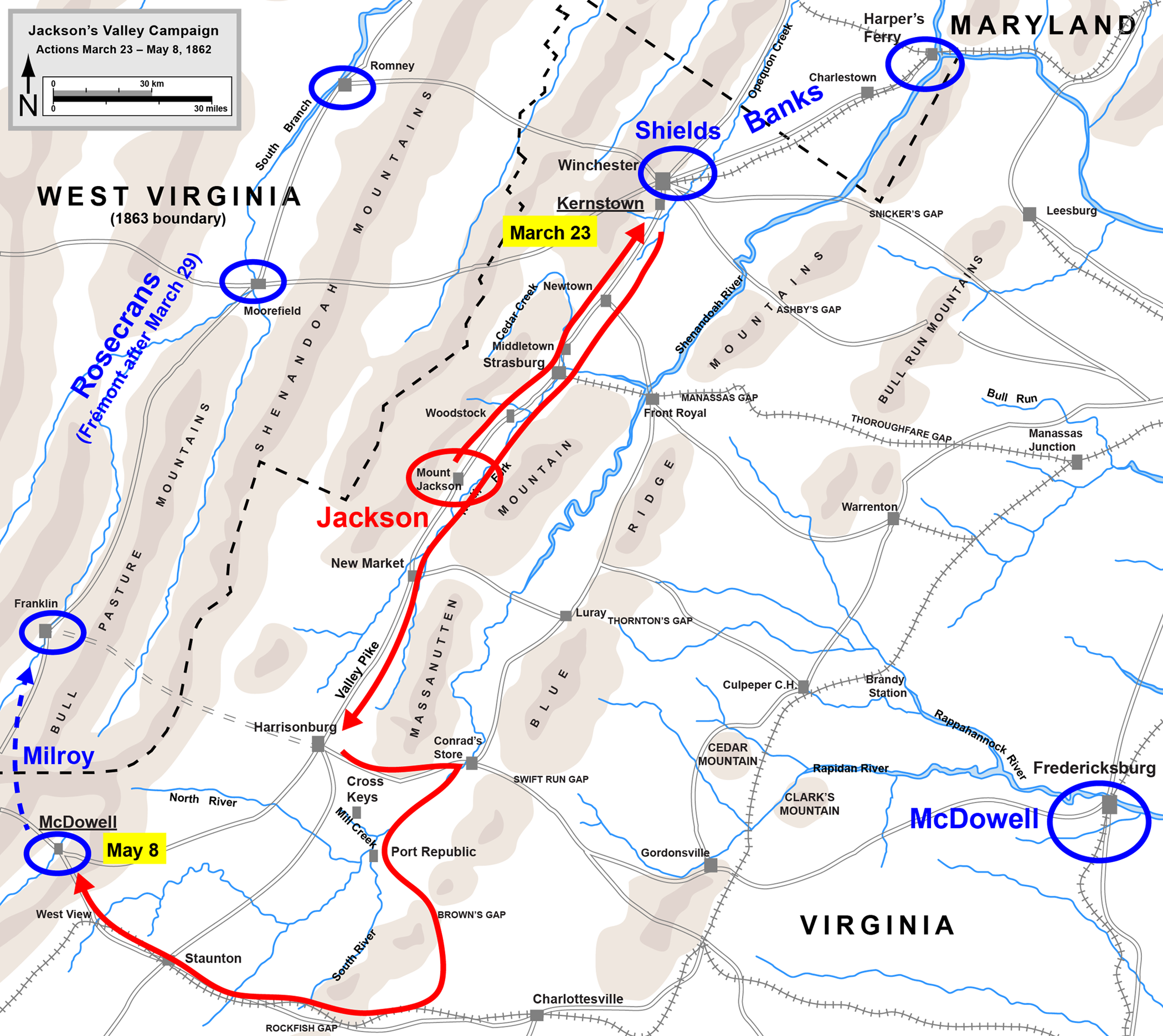
Today, 150 Years ago, the Valley Army of CS Major General Thomas "Stonewall" Jackson fought a battle with forces of the Union Mountain Department at McDowell in Highland County, Virginia.

Back in March, Jackson had forcefully attacked superior Union forces around Winchester, VA at Kernstown, pinning down Union troops for the defense of Washington, DC and forcing Lincoln to allocate more men to eradicate him from the Shenandoah Valley.  Now Jackson was being pinched -- US Maj. Gen. Nathaniel Banks was coming up the Valley from Harpers Ferry, and troops of the Mountain Department of US Maj. Gen. John C. Fremont approached from West Virginia.  Meanwhile, a third force sat in Fredericksburg under Gen McDowell (who commanded Union forces at First Manassas).  Jackson resolved to strike Fremont's men as the emerged from the Alleghenies.

At McDowell, Jackon's 9,000 men attacked Fremont's advance guard of 6,000 under US Generals Milroy and Schenck.  Union forces attacked, but, in the end retired from the field, inflicting twice the casualties they received (256US to 500CS).  This action, however, slowed the Union advance into the Valley, causing them to fall back into modern West Virginia and gave Jackson the time he needed to turn north to face the force under Banks back around Winchester.  The chase is on!

For more description, this link goes to the National Park Service summary of the battle: http://www.cr.nps.gov/hps/abpp/battles/va102.htm

This link gives you the Civil War Daily Gazette description:
http://civilwardailygazette.com/2012/05/08/no-battle-expected-at-the-battle-of-mcdowell/

File:Jackson Valley Campaign Part1.png
The strategic situation -- Jackson's march from the Battle of Kernstown, VA 23 March, to today's fight at McDowell, 8 May 1862.  Map by Hal Jespersen

Monday, May 7, 2012

Carnivorous Plants

Certainly some of the more exotic and rewarding plants to cultivate are those that supplement their diet with living prey: the Carnivorous plants.  Most are thought to capture and "digest" prey with their modified leaves for the purpose of obtaining minerals that are lacking in acidic swamp soil.  All the same, it makes for some interesting vegetation.  An excellent resource on this subject can be found here: http://www.sarracenia.com/faq.html

I have had the pleasure of cultivating species of three significant families of carnivorous plants: Droseraceae [Sundew & Venus fly-trap family], Sarraceniaceae [Pitcher-plant family], and Nepenthaceae [East Indian Pitcher-plant family].

The members of the family Droseraceae all share the characteristic of actively trapping some prey, usually an insect, either by using sticky droplets or the famous "fly-trap" jaw trap.  Once the insect is captured, the leaf releases enzymes to digest the hapless critter.  In the case of the Sundew, the leaf actually rolls over the prey.
File:Drosera rotundifolia ne2.jpg
The Roundleaf Sundew (Drosera rotundifolia).

The Venus fly-trap (Dionaea muscipula) of the Carolinas is the only member of the genus, and is justly famous.  It also boasts a delightful and delicate white flower -- my speciman has bloomed the last two years.
File:Dionaea muscipula01.jpgFile:Dionaea muscipula bluete.jpeg
Venus fly-trap (Dionaea muscipula)

The Sarraceniaceae include the provincial flower of Newfoundland and Labrador: the Purple Pitcher-plant (Sarracenia purpurea).  In this family, the members have modified pitcher-like leaves that grow from the ground.  There is no active leaf mechanism here -- the prey are attracted to the rim of the leaf with a sappy substance and simply slip into the broth of rainwater and enzymes where they drown and slowly dissolve.  Purple Pitcher-plants also boast a distinctive maroon, down-turned flower.  My speciman actually bloomed last year and has been rather easy to grow.  They're are an impressive sight in the moors of the Southwest coast of Newfoundland!
File:Purplepitcherplant.jpg
Purple Pitcher-plant (Sarracenia purpurea)

Finally, the Nepenthaceae capture prey in much the same way as their American counterparts, but their pitchers actually grow as extentions off the tips of otherwise normal looking leaves.  This leaves them looking much like a house-plant decked with peculiar Christmas ornaments!  I have had great success growing a species from the Philippines, Nepenthes alata.

Nepenthes alata.

Happy growing!