Friday, July 3, 2020

Of Monuments

The Monument of James Oglethorpe in Chippewa Square, Savannah, Georgia


I have watched as across the United States, and even the world, there have been not only calls for the removal of a great number of historical monuments and statues, but even mobs proceeding to do so on their own initiative.  What of all of this?  Should we have public monuments to men whose positions are, at least in part, no longer societally acceptable?  Here are this blogger’s own thoughts on the question, for the fair minded.

To start with, I must grant that I obviously cannot speak to how an individual feels about a particular monument or statue.  I have no doubt that a great number of monuments are the cause of distress and anger in individuals.  There are certainly monuments in our world to individuals whose legacy I do not approve and whose example I would not seek to imitate.  At the same time, I am concerned that it would be short-sighted to remove a monument simply because it elicits a negative reaction in some folks.  Maintaining such historical monuments should be a matter of reasoned consideration, not of the passion of the moment.  In such considerations, I am convinced that making distinctions is key to arriving at the most prudent course.

I would also note, at the outset, that the mob-destruction of monuments and statues is, to me, a clear sign of anarchy and barbarism.  If a monument must go, it must depart according to the rule of law.  What we are witnessing today is outrageous and disturbing.

That said, now let us consider what should be portrayed and what should stay.

I will take for granted that we should not honor a truly wicked character, like Adolf Hitler, and that it is obviously right and good to honor those supremely good as Our Divine Lord and the Blessed Virgin Mary.  Disagreement at this level betrays such a radically different worldview that we’d be better served discussing the nature of that reality than the places of monuments within it.

For the purposes of these reflections, I wish to wade into the question of monuments celebrating a complex character.

What do I mean by a complex character?  Here I am looking at someone whose life was a mixture of the good and bad, and while he or she may have had traits or accomplishments worthy of honor, they also had failings or problematic characteristics.  It is important for us to recognize and respect the virtues in men revered by past generations and for us to be able to recognize these virtues in regional or local figures.  I think it is possible that a character be honored for their virtue or accomplishments, without implying an endorsement of their failings or of all that they did or believed; or, at the very least, we can appreciate that virtue for which they were honored, even if it seems less relevant for our own time.  While it might not make sense to put up a new monument to such a complex character whose relevance is no longer so significant to our own time, we should certainly maintain what past generations erected to honor them.  That is an important part of our public history.

I will take as an example four historical figures that I can see being “complex” in some respect, that admittedly not equally so: James Oglethorpe, George Washington, and two notable Southern figures associated with the late Confederacy: the famous Robert E. Lee, and the Georgian John B. Gordon.  Along with them, I want to consider monuments to all of the men that served that cause.

James Oglethorpe was the founder of the Colony of Georgia, a member of Parliament, and an English general.  He was a famous philanthropist, whose idea for Georgia was as both a buffer to Spanish expansion, but also as a haven for debtors, where he forbid the institution of slavery.  At the same time, the Charter for the new Province of Georgia included this line: “there shall be a liberty of conscience allowed in the worship of God, to all persons inhabiting, or which shall inhabit or be resident within our said provinces and that all such persons, except papists, shall have a free exercise of their religion, so they be contented with the quiet and peaceable enjoyment of the same, not giving offence or scandal to the government.”  Oglethorpe, like so many others in the English-speaking world, was anti-Catholic and denied religious liberty to Catholics, like myself.  Hence, whatever his other accomplishments, he is a character of some complexity.  Nevertheless, the monuments to Oglethorpe are not fundamentally meant as monuments to anti-Catholicism and bigotry; the represent a man of great talent and ideals who motivated by a desire to help the disadvantaged, founded a new colony.

George Washington is honored as the great military leader of the American Revolution and first President of the United States.  His fortitude during that conflict and his combination of prudence and humility as President surely merit praise and honor.  Pope Leo XIII in his encyclical Longinqua wrote that, “at the very time when the popular suffrage placed the great Washington at the helm of the Republic, the first bishop was set by apostolic authority over the American Church. The well-known friendship and familiar intercourse which subsisted between these two men seems to be an evidence that the United States ought to be conjoined in concord and amity with the Catholic Church. And not without cause; for without morality the State cannot endure-a truth which that illustrious citizen of yours, whom We have just mentioned, with a keenness of insight worthy of his genius and statesmanship perceived and proclaimed.”
He is, of course, a complex character, as he was a slaveowner.  There is no defending his participation with that immoral institution; but that association is not why he has been honored for generations – and is not why the same Pope who wrote an encyclical condemning slavery would call him “the great Washington.”  Surely we can separate the symbolism of Washington and reason he is honored from his personal faults and failings.

Let us consider the Confederates.  I do not think we need approve or endorse the Confederate cause to appreciate the place of a monument to a complex character associated with the conflict. 

Before proceeding any further in discussing these Confederate figures, though, I would encourage you to read my earlier post on the causes and complexities that led to the Civil War: Why Civil War?
To dismiss out of hand anyone associated with the Confederacy as nothing more than a traitor and promoter of slavery is a gross historical oversimplification.  For instance, it was a real contested question as to where loyalties should rest: Home State or Federal Union.  Further, the respective attitudes and actions of the Cotton States (seceding before Lincoln was inaugurated) and the Tobacco States (seceding only after Lincoln demanded they contribute troops to invade the Deep South - Virginia having earlier voted against secession) certainly present two different paths to an attempted separation from the United States.  All of these states sought, in part, to defend legal slavery as it had been protected under the United States Constitution, and all of these states sought to depart the Union through elected conventions and in an orderly and legal fashion, based on the political ideals of the American founding.  Not only slavery, but whether a free Union should be maintained by coercion, was very much a matter in question.

Robert E. Lee was honored by a resolution of Congress to name the Arlington House in Arlington, Virginia as the Robert E. Lee Memorial in 1955, wherein was proclaimed:
“Whereas Robert E. Lee had graduated from West Point, dedicated himself to an Army career, and became a colonel in the United States Army, then the commander of the Confederate forces, attained world renown as a military genius, and after Appomattox fervently devoted himself to peace, to the reuniting of the Nation, and to the advancement of youth education and the welfare and progress of mankind, becoming president of the Washington and Lee University at Lexington, Virginia; and Whereas the desire and hope of Robert E. Lee for peace and unity within our Nation has come to pass in the years since his death, and the United States of America now stands united and firm, indivisible, and unshakable.”
While some may choose to view Lee simply as a traitor leading troops for a pro-slavery secessionist movement, the reality is that he was a man of deep honor or decided to remain loyal to his home state, and who worked for reunion and reconciliation after the conflict.  He could have chosen to urge his men to wage on-going guerilla war or refuse to accept their place in the United States once more.

John B. Gordon, a Georgia native, served in the Confederate army, rising through the ranks to end up one of Robert E. Lee’s chief lieutenants by the end of the war, having a prominent role in the formal surrender at Appomattox.  After the war, he would write, that, "The South maintained with the depth of religious conviction that the Union formed under the Constitution was a Union of consent and not of force; that the original States were not the creatures but the creators of the Union; that these States had gained their independence, their freedom, and their sovereignty from the mother country, and had not surrendered these on entering the Union; that by the express terms of the Constitution all rights and powers not delegated were reserved to the States; and the South challenged the North to find one trace of authority in that Constitution for invading and coercing a sovereign State." Cf., General Gordon's Reminiscences
It is true that he was an opponent of Reconstruction – and some even allege a connection with the KKK, though he denied any such connection and the evidence of his participation is rather circumstantial.  It is without question that he would serve in the U.S. Senate from 1873-1880 and 1891-1897 and Governor of Georgia from 1886-1890.  When a monument was erected of him at the Georgia State Capitol, he represented not only military heroism but the resumption of Georgia in the life of the United States. 

Gordon was not the only prominent Georgian to have a leadership post in the Confederacy and then take a leading role in the post-war United States government – I might observe that Alexander Stephens, who voted against the secession of Georgia but was Vice President of the Confederacy, was later both U.S. Congressman (1873-1882) and Georgia Governor (1882-1883) after the war.  Like so many of his time, he was certainly a racist in his views (his Cornerstone Speech makes that clear), but he also represents a reconciliation of the defeated South to the American Republic.

Not only were men like Gordon and Stephens willing to reenter the halls of Congress, but they were allowed to do so, in a show of clemency that made reconciliation possible.  They certainly had views on race that were simply wrong; as wrong as Oglethorpe was about Catholics.  Like Oglethorpe, however, they represent a key historical role and contribution, as well.  When monuments were erected to Lee and Gordon, these men represented not only the pride and honor of their region, but also reconciliation and reunion after the terrible conflict of the Civil War.  It is peculiar to see less tolerance for the memory of such former Confederate leaders from our contemporaries than from those who had personally fought against them. 

Let us move to my last category: monuments commemorating common soldiers, but of such a cause as the Confederacy.

In considering whether it is appropriate to maintain monuments to the common soldier that fought for a Southern state during the Civil War, I think of my great-great grandfather.

In the summer of 1864, my great-great grandfather, Thomas J. Cole, a lad of 16 years of age from Butts County, Georgia, joined the 3rd Georgia Reserve regiment.  He had never been far from his family’s farm in Middle Georgia – a family farm that did not include any slaves.  That same summer the State of Georgia was being invaded by the armies of US General William T. Sherman which would go on to burn Atlanta and devastate Middle Georgia on his way to Savannah.  My great-great grandfather responded to the call of the State of Georgia in that moment of crisis.  The historian William Marvel, who wrote about him and his service at the terrible prison of Andersonville, describes his ordeal:
"Nor were the prisoners the only victims. Sixteen-year-old Thomas J. Cole joined the 3rd Georgia Reserves during Rousseau's cavalry raid, in July [1864]. He had never wandered far from his father's farm in Butts County, midway between Macon and Atlanta, and shoes had never served as part of his daily wardrobe. He arrived at Andersonville with a pair of brogans on, however, and they irritated an insignificant scratch on his left foot, just below the ankle. The nearest he ever came to the stockade was the sentry box, and he did not approach the prisoners' hospital at all, but, just before the evacuation of prisoners began, his foot turned so sore that he had to be relieved from duty. A week later his comrades carried him from his tent over to Sumter Hospital -- the parallel pair of two-story barracks buildings alongside the railroad. In seven weeks the wound had grown to look like a carbuncle, but ten days in the hospital transformed it into a gaping, putrid lesion four inches in diameter. The flesh dropped away to reveal his ankle joint, his lower leg started to swell and ulcerate, and he wailed piteously whenever the doctors tried to touch it.

Cole would survive, however. He would live into the twentieth century and raise five children, but he would have to sacrifice the leg in order to save the rest of his hide."  [William Marvel, Andersonville: The Last Depot, pgs. 209-210]

He was not a slave-owner, and neither was his father.  He responded to a call for help from this state, served with honor, and lost a leg in service to his state.  He, while just a boy, responded to Georgia in her moment of need; surely the State of Georgia must continue to honor him, and others like him, who gave life and limb for their home.

We must reject the legacy of slavery and racism that has surely tainted the history of our country.  At the same time, we cannot ignore honor and sacrifice on behalf of their homes, even if the cause is not all that it might have been or all that we would wish it to be today.

In all these cases, I think fair-minded folks can reasonably debate and discuss the merits of these figures whose life and legacy are complex.  In the end, however, I would think a deference to the public goods celebrated by past generations is a healthy tendency, and that we can distinguish between the good honored and the failings tolerated.  Even a monument to a figure whose ideals were problematic can serve to teach us a lesson about our own past and need to improve as a society.

Live well!

Thursday, July 2, 2020

Of a Dream

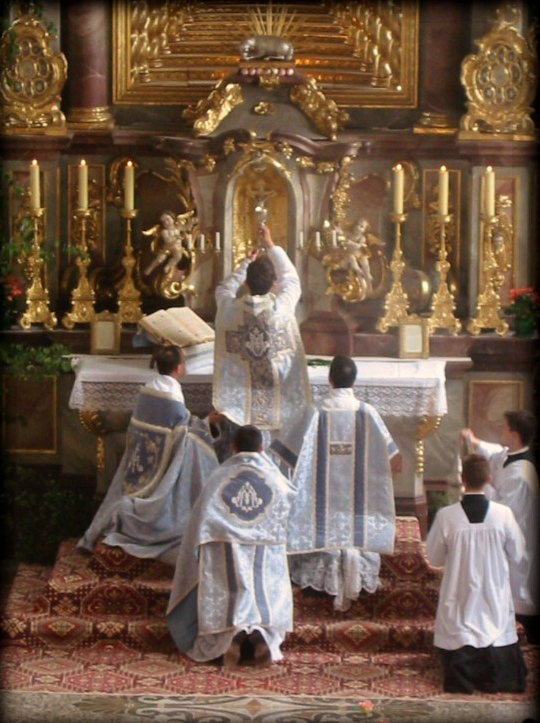
Cardinal Sarah, prefect of the Congregation for Divine Worship, says Mass in the London Oratory for the Sacra Liturgia conference, July 6, 2016. Credit: Lawrence OP via Flickr (CC BY-NC-ND 2.0).


The contemporary world, for a variety of reasons, is very much in a tumult, with questions of race and racism in the forefront of the discussion and protests.  It is in this context that I propose to offer a few thoughts.

In the first place, I must note that my Catholic Faith is the root and source of my view of the world; I seek to conform my intellect and will to the truth and goodness of Christ, and not the spirit of the age or the fads of society. I don't want to undermine or contradict the Truth. Ever.  Making distinctions and being precise is critical; especially in moral and theological matters.

In considering any question of race, then, the starting place for me is the call of Our Lord, Jesus Christ, to make disciples of all nations.  Racism is a sin.  If you find yourself hating individuals of a particular race because of their race, or seek to make another ashamed of their own race, you have drifted from the charge of Christ to love one another and baptize all nations. As St. Paul says: in Christ, there is neither Jew nor Greek. (Gal 3:28)
Every human person has equal dignity, being made in the image and likeness of God. Our race is not our identity; neither is our nationality -- that comes from our Baptism in Jesus Christ.

I appreciate the particular wisdom and truth in the famous line of the Atlanta, Georgia native, Dr. Martin Luther King, Jr:  "I have a dream that my four little children will one day live in a nation where they will not be judged by the color of their skin but by their character."

Two points immediately present themselves in response to that statement.

In the first place, I think the statement is so moving and memorable because there is a solid grounding in truth that underlies this "dream."  We should, indeed, be concerned with the character of a man, rather than on his particular race.  All men ought to be equal under law, insofar as reason allows and permits.  Law is, after all, "an ordinance of reason for the common good, made by him who has care of the community, and promulgated."  It is incumbent on everyone, regardless of their own race, to treat others with charity, respect, and at the very least, in justice.  Certainly, public officials have a grave obligation in this regard.  In addition, we should by all means extend charity to the poor and the disadvantaged -- of any and every race!

The second thought regards the interpretation of this statement and the larger, and more difficult question, of race relations, especially in the United States.  To a great many people, equal rights seems to mean not a matter of equality under law, or in treating folks justly, but of something rather different.  Many seem to assume that equality should mean either equal societal status in terms or wealth or power on one hand, or reparation for past wrongs, on the other.  History is filled with accounts of injustice, inequality, and tragedy.  That of the United States is certainly no exception; and a single ethnic group can by no means claim a monopoly on being the object of such injustice.  An agenda of revenge, of coercive redistribution of wealth, of legal preferences -- these hardly contribute positively to society or truly right the wrongs of the past, however.

At the same time, while the law and justice demands that we treat all equally, nature and experience tells us that folks do have cultural and ethnic differences.  As well it should be.  Equality can not and should not mean that there is no recognition of such differences in people.  Different peoples have different customs, music, foods, histories, heroes, and languages.  We should not deny to a race or ethnic group its strengths or unique characteristics.  At the same time, it makes little sense to ignore the prevailing faults or strengths of a people, especially if you are charged with the common good.  Denying someone their legal rights based on race alone is an injustice.  Ignoring statistics and failing to remain vigilant of trends within ethnic groups seems naïve.

Also, for reference, here is a link to the full text of the speech: "I Have A Dream," 28 August 1963.

Finally, in addressing real questions of racism and injustice, I close with these reflections from C. S. Lewis:
"Beware lest you are making use of the idea of corporate guilt to distract your attention from those humdrum, old-fashioned guilts of your own which have nothing to do with 'the system' and which can be dealt with without waiting for the millennium. For corporate guilt perhaps cannot be, and certainly is not, felt with the same force as personal guilt. For most of us, as we now are, this conception is a mere excuse for evading the real issue.
When we have really learned to know our individual corruption, then indeed we can go on to think of the corporate guilt and can hardly think of it too much. But we must learn to walk before we can run....
From considering how the cruelty of our ancestors looks to us, you may get some inkling how our softness, worldliness, and timidity would have looked to them, and hence how both must look to God.
...pity for the oppressed classes, when separated from the moral law as a whole, leads by a very natural process to the unremitting brutalities of a reign of terror."
-- Problem of Pain, pages 54, 58, & 59

In the end, we should dream of a "a nation where they will not be judged by the color of their skin but by their character."  We should treat individuals with justice, respect, and charity; we should acknowledge and appreciate the strengths and contributions of various races and ethnic groups and commit ourselves to working for equal justice under law and the end to the evil of racism.

That is this blogger's two cents, anyway!

Live well!

Friday, June 26, 2020

Why Civil War: Secession & the War of the Union


Why Civil War?

The causes and complexities of the secession crisis and War of Union of the 1860s are often a topic of discussion and dispute.  Unfortunately, nearly as often, these causes and complexities are distorted or exaggerated to justify one side or the other.  It is my hope to fairly and concisely lay out some of the key causes and motivations that turned the sectional dispute into a war, especially hoping to fill out an understanding of Southern motivations and rationale.


Usually the South is blamed for the advent of Civil War; really a War of Independence or a War of Union.  Secession and war are considered and treated as equivalent to one another.  Secession is war.  There is an important distinction, however, between the two, as history demonstrates.  Let us begin with secession.  Why did the South secede?

The Southern concerns were these: the Northern states pursued a set of economic policies (on tariffs, internal improvements, for instance) that undermined Southern economic interests.  The tariff issue was no small matter for the South, as Southern cotton exports made up more than half of American exports.  Further, Northern states had proven unwilling to recognize and enforce fugitive slave laws (as required by the Constitution), and they had railed against the South and the institution of slavery, seeking to restrict their ability to bring their "property" to the western territories; this even after the Dred Scott decision of 1857 that affirmed that as a Constitutional right.  Add to this the kind of affirming rhetoric that glorified John Brown at Harpers Ferry in 1859 and his militant anti-slavery techniques.  A host of issues divided the sections, and slavery, important in itself, became symbolic for them all.

The South may have lost control of the House of Representatives some years before, but had been able to rely on its standing in the Senate and the jurisprudence of the Supreme Court to broker compromises or defend its regional interests.  With the admission of several free states without new Southern states to balance, the South lost its equal status in the Senate.   On top of that, when the Republican Abraham Lincoln of Illinois was elected President, he was not even on the ballot in any of the states that would form the Confederacy except Virginia (in the Old Dominion, he received 1.1% of the vote; as an interesting side note, Lincoln carried California with 32.3% of the vote!).  That means that Lincoln did not receive a single popular vote, never mind electoral vote, in NC, SC, GA, FL, TN, AL, MS, LA, AR, and TX.

ElectoralCollege1860.svg
Presidential Election of 1860.

For the fire-eaters in places like South Carolina, they determined to get out while the getting was good. They lost Congress, the Presidency, and the Supreme Court would soon inevitably follow. They had no expectations that the federal government would ever protect their interests, especially when they had shown that they weren’t willing to uphold their Constitutional rights.  As far as they were concerned, the Union that was the United States, no longer protected their interests, and they understood that departure from this free Union was their legal right.  States like Virginia, when they ratified the Constitution, expressed their understanding that they had the right to withdraw if the new government acted to injure or oppress the people.  (Cf., Ratification of the Constitution by the State of Virginia) 

John B. Gordon, a Confederate general, and later Governor of Georgia and member of the U.S. Senate, expressed the Southern understanding thus: “The South maintained with the depth of religious conviction that the Union formed under the Constitution was a Union of consent and not of force; that the original States were not the creatures but the creators of the Union; that these States had gained their independence, their freedom, and their sovereignty from the mother country, and had not surrendered these on entering the Union; that by the express terms of the Constitution all rights and powers not delegated were reserved to the States; and the South challenged the North to find one trace of authority in that Constitution for invading and coercing a sovereign State.” (cf., General Gordon's Reminiscences)

Conventions were called, delegates elected, and the secession crisis was at hand.

Hence, the Deep South (The Cotton States: SC, GA, FL, AL, MS, LA, and TX) went ahead and seceded, from December 1860 to February 1861, before Lincoln even took office in March 1861.  These states (like MS) did express the protection of slavery as a reason for secession. (The MS ordinance can be viewed here: Mississippi Secession Ordinance)   The Vice-President of the new Confederacy, Alexander Stephens, himself a Unionist opposed to secession, but who remained loyal to Georgia, famously expressed this in his “Cornerstone Speech.” (Cf., Stephens: Cornerstone Speech)

For the upper South (The Tobacco States: VA, NC, TN, AR), secession only came after President Lincoln actually called up troops to invade the Cotton States after Fort Sumter. Virginia had actually voted against secession at the beginning of April (Cf., VIRGINIA CONVENTION VOTES AGAINST SECESSION), but reconsidered once Lincoln proposed to make it a war and invade the Deep South to compel them to remain.  For Virginia, the debate was about coercion.  Governor Letcher of Virginia responded to the call for troops to subdue the Deep South thus: "You have chosen to inaugurate civil war, and having done so, we will meet it in a spirit as determined as the Administration has exhibited towards the South." (Cf., New York Times: GOV. LETCHER REPLY TO SECRETARY CAMERON)

North Carolina, too, initially opposed secession, not even calling a convention.  The Tar Heel State changed her tune when President Lincoln called up troops:  “Congressman Zebulon Vance, a western Unionist, was gesturing to the heavens ‘for peace and the Union of our Fathers’ when someone handed him news of Lincoln’s call for troops. ‘When my hand came down,’ Vance recalled later, ‘it fell slowly and sadly by the side of a secessionist. I immediately, with altered voice and manner, called upon the assembled multitude to volunteer, not to fight against but for South Carolina.’”  (Cf., NY Times Opinionator: ‘The Death Knell of Slavery’):

This is an important point – the Southern states actually seceded at different points with different specific reasons and motivations.  All of them were content to separate from the United States without a war.  Confederate Vice-President Stephens in his “Cornerstone Speech” remarked in March 1861: “This revolution has been signally marked, up to this time, by the fact of its having been accomplished without the loss of a single drop of blood.”  Nevertheless, they were also clearly willing to defend their right to secede with force of arms.


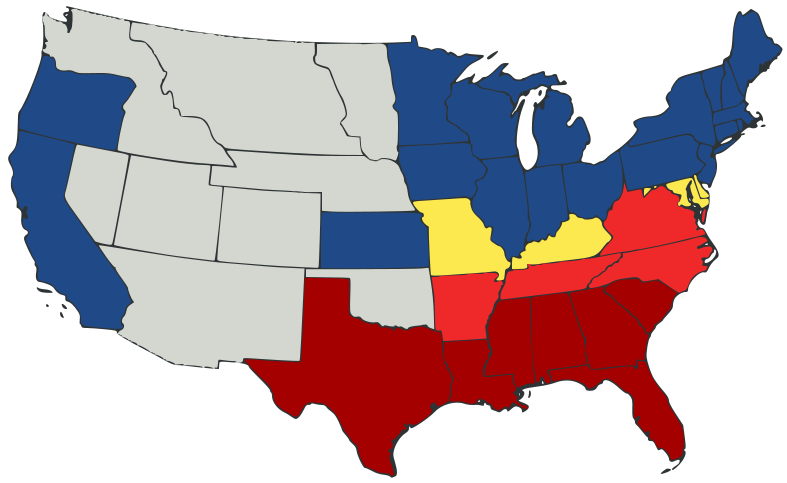
Map of U.S. showing two kinds of Union states, two phases of secession and territories.
Blue: Free Union States.
Yellow: Slave Union States (Border States)
Light Red: Upper South States (Tobacco States), which seceded after Lincoln's call for troops.
Dark Red: Deep South States (Cotton States), which seceded after Lincoln's election.
["US Secession map 1861" by Júlio Reis - The source code of this SVG is valid.This vector image was created with Inkscape, and then manually edited.A trace, retouch, and recolour of Image:Secession Map of the United States, 1861.png by User:Tomf688.. Licensed under CC BY-SA 3.0 via Wikimedia Commons]


When the Deep South seceded, President James Buchanan of PA was in office, and would remain so until Lincoln’s inauguration in March 1861.  Buchanan viewed secession as being illegal, but also believed that a President had no legal power to make war on the states.  Hence, while he was President, there were attempts to retain federal property (several forts did remain under federal control, including Fort Sumter in SC, Fort Pickens in FL, and Fort Monroe in VA), but there was no war or invasion.  In his Fourth Annual Address in December 1860, President Buchanan observed: “The fact is that our Union rests upon public opinion, and can never be cemented by the blood of its citizens shed in civil war. If it can not live in the affections of the people, it must one day perish. Congress possesses many means of preserving it by conciliation, but the sword was not placed in their hand to preserve it by force.” (Cf., Fourth Annual Message to Congress on the State of the Union)

President Abraham Lincoln, too, considered secession illegal, but curiously, like Buchanan, also maintained a right of the people to Revolution: “This country, with its institutions, belongs to the people who inhabit it. Whenever they shall grow weary of the existing Government, they can exercise their constitutional right of amending it or their revolutionary right to dismember or overthrow it.” First Inaugural Address, March 1861. (Cf., First Inaugural Address of Abraham Lincoln)

Ultimately, it was Abraham Lincoln that determined that secession was illegal, the Union must be saved, and it must be saved by the use of military force.  For Lincoln, this was to be a war to save the Union – and he said it was so in a letter to newspaper editor Horace Greeley of NY in August 1862: “My paramount object in this struggle is to save the Union, and is not either to save or destroy Slavery. If I could save the Union without freeing any slave, I would do it, and if I could save it by freeing all the slaves, I would do it, and if I could save it by freeing some and leaving others alone, I would also do that. What I do about Slavery and the colored race, I do because I believe it helps to save this Union, and what I forbear, I forbear because I do not believe it would help to save the Union.” (cf., New York Times: Reply to Horace Greeley)

It is an interesting to ponder the question of using coercion to compel so many states to remain in a free union, even at the cost of over 600,000 lives and four years of war.

Without question, Abraham Lincoln was opposed to slavery, but he was also very much against racial equality, having said: "...I am not, nor ever have been in favor of bringing about in any way the social and political equality of the white and black races -- that I am not...in favor of making voters or jurors of negroes, not of qualifying them to hold office, nor to intermarry with white people...there is a physical difference between the white and black races which I believe will for ever forbid the two races living together on terms of social and political equality." -- Abraham Lincoln, 18 September 1858; Fourth Debate with Stephen Douglas.  Lincoln himself supported compensated emancipation and hoped to avoid racial issues in the U.S. by encouraging freedmen to emigrate. (Cf., Civil War Daily Gazette: LINCOLN ARGUES IN FAVOR OF COLONIZING THE FREED SLAVES)

Later on, as the war progressed, the decision was made to eradicate slavery.  The role of the freedmen in society, however, remained hotly debated.  Ending slavery and granting equal rights were two rather different things.  New York had overwhelmingly voted down a referendum to extend voting rights to blacks in 1860.  Indeed, at the time of the ratification of the 15th Amendment after the war, only 7 of the Northern states had extended voting franchise to African Americans.

That said, it should be highlighted that the institution of slavery, as it existed in ante bellum America, was morally problematic and certainly an injustice.  Perhaps the greatest injustice was the failure of U.S. laws to recognize slave marriages or to legally prohibit the separation of families.  Even if we seek to understand Southern motivations, we certainly ought not try to whitewash or justify the evils of slavery as it was practiced in the United States.  Of course, a study of slavery, to be complete, would also probe the unseemly role of northern ports in the slave trade, and the motivation to protect slavery in the calls for independence from Great Britain in the American Revolution.   America has had a race problem, and a problem with racism, but it is not limited to the South.  Of course, racism is hardly a uniquely American problem!

In sum, secession and war were two different matters, and the reasons that various individuals and states involved themselves in either certainly varied.

A great deal more could be said about the prosecution of the war and the era of Reconstruction that followed, but that is a subject for another day.

In all of these issues, it is certainly important for the honest student of history to seek to understand the motivations of both sides, the complexities of the issues, and seek to learn what we can from the shortcomings of our forefathers and our Republic.


Live well!

Tuesday, June 23, 2020

Feast of St. Etheldreda

St-aethelthryth.jpg

Today is the Feast of the Anglo-Saxon Saint, St. Etheldreda (+679AD).  She is also known as St. Audrey or, in another form, Audra!

She was a member of the royal family of East Anglia, the daughter of the king, became the queen of Northumbria, and, when widowed, founded a monastery in Ely, England.  When her body was moved in the 12th century, it was still incorrupt.

Here is a bit more information on this saint, little known outside England:
Catholic Saints Info: Saint Etheldreda

This is the account in the Old Catholic Encyclopedia:
Old Catholic Encyclopedia: St. Etheldreda

This link goes to the site of the Church of St. Etheldreda in London, England:
St. Etheldreda's Church, London

Live well!

Sunday, June 21, 2020

Feast of St. Aloysius of Gonzaga

The Vocation of Saint Aloysius Gonzaga.PNG
The Vocation of Saint Aloysius by Guercino


We might note that it is the feast of St. Aloysius Gonzaga, the young 16th century Jesuit.  Born in 1568 into the prominent noble Italian family of Gonzaga, he spurned the excesses of the court, and joined the Society of Jesus at the tender age of 16.  St. Aloysius died during an outbreak of the plague in Rome during the year 1591AD.

Today, he is buried in the marvelous Baroque Jesuit Church of Sant'Ignazio in Rome: Chiesa di Sant'Ignazio

For more on this great saint, you might note:
Old Catholic Encyclopedia: St. Aloysius Gonzaga

Catholic Saints Info: St. Aloysius Gonzaga

Live well!

Friday, May 22, 2020

Epidemic Response: A critique


I don’t often express my own opinion at any length on this forum, especially on “hot topics.” Typically, I doubt the fruitfulness of the exercise. That said, in this case, I think it is worth putting a couple thoughts out there on this question of the response to Wuhan Coronavirus.

I should start with the obligatory caveat that yes, I do think that the virus is more serious than your typical seasonal flu, and that, yes, of course, we should act responsibly and especially do our part to protect vulnerable folks.

My critique is this: during this pandemic, our public health officials and the press corps have badly handled their direction and communication of the situation. I think a scientist and public health official should be clear, honest, and sober. In such a case, the press need only give them a platform. I don’t think that has happened.

Let me explain my dissatisfaction.

Science is all about observation, gathering evidence, and testing theories to explain what you see. In a case like this, when you are facing a novel virus, it is common sense that there is a great deal you would not know: it's new. So, tell the public that. Be transparent on what we have proven and what we merely guess or surmise. Be equally honest about how you may have initially been wrong. If goals have to change, make it quite clear that the goal is changing and why new evidence necessitates the change. I'm not seeing that.

So far, I can recall being told:
-- There is no evidence of human-to-human transmission
-- There is no threat to the United States
-- The virus can be spread even by those who are asymptomatic
-- It can take two weeks to manifest symptoms
-- Some infected people never actually manifest symptoms
-- Wash your hands and don't touch your face
-- Don't wear a mask unless you are sick or a medical professional. Cloth masks are useless with a virus and give a false sense of security.
-- The virus can live 7 days on some surfaces, so wipe everything down
-- The is a national medical emergency that necessitates shuttering the nation
-- We need to flatten the curve to keep from overwhelming our medical facilities, even though this will prolong the epidemic
-- Wear a mask. This is primarily to protect others
-- The chance of transmission from inanimate surfaces is low
-- Most healthy people who become infected have no symptoms or have mild symptoms
-- The chance of asymptomatic transmission is less than that from one manifesting symptoms
Now we even have some public officials in certain places talking about continuing restrictions until there is a vaccine or “cure.”

Please note: I’ve got no problem with any of this progression, insofar as it is based on the new evidence and experience that we gained. Indeed, I am excited that we continue to learn more about this pathogen and will be better able to stop its spread and treat those who contract it.

I am troubled, though, at this tendency to “update” the recommendations and “facts” about the disease without an admission that earlier recommendations and theories about it were, in fact, erroneous. I am concerned, too, that the public is lectured to like fools and treated as an ignorant, selfish, and “anti-science” should there be any questioning of these recommendations or policies. If you want the public to cooperate, you’ve got to give clear goals, convincing reasons, and sensible recommendations. You need to be clear, honest, and sober. We have had shifting goals, appeals to authority, and mandates that often don’t make sense. That doesn’t work. The tone from too many officials and press outlets has been contradictory, politically charged, and alarmist.

For instance, the policy of trying to “flatten the curve” made good sense. So why have we abandoned it? What was wrong with that? You need to explain why that is no longer an appropriate strategy, not just introduce a new one and accuse those asking questions with not caring about how many people die.

I also want to note: life involves risks. The argument that it is worth it to remain “locked down as long as it takes” or utterly changing society on a permanent basis if it would even save a single life from the Coronavirus is, frankly, nonsense. Public policy should be about the promotion of the common good; the common good involves, not just what’s best for some, or even the majority, but what is just and tends to general human flourishing. To impose long-term quarantines that result in catastrophic economic and societal consequences demands that there be a yet more serious danger in not doing so. Right? Utterly overwhelmed medical facilities where folks can’t even get treatment for emergencies unrelated to the Wuhan Coronavirus; that’s worth avoiding, for sure. “Flatten the curve.” That makes sense. That’s not a threat right now in most places, though. Again, life involves risk. We can never totally avoid it; we should responsibly manage it. Striking that balance takes prudence and sobriety.

Finally, I think the adversarial attitude of the press towards the President and my own governor here in Georgia is counterproductive. Of course, the comments of President Trump have been inconsistent, confusing, and too often off-the-cuff. Anyone who knows Donald Trump knows that while he is to be taken seriously, his off-the-cuff comments should not be taken so seriously. The press, however, doesn't take him seriously, but takes every word he says way too seriously, and ultimately misses the point. I’m not defending the President’s delivery or his tendency to speak off-the-cuff or on Twitter. I am saying that, by now, the press should know how he works and stop giving so much attention and time to these statements. It's a distraction that makes it look like their priority is really just to discredit the president. I know they can do this: they seem to know how to take particular comments of Joe Biden with a grain of salt!

I should say, in closing, that I think my own governor here in Georgia has done a comparatively good job and has been at the receiving end of a great deal of dishonest and ill-informed ridicule.

In the end, I write all of these things hoping and praying for the best and acknowledging my own ignorance of much of the complexities of public policy and public health. On the other hand, if policy makers and health experts want the support of someone like me, they might note that what they are doing now isn’t working too well. I do fear they may have cried wolf a few times too many in this crisis, and I am concerned that folks are just going to stop listening. I don’t think that would be a good thing, in the end.

Let us pray for one another.

Live well!


Thursday, February 27, 2020

Confraternity of St. Peter

Image result for Confraternity of St. Peter
Coat of Arms of the Confraternity of St. Peter

Today, 27 February, marks the anniversary of this bloggers enrollment in the Confraternity of St. Peter.

A confraternity is, of course, a sort of organization of those united in their prayer for a particular intention and cause.  In this case, "The Confraternity of St. Peter is a sodality of members who wish to unite themselves to the Priestly Fraternity of St. Peter and aid in the work of our fraternity, primarily by their prayers...Members of the Confraternity of St. Peter (CSP) pray a decade of the Rosary and the Confraternity Prayer each day for the intentions of the CSP."

The Confraternity Prayer is as follows:
"V. Remember, O Lord, Thy congregation.
R. Which Thou hast possessed from the beginning.

Let us pray.
O Lord Jesus, born to give testimony to the Truth, Thou who lovest unto the end those whom Thou hast chosen, kindly hear our prayers for our pastors.
Thou who knowest all things, knowest that they love Thee and can do all things in Thee who strengthenest them.
Sanctify them in Truth. Pour into them, we beseech Thee, the Spirit whom Thou didst give to Thy apostles, who would make them, in all things, like unto Thee.
Receive the homage of love which they offer up to Thee, who hast graciously received the threefold confession of Peter.
And so that a pure oblation may everywhere be offered without ceasing unto the Most Holy Trinity, graciously enrich their number and keep them in Thy love, who art one with the Father and the Holy Ghost, to whom be glory and honour forever.
Amen."

The website of the Confraternity can be found here: Confraternity of St. Peter

Picture credit: [By Required attribution text: by the Priestly Fraternity of Saint Peter, available from http://fssp.org., Attribution, https://commons.wikimedia.org/w/index.php?curid=5289044]


The Priestly Fraternity of St. Peter (FSSP) is an Society of Apostolic Life of Pontifical Right established in 1988 at the direction of Pope St. John Paul II for the specific purpose of preserving the traditional liturgy of the Latin Rite.  This Priestly Fraternity was specifically founded to allow these venerable liturgies to remain alive in a community in full communion with, and with a deep attachment to, the Chair of St. Peter.  Hence they celebrate the Mass and sacraments according to the Roman Missal of 1962; the form of the Mass authorized for use by any priests by the Apostolic Letter Motu Proprio of Pope Benedict XVI, Summorum Pontificum.  Here is the website of the community: Priestly Fraternity of St. Peter (FSSP)

The FSSP celebrates Mass in 124 dioceses worldwide, and in their North American District, 96 priests administer parishes in 39 dioceses in the USA and 7 in Canada.  This includes my own Archdiocese of Atlanta.  Here is the website of that North American District: FSSP North American District

I am particularly blessed to belong to the parish of St. Francis de Sales, which they administer in Mableton, Georgia!

Live well!