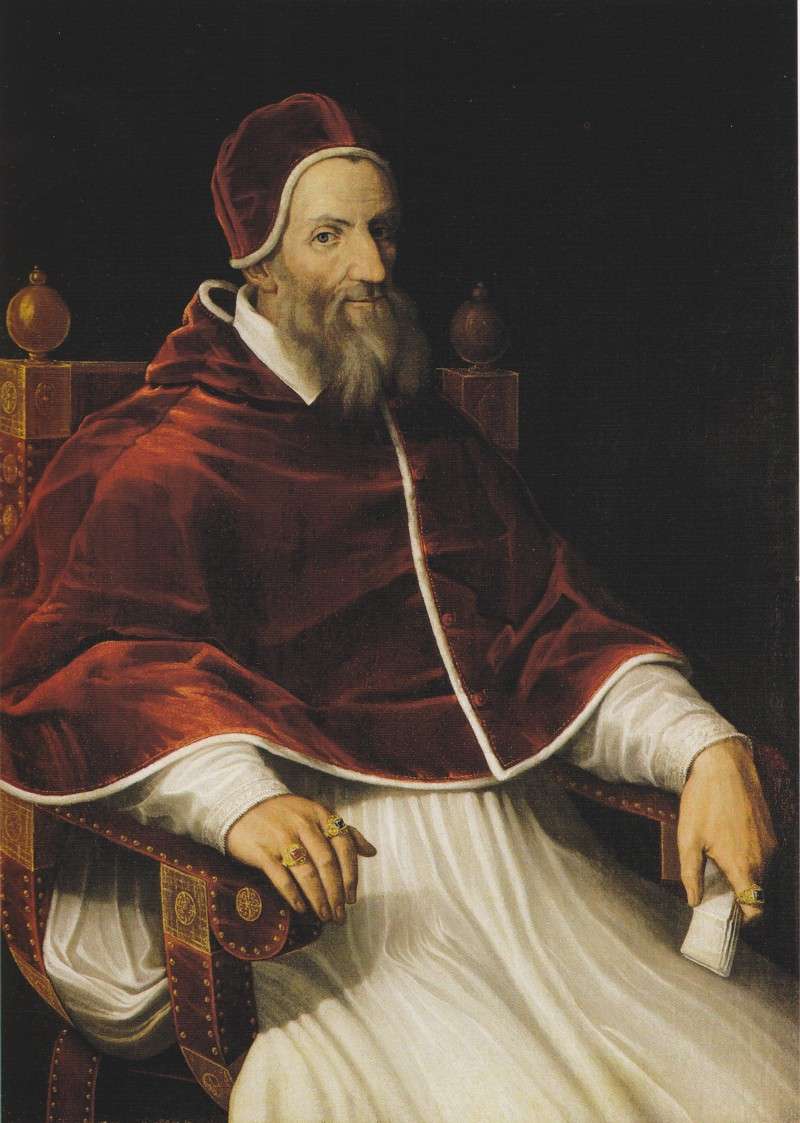
Pope Gregory XIII (1572-1585) who introduced the Gregorian Calendar
Today is Bissextile Day! What is that?
Have you ever wondered why we have leap years, and why, on the traditional Catholic calendar, the feasts of late February shift a day in leap years?
Read on.
Of course, today we use the Gregorian calendar, promulgated by Pope Gregory XIII in 1582. It replaced the earlier Julian calendar that dated to the Roman era, but proved less than accurate, and the error between date and solar events such as the equinoxes, necessitated a new calendar. The root of the Julian Calendar error is this: it presumed that the year was 365.25 days long, meaning that a leap year every four years would account for the decimal places and keep the calendar year in sync with the actual solar year. As it happens, the year is more precisely 365.2422 days long, meaning that the seasons would slowly drift away from their calendar dates with the Julian Calendar -- for instance, by 1582, the Vernal Equinox was occurring on 11 March, rather than 21 March as is traditionally assumed. So, the new Gregorian Calendar restored the Equinox to its traditional date by dropping 10 days that October of 1582. It would try to remain accurate by modifying the reckoning of leap years: it would have a leap year every year divisible by 4, except those divisible by 100 (most years such as 1700AD are not leap years), but if divisible by 400, remaining a leap year (so 1600AD was a leap year). This is still a hair off, and some have suggested that we waive the leap year in 4000AD to fix the problem.
At this point, the leap day, when added, is 29 February. Formerly, however, the extra day was not inserted in that last place of the month of February, but on the "sixth day before the Kalends of March." The Roman manner of inserting a leap day was this -- simply double that sixth day before the Kalends of March. You would have the sixth day twice in a row -- hence the term Bissextile, giving you ante diem bis sextum Kalendas Martias; the second sixth day before the Kalends of March. Of course, the Romans reckoned their dates by counting down to the Kalends (First of the Month), Nones (5th or 7th of the Month), and Ides (13th or 15th of the Month). The countdown was inclusive, so the third day before the Kalends of January, would be 30 December, by our sequential method. This site has a wonderful chart showing the equivalent dates between our sequential reckoning and the Roman method: Roman Calendar: Conversion to our Calendar
The bissextile day, or leap day, then, was, considered from this perspective, that sixth day before the first of March, inclusive, or as we call it in normal years, 24 February. When that day was "doubled" you had two legal "sixth days." Sequentially, however, that meant that the 25 day of the month was now the actual sixth day before the Kalends of March, and the 29th of February the day before the Kalends.
All of this has significance for the traditional Catholic feasts that fall on 24 February or later in this month. Since, in leap years, the 24th was "doubled," in order for a feast day like that of St. Matthias the Apostle to remain on "the sixth day before the Kalends of March" it would migrate to 25 February that year. The same would go for the other feasts at the end of the month -- traditionally their place was reckoned based on their number of days from the Kalends. So, St. Gabriel of Our Lady of Sorrows typically has his traditional feast on 27 February, which is the third day before the Kalends of March, but in order to be on the third day before the Kalends of March in a leap year, it must shift to 28 February.
With the reform of the calendar in 1970, all feasts were reckoned by the sequential numbering, and the issue disappeared, much like the Roman technique of counting down to a date rather than sequentially counting up.
The great Fr. Z. has posted on this very subject, noting pertinent details that I did not go into: Fr. Z: Felix Bissextilis!
Tempus fugit!
Live well!
Monday, February 24, 2020
Wednesday, February 19, 2020
Ave Regina Caelorum
Small Cowper Madonna, by Raphael.
It is with that great feast of Candlemas (2 February) that the Marian Anthem chanted at the end of Compline, shifts from the Alma Redemptoris Mater, which we have said since the start of Advent and through the Christmas season, to the Ave Regina Caelorum. It is customary to say or sing the Ave Regina Caelorum through Lent and until the Holy Triduum and the start of the Easter Season.
The Ave Regina Caelorum, like the Alma Redemptoris Mater, was written by Hermann Contractus, who died in 1054AD. For a bit more: Old Catholic Encyclopedia: Ave Regina
The text reads:
Ave, Regina Caelorum.
Ave Domina Angelorum!
Salve Radix, salve porta,
Ex qua mundo lux est orta.
Gaude Virgo gloriosa,
Super omnes speciosa.
Vale, o valde decora.
Et pro nobis Christum exora.
In English:
Welcome, O Queen of Heaven.
Welcome, O Lady of Angels
Hail! thou root, hail! thou gate
From whom unto the world, a light has arisen:
Rejoice, O glorious Virgin,
Lovely beyond all others,
Farewell, most beautiful maiden,
And pray for us to Christ.
A more poetic English translation:
Hail, O Queen of heaven enthroned!
Hail, by Angels mistress own'd!
Root of Jesse, gate of morn,
Whence the world's true Light was born.
Loveliest whom in Heaven they see,
Fairest thou where all are fair!
Plead with Christ our sins to spare.
[From my Baronius Press hand missal, pg. 120]
This is the original Gregorian Chant setting of the Ave Regina Caelorum:
Here is a setting of the Anthem by the master composer Palestrina (+1594AD):
This is another setting, this by the great Lassus (+1594AD):
Finally, a setting by the lesser known-German Composer, Johann Kaspar Kerll (+1693):
Live well!
Friday, February 14, 2020
Feast of St. Valentine, Priest and Martyr
St. Valentine Baptizing St. Lucilla, by Jacopo Bassano.
Today is the feast of St. Valentine, priest and martyr, who died for the faith during the persecution of Aurelius, around 270AD.
This feast had a place on the general calendar of the Latin Church until the 1970 revisions; Mass is still celebrated in honor of St. Valentine on this day when said according to the 1962 missal, as at this blogger's parish. It seems that much of the world today is busy celebrating a traditional Catholic feast day; in most Catholic Latin parishes, where the 1970 missal is used, it is the feast of Sts. Cyril and Methodius.
In fairness, St. Valentine remains an entry in the Roman martyrology for this day, even with his removal from the general calendar -- so even in the reformed calendar it is still the feast of St. Valentine. We do see a rather striking feature of the danger of reforming a calendar when so many cultural associations have grown up around those days!
From the 13th century Golden Legend we have this account:
"Here beginneth the Life of S. Valentine, and first the interpretation of his name.
Valentine is as much to say as containing valour that is perseverant in great holiness. Valentine is said also as a valiant knight, for he was a right noble knight of God, and the knight is said valiant that fleeth not, and smiteth and defendeth valiantly and overcometh much puissantly. And so S. Valentine withdrew him not from his martyrdom in fleeing, he smote in destroying the idols, he defended the faith, he overcame in suffering.
Of S. Valentine the Martyr.
S. Valentine, friend of our Lord and priest of great authority, was at Rome. It happed that Claudius the emperor made him to come tofore him and said to him in demanding: What thing is that which I have heard of thee, Valentine? Why wilt thou not abide in our amity, and worship the idols and renounce the vain opinion of thy creance? S. Valentine answered him: If thou hadst very knowledge of the grace of Jesu Christ thou shouldest not say this that thou sayest, but shouldest reny the idols and worship very God. Then said to S. Valentine a prince which was of the council of the emperor: What wilt thou say of our gods and of their holy life? And S. Valentine answered: I say none other thing of them but that they were men mortal and mechant and full of all ordure and evil. Then said Claudius the emperor: If Jesu Christ be God verily, wherefore sayst thou not the truth? And S. Valentine said: Certainly Jesu Christ is only very God, and if thou believe in him, verily thy soul shall be saved, thy realm shall multiply, and he shall give to thee alway victory of thine enemies. Then Claudius turned him unto all them that were there, and said to them: Lords, Romans, hear ye how wisely and reasonably this man speaketh? Anon the provost of the city said: The emperor is deceived and betrayed, how may we leave that which we have holden and been accustomed to hold sith our infancy? With these words the emperor turned and changed his courage, and S. Valentine was delivered in the keeping of the provost.
When S. Valentine was brought in an house in prison, then he prayed to God, saying: Lord Jesu Christ very God, which art very light, enlumine this house in such wise that they that dwell therein may know thee to be very God. And the provost said: I marvel me that thou sayest that thy God is very light, and nevertheless, if he may make my daughter to hear and see, which long time hath been blind, I shall do all that thou commandest me, and shall believe in thy God. S. Valentine anon put him in prayers, and by his prayers the daughter of the provost received again her sight, and anon all they of the the house were converted. After, the emperor did do smite off the head of S. Valentine, the year of our Lord two hundred and eighty. Then let us pray to S. Valentine that he get us pardon of our sins. Amen."
[cf., Fordham Medieval Sourcebook: Golden Legend]For more on St. Valentine, you might note:
Old Catholic Encyclopedia: St. Valentine
Catholic Saints Info: St. Valentine
This site offers a splendid summary of the customs associated with this day:
Fisheaters: St. Valentine's Day
The Skull of St. Valentine at Santa Maria in Cosmedin, Roma, Italia.
The relics of St. Valentine are kept in the Church of Santa Maria in Cosmedin in Rome, Italy. This basilica is much more famous for the La Bocca della Verita (The Mouth of Truth; prominently featured in the film Roman Holiday) that sits at its entrance. Not finding an official page for the Church, here is its entry at the ubiquitous Wikipedia: Santa Maria in Cosmedin, Roma.
To make it a meme...
Why the association with romance? The Old Catholic Encyclopedia notes:
"The popular customs associated with Saint Valentine's Day undoubtedly had their origin in a conventional belief generally received in England and France during the Middle Ages, that on 14 February, i.e. half way through the second month of the year, the birds began to pair. Thus in Chaucer's Parliament of Foules we read:
For this was sent on Seynt Valentyne's daySo, may this priest and martyr of the early Church intercede for you, and for your purity!
Whan every foul cometh ther to choose his mate. "
Live well!
Saturday, January 4, 2020
Feast of St. Elizabeth Ann Seton
Today is the feast of the American saint, St. Elizabeth Ann Seton (+1821AD), who was a wife, mother, widow, convert, and religious founder. She was also the first American citizen canonized.
Here is a link to her shrine and burial place in Emmitsburg, Maryland, not far from the field of Gettysburg, Pennsylvania: Seton Heritage
These sites provide some more details on the life of St. Elizabeth Ann Seton:
Old Catholic Encyclopedia: St. Elizabeth Ann Seton
Catholic Saints Info: St. Elizabeth Ann Seton
Live well!
Tuesday, December 24, 2019
Rorate Caeli & Christmas Eve
Rorate caeli desuper et nubes pluant justum. Drop down dew, ye heavens, from above, and let the clouds rain the Just. (Introit of the Fourth Sunday of Advent, from Isaiah 45:8.)
Last Sunday was the Fourth Sunday of Advent. The introit of this Sunday echoes one of the great hymns of the season, the Rorate Caeli, which you can listen to here:
| Latin | English |
|---|---|
| Roráte caéli désuper, et núbes plúant jústum. | Drop down ye heavens, from above, and let the skies pour down righteousness: |
| Ne irascáris Dómine, ne ultra memíneris iniquitátis: ecce cívitas Sáncti fácta est desérta: Síon desérta fácta est: Jerúsalem desoláta est: dómus sanctificatiónis túæ et glóriæ túæ, ubi laudavérunt te pátres nóstri. | Be not wroth very sore, O Lord, neither remember iniquity for ever: the holy cities are a wilderness, Sion is a wilderness, Jerusalem a desolation: our holy and our beautiful house, where our fathers praised thee. |
Peccávimus, et fácti súmus tamquam immúndus nos, et cecídimus quasi fólium univérsi: et iniquitátes nóstræ quasi véntus abstulérunt nos: abscondísti faciem túam a nóbis, et allisísti nos in mánu iniquitátis nóstræ. | We have sinned, and are as an unclean thing, and we all do fade as a leaf: and our iniquities, like the wind, have taken us away; thou hast hid thy face from us: and hast consumed us, because of our iniquities. |
Víde Dómine afflictiónem pópuli túi, et mítte quem missúrus es: emítte Agnum dominatórem térræ, de Pétra desérti ad móntem fíliæ Síon: ut áuferat ípse júgum captivitátis nóstræ. | Behold, O Lord, the affliction of thy people and send forth Him who is to come send forth the Lamb, the ruler of the earth from Petra of the desert to the mount of the daughter of Sion that He may take away the yoke of our captivity |
| Consolámini, consolámini, pópule méus: cito véniet sálus túa: quare mæróre consúmeris, quia innovávit te dólor? Salvábo te, nóli timére, égo enim sum Dóminus Déus túus, Sánctus Israël, Redémptor túus. | Comfort ye, comfort ye, my people, my salvation shall not tarry: why wilt thou waste away in sadness? why hath sorrow seized thee? Fear not, for I will save thee: for I am the Lord thy God, the Holy One of Israel, thy Redeemer. |
Here is a robust polyphonic setting from the incomparable English recusant composer, William Byrd:
For more on the hymn, you should note: Old Catholic Encyclopedia: Rorate Caeli
The Visitation by Raphael
Today is the Eve of Christmas!
Fisheaters: Christmas Eve & Christmas
The Golden Legend of Blessed Jacobus de Voragine, OP, writes about this time of year, the end of Advent:
"As touching the coming of our Lord in our bodily flesh, we may consider three things of this coming, that is to wit, the opportunity, the necessity and the utility.
The opportunity of coming is taken by the reason of the man that first was vanquished in the law of nature of the default of the knowledge of God, by which he fell into evil errors, and therefore he was constrained to cry to God: Illumina oculos meos, that is to say, Lord, give light to mine eyes. After, came the law of God, which hath given commandment in which he hath been overcome of impuissance, as first he hath cried: There is none that fulfilleth but that commandeth. For there he is only taught, but not delivered from sin, ne holpen by grace, and therefore he was constrained to cry: There lacketh none to command, but there is none that accomplished the commandment. Then came the Son of God in time when man was vanquished of ignorance and impuissance. To that if he had so come tofore, peradventure man might say that by his own merits he might have been saved, and thus he had not been bound to yield thanks to God.
The second thing that is shown us of this coming is the necessity by reason of the time, of which the apostle Paul speaketh, ad Galatas the fourth chapter: At ubi venit plenitudo temporis, when the plentitude or full time of the grace of God was ordained, then he sent his Son that was God and Son of the virgin and wife which was made subject to the law. To that, that they be subject to the law he bought them again, and were received sons of God by grace of adoption. Now saith S. Austin that many demand why he came not rather. He answered that it was because that the plentitude of time was not come, which should come by him, that all things were ordained and made, and after when this plentitude of time came, he came that of time past hath delivered us, to that we shall bedelivered of time, we shall come to him whereas no time passeth, but is perpetuity. The third thing that is showed to us of this coming is the utility and profit that cometh for the cause of the hurt and sickness general. For sith the malady was general, the medicine must be general, whereof saith S. Austin that: Then came the great medicine, when the great malady was through all the world.
Whereof the holy Church remembereth in the seven anthems that be sung before the nativity of our Lord, where the malady is showed in divers manners, and for each demandeth remedy of his malady of prisoner out of the prison that sitteth in darkness and shadow of death. For they that have been long in prison and dark places may not see clearly, but have their eyes dim. Therefore, after we be delivered from prison, it behoveth that our eyes be made clear and our sight illumined for to see whither we should go, and therefore we cry in the fifth anthem: O Oriens splendor lucis eterne, veni et illumina sedentes in tenebris et umbra mortis, O Orient that art the resplendour of the eternal light, come and illumine them that sit in darkness and shadow of death, and if we were taught, lighted, unbound, and bought, what should it avail to us but if we should be saved? And, therefore, we require to be saved, and therefore we say in the two last anthems, the sixth and the seventh; when we cry: O Rex gentium, veni et salva hominem quem de limo formasti, O thou King of peoples come and save the man that thou hast formed of the slime of the earth; and in the seventh: O Emmanuel rex et legifer noster veni ad saluandum nos, domine deus noster, O Emmanuel that art our King, and bearer of our law, our Lord, our God, come and save us.
The profit of his coming is assigned of many saints in many manners, for Luke saith in the fourth chapter that our Lord was sent and came to us for seven profits, where he saith: The Spirit of our Lord is on me, which he rehearseth by order; he was sent for the comfort of the poor, to heal them that were sick in sin, to deliver them that were in prison, to teach them that were uncunning. To forgive sins, to buy again all mankind. And for to give reward to them that deserve it.
And S. Austin putteth here three profits of his coming and saith: In this wretched world what aboundeth but to be born to labour and to die. These be the merchandise of our region, and to these merchandises the noble merchant Jesus descended. And because all merchants give and take, they give that they have and take that they have not; Jesu Christ in this merchandise gave and took, he took that which in this world aboundeth, that is to wit, to be born to labour and to die, he gave again to us to be born spiritually, to rise and reign perdurably. And he himself came to us to take villanies and to give to us honour, to suffer death and to give us life, to take poverty and to give us glory.
S. Gregory putteth four causes of the profit of his coming: Studebant omnes superbi de eadem stirpe progeniti, prospera vitæ præsentis appetere, adversa devitare, opprobria fugere, gloriam sequi: They of the world, in their pride descended of the same lineage, studied to desire the prosperity of this present life, to eschew the adversities, to flee the reproofs and shames and to ensue the glory of the world. And our Lord came incarnate among them, asking and seeking the adversities, despiting the prosperities, embracing villanies, fleeing all vain glory. And he himself which descended from glory, came, and he being come, taught new things, and in showing marvels suffered many evils.
S. Bernard putteth other causes, and saith that, we travail in this world for three manner of maladies or sickness, for we be lightly deceived, feeble to do well, and frail to resist against evil. If we entend to do well we fail, it we do pain to resist the evil, we be surmounted and overcome; and for this the coming of Jesu Christ was to us necessary. To that he inhabiteth in us, by faith he illumineth our eyes of the heart, and in abiding with us he helpeth us in our malady, and in being with us he defendeth our frailty against our enemies." (Golden Legend, Advent of the Lord)
Live well!
Friday, October 18, 2019
Feast of St. Luke, Evangelist
Today is the feast day of St. Luke the Evangelist!
St. Luke Displaying a Painting of the Virgin by Guercino, ca. 1650AD.
We know that St. Luke was born in Antioch, was not a Jew by ethnicity, and was a physician by trade. Indeed, St. Luke, a companion of St. Paul (Luke 16:8) was called by the Apostle to the Gentiles "the most dear physician" (Colossians 4:14).
He is rightly famous for both his Holy Gospel, represented in art with an Ox, as it begins with the Temple sacrifice of Zachary (cf. Ezekiel), and the book of the Acts of the Apostles.
Much more could be said of St. Luke's writing style, the service he rendered to the Church with his contribution to Sacred Scripture, and the wonderful details concerning the life of the Blessed Mother contained in his gospel.
Of course, St. Luke, too, is known by tradition to be an artist, and hence his patronage of artists!
Perhaps today is a good one to start a study of the Gospel of St. Luke? Gospel of St. Luke
Maybe the Acts of the Apostles instead? Acts of the Apostles
After the death of St. Paul, he is thought to have preached in Greece, where he died. His relics would end up in the Abbey of Santa Giustina in Padua, Italy, in an area formerly part of the Venetian Republic. Here is a link to that Church: Abbey of Santa Giustina
Interestingly, a bit of scientific research has been conducted on the relics of St. Luke, of which part are now also in Prague and in Greece. Here is an article on the research: NY Times: "Body of St. Luke Gains Credibility"
Also worthy of note is the courtyard at the Basilica of San Paolo fuori le mura in Rome; there is a prominent statue of St. Paul in the center of that courtyard, pictured here:
[By I, Alberto Fernandez Fernandez, CC BY 2.5, https://commons.wikimedia.org/w/index.php?curid=2658277]
In the four corners of the same courtyard are four pedestals for statues. Only one actually has a statue: that of St. Luke. The other three pedestals are empty, as though for statues lost. How can one not appreciate the connection with what St. Paul wrote in 2 Timothy 4:
"Demas has fallen in love with this present world; he has deserted me, and gone to Thessalonica. Crescens has gone to Galatia, Titus to Dalmatia, and Luke is my only companion."
For more on this great Evangelist, you can read here:
Catholic Saints Info: St. Luke
Old Catholic Encyclopedia: St. Luke
Live well!
St. Luke Displaying a Painting of the Virgin by Guercino, ca. 1650AD.
We know that St. Luke was born in Antioch, was not a Jew by ethnicity, and was a physician by trade. Indeed, St. Luke, a companion of St. Paul (Luke 16:8) was called by the Apostle to the Gentiles "the most dear physician" (Colossians 4:14).
He is rightly famous for both his Holy Gospel, represented in art with an Ox, as it begins with the Temple sacrifice of Zachary (cf. Ezekiel), and the book of the Acts of the Apostles.
Much more could be said of St. Luke's writing style, the service he rendered to the Church with his contribution to Sacred Scripture, and the wonderful details concerning the life of the Blessed Mother contained in his gospel.
Of course, St. Luke, too, is known by tradition to be an artist, and hence his patronage of artists!
Perhaps today is a good one to start a study of the Gospel of St. Luke? Gospel of St. Luke
Maybe the Acts of the Apostles instead? Acts of the Apostles
After the death of St. Paul, he is thought to have preached in Greece, where he died. His relics would end up in the Abbey of Santa Giustina in Padua, Italy, in an area formerly part of the Venetian Republic. Here is a link to that Church: Abbey of Santa Giustina
Interestingly, a bit of scientific research has been conducted on the relics of St. Luke, of which part are now also in Prague and in Greece. Here is an article on the research: NY Times: "Body of St. Luke Gains Credibility"
Also worthy of note is the courtyard at the Basilica of San Paolo fuori le mura in Rome; there is a prominent statue of St. Paul in the center of that courtyard, pictured here:
[By I, Alberto Fernandez Fernandez, CC BY 2.5, https://commons.wikimedia.org/w/index.php?curid=2658277]
In the four corners of the same courtyard are four pedestals for statues. Only one actually has a statue: that of St. Luke. The other three pedestals are empty, as though for statues lost. How can one not appreciate the connection with what St. Paul wrote in 2 Timothy 4:
"Demas has fallen in love with this present world; he has deserted me, and gone to Thessalonica. Crescens has gone to Galatia, Titus to Dalmatia, and Luke is my only companion."
For more on this great Evangelist, you can read here:
Catholic Saints Info: St. Luke
Old Catholic Encyclopedia: St. Luke
Live well!
Friday, September 13, 2019
Friday Penance
Christ Crucified by Diego Velazquez.
It was on a Friday that our Divine Lord shed his blood for the salvation of mankind.
For this reason, Catholics observe the day as one of particular penance. The penance most associated with the day is that of abstinence from blood meat; the Code of Canon Law expresses:
" The penitential days and times in the universal Church are every Friday of the whole year and the season of Lent.
Abstinence from eating meat or some other food according to the prescripts of the conference of bishops is to be observed on every Friday of the year unless a Friday occurs on a day listed as a solemnity.
It was on a Friday that our Divine Lord shed his blood for the salvation of mankind.
For this reason, Catholics observe the day as one of particular penance. The penance most associated with the day is that of abstinence from blood meat; the Code of Canon Law expresses:
" The penitential days and times in the universal Church are every Friday of the whole year and the season of Lent.
Abstinence from eating meat or some other food according to the prescripts of the conference of bishops is to be observed on every Friday of the year unless a Friday occurs on a day listed as a solemnity.
The law of abstinence binds those who have completed their fourteenth year of age. The law of fasting, however, binds all those who have attained their majority until the beginning of their sixtieth year. Nevertheless, pastors of souls and parents are to take care that minors not bound by the law of fast and abstinence are also educated in a genuine sense of penance."
(Cf., Code of Canon Law: Canons 1249-1253)
Clement of Alexandria, from book 1, folio 5 recto
of Les vrais pourtraits et vies des hommes illustres
grecz, latins et payens (1584) by André Thevet.
The association of abstinence from blood meat on Friday is, indeed, a particularly ancient Christian practice. The old Catholic Encyclopedia includes this passage on the practice:
"From the dawn of Christianity, Friday has been signalized as an abstinence day, in order to do homage to the memory of Christ suffering and dying on that day of the week. The 'Teaching of the Apostles' (viii), Clement of Alexandria (Stromata VI.75), and Tertullian (On Fasting 14) make explicit mention of this practice. Pope Nicholas I (858-867) declares that abstinence from flesh meat is enjoined on Fridays. There is every reason to conjecture that Innocent III (1198-1216) had the existence of this law in mind when he said that this obligation is suppressed as often as Christmas Day falls on Friday (De observ. jejunii, ult. cap. Ap. Layman, Theologia Moralis, I, iv, tract. viii, ii). Moreover, the way in which the custom of abstaining on Saturday originated in the Roman Church is a striking evidence of the early institution of Friday as an abstinence day." (Old Catholic Encyclopedia: Abstinence)
The "meat" envisioned by the practice is that, typically, of warm-blooded animals (mammals & birds), with a few peculiar local exceptions (capybara, beaver, et al.).
It is particularly fitting to abstain from eating the meat of warm, red-blooded, animals on that day that Christ shed His Most Precious Blood for us!
It is also the case that Canon Law allows for substitutions of other required penances aside from that of abstinence from meat and the discretion of local bishops:
"Can. 1253 The conference of bishops can determine more precisely the observance of fast and abstinence as well as substitute other forms of penance, especially works of charity and exercises of piety, in whole or in part, for abstinence and fast."
In the Dioceses of the United States of America, the Bishops have allowed for the substitution of abstinence for some other penance on Fridays outside of the season of Lent, writing in 1966:
"Every Catholic Christian understands that the fast and abstinence regulations admit of change, unlike the commandments and precepts of that unchanging divine moral law which the Church must today and always defend as immutable. This said, we emphasize that our people are henceforth free from the obligation traditionally binding under pain of sin in what pertains to Friday abstinence, except as noted above for Lent. We stress this so that 'no' scrupulosity will enter into examinations of conscience, confessions, or personal decisions on this point."
They would go on to emphasize that they hoped that the people of God would continue the practice, now voluntarily: "Among the works of voluntary self-denial and personal penance which we especially commend to our people for the future observance of Friday, even though we hereby terminate the traditional law of abstinence binding under pain of sin, as the sole prescribed means of observing Friday, we give first place to abstinence from flesh meat. We do so in the hope that the Catholic community will ordinarily continue to abstain from meat by free choice as formerly we did in obedience to Church law."
The bishops also had particular recommendations of other penances that might be undertaken:
"Friday, please God, will acquire among us other forms of penitential witness which may become as much a part of the devout way of life in the future as Friday abstinence from meat. In this connection we have foremost in mind the modern need for self-discipline in the use of stimulants and for a renewed emphasis on the virtue of temperance, especially in the use of alcoholic beverages."
The bishops, then, in making the specific observation of Friday abstinence optional outside of Lent, hoped that the practice would be freely embraced by the faithful, and even accompanied by another particular penance, such as abstinence from alcoholic beverages!
You can read their whole statement here: Pastoral Statement on Penance and Abstinence: A Statement Issued by the National Conference of Catholic Bishops November 18, 1966
Live well by doing penance!
Subscribe to:
Posts (Atom)


