Friday, October 18, 2019

Feast of St. Luke, Evangelist

Today is the feast day of St. Luke the Evangelist!

St. Luke Displaying a Painting of the Virgin by Guercino, ca. 1650AD.

We know that St. Luke was born in Antioch, was not a Jew by ethnicity, and was a physician by trade.  Indeed, St. Luke, a companion of St. Paul (Luke 16:8) was called by the Apostle to the Gentiles "the most dear physician" (Colossians 4:14).

He is rightly famous for both his Holy Gospel, represented in art with an Ox, as it begins with the Temple sacrifice of Zachary (cf. Ezekiel), and the book of the Acts of the Apostles.

Much more could be said of St. Luke's writing style, the service he rendered to the Church with his contribution to Sacred Scripture, and the wonderful details concerning the life of the Blessed Mother contained in his gospel.

Of course, St. Luke, too, is known by tradition to be an artist, and hence his patronage of artists!

Perhaps today is a good one to start a study of the Gospel of St. Luke?  Gospel of St. Luke

Maybe the Acts of the Apostles instead? Acts of the Apostles

After the death of St. Paul, he is thought to have preached in Greece, where he died.  His relics would end up in the Abbey of Santa Giustina in Padua, Italy, in an area formerly part of the Venetian Republic.  Here is a link to that Church: Abbey of Santa Giustina

Interestingly, a bit of scientific research has been conducted on the relics of St. Luke, of which part are now also in Prague and in Greece.  Here is an article on the research: NY Times: "Body of St. Luke Gains Credibility"

Also worthy of note is the courtyard at the Basilica of San Paolo fuori le mura in Rome; there is a prominent statue of St. Paul in the center of that courtyard, pictured here:

[By I, Alberto Fernandez Fernandez, CC BY 2.5, https://commons.wikimedia.org/w/index.php?curid=2658277]

In the four corners of the same courtyard are four pedestals for statues.  Only one actually has a statue: that of St. Luke.  The other three pedestals are empty, as though for statues lost.  How can one not appreciate the connection with what St. Paul wrote in 2 Timothy 4:
"Demas has fallen in love with this present world; he has deserted me, and gone to Thessalonica. Crescens has gone to Galatia, Titus to Dalmatia, and Luke is my only companion."

For more on this great Evangelist, you can read here:

Catholic Saints Info: St. Luke

Old Catholic Encyclopedia: St. Luke


Live well!

Friday, September 13, 2019

Friday Penance

Christ Crucified by Diego Velazquez.

It was on a Friday that our Divine Lord shed his blood for the salvation of mankind.

For this reason, Catholics observe the day as one of particular penance.  The penance most associated with the day is that of abstinence from blood meat; the Code of Canon Law expresses:
"
The penitential days and times in the universal Church are every Friday of the whole year and the season of Lent.
Abstinence from eating meat or some other food according to the prescripts of the conference of bishops is to be observed on every Friday of the year unless a Friday occurs on a day listed as a solemnity. 

The law of abstinence binds those who have completed their fourteenth year of age. The law of fasting, however, binds all those who have attained their majority until the beginning of their sixtieth year. Nevertheless, pastors of souls and parents are to take care that minors not bound by the law of fast and abstinence are also educated in a genuine sense of penance."
(Cf., 
Code of Canon Law: Canons 1249-1253)


Clement of Alexandria, from book 1, folio 5 recto of Les vrais pourtraits et vies des hommes illustres grecz, latins et payens (1584) by André Thevet.


The association of abstinence from blood meat on Friday is, indeed, a particularly ancient Christian practice.  The old Catholic Encyclopedia includes this passage on the practice:
"
From the dawn of Christianity, Friday has been signalized as an abstinence day, in order to do homage to the memory of Christ suffering and dying on that day of the week. The 'Teaching of the Apostles' (viii), Clement of Alexandria (Stromata VI.75), and Tertullian (On Fasting 14) make explicit mention of this practice. Pope Nicholas I (858-867) declares that abstinence from flesh meat is enjoined on Fridays. There is every reason to conjecture that Innocent III (1198-1216) had the existence of this law in mind when he said that this obligation is suppressed as often as Christmas Day falls on Friday (De observ. jejunii, ult. cap. Ap. Layman, Theologia Moralis, I, iv, tract. viii, ii). Moreover, the way in which the custom of abstaining on Saturday originated in the Roman Church is a striking evidence of the early institution of Friday as an abstinence day." (Old Catholic Encyclopedia: Abstinence)

The "meat" envisioned by the practice is that, typically, of warm-blooded animals (mammals & birds), with a few peculiar local exceptions (capybara, beaver, et al.).

It is particularly fitting to abstain from eating the meat of warm, red-blooded, animals on that day that Christ shed His Most Precious Blood for us!

It is also the case that Canon Law allows for substitutions of other required penances aside from that of abstinence from meat and the discretion of local bishops:
"
Can.  1253 The conference of bishops can determine more precisely the observance of fast and abstinence as well as substitute other forms of penance, especially works of charity and exercises of piety, in whole or in part, for abstinence and fast."

In the Dioceses of the United States of America, the Bishops have allowed for the substitution of abstinence for some other penance on Fridays outside of the season of Lent, writing in 1966:
"
Every Catholic Christian understands that the fast and abstinence regulations admit of change, unlike the commandments and precepts of that unchanging divine moral law which the Church must today and always defend as immutable. This said, we emphasize that our people are henceforth free from the obligation traditionally binding under pain of sin in what pertains to Friday abstinence, except as noted above for Lent. We stress this so that 'no' scrupulosity will enter into examinations of conscience, confessions, or personal decisions on this point."

They would go on to emphasize that they hoped that the people of God would continue the practice, now voluntarily: "
Among the works of voluntary self-denial and personal penance which we especially commend to our people for the future observance of Friday, even though we hereby terminate the traditional law of abstinence binding under pain of sin, as the sole prescribed means of observing Friday, we give first place to abstinence from flesh meat. We do so in the hope that the Catholic community will ordinarily continue to abstain from meat by free choice as formerly we did in obedience to Church law."

The bishops also had particular recommendations of other penances that might be undertaken:
"
Friday, please God, will acquire among us other forms of penitential witness which may become as much a part of the devout way of life in the future as Friday abstinence from meat. In this connection we have foremost in mind the modern need for self-discipline in the use of stimulants and for a renewed emphasis on the virtue of temperance, especially in the use of alcoholic beverages."

The bishops, then, in making the specific observation of Friday abstinence optional outside of Lent, hoped that the practice would be freely embraced by the faithful, and even accompanied by another particular penance, such as abstinence from alcoholic beverages!


You can read their whole statement here: Pastoral Statement on Penance and Abstinence: A Statement Issued by the National Conference of Catholic Bishops November 18, 1966

Live well by doing penance!

Friday, March 22, 2019

Lenten Friday Abstinence

File:Salvelinus fontinalis.jpg
Catholics can eat this fellow on a Lenten Friday (a speciman of Salvelinus fontinalis)

As we have entered Lent, it is a fine time to recall the discipline of abstinence that, by canon law, binds Catholics of a certain age on Fridays of the season, in addition to Ash Wednesday.

Abstinence from the flesh of warm-blooded creatures on the day that Christ shed His Precious Blood for us is both fitting, as we refrain from shedding blood in a kind of symbolic way, and a helpful way in which to recall His Sacrifice for us, even in what we choose to eat!

The 1983 Code of Canon Law lays down for us the current law:
"Can. 1250 The penitential days and times in the universal Church are every Friday of the whole year and the season of Lent.


Can. 1251 Abstinence from meat, or from some other food as determined by the Episcopal Conference, is to be observed on all Fridays, unless a solemnity should fall on a Friday. Abstinence and fasting are to be observed on Ash Wednesday and Good Friday.


Can. 1252 The law of abstinence binds those who have completed their fourteenth year. The law of fasting binds those who have attained their majority, until the beginning of their sixtieth year. Pastors of souls and parents are to ensure that even those who by reason of their age are not bound by the law of fasting and abstinence, are taught the true meaning of penance."
[cf., Code of Canon Law]

Further, the entire season of Lent is a time of general penance -- penance that traditionally includes fasting, even if that is not required by Church law!  In a similar way, every Friday of the year is a day of canonical penance for Catholics.

Finally, the age of those bound to abstain from meat on Friday is for those that have turned 14 years old until the "beginning of their sixtieth year."

The following link goes to an entry of a commentary on Canon Law that explains the above canons a bit more -- in particular as regards what is meant by "meat":
New Commentary on the Code of Canon Law, canon 1251.

That commentary sites the Apostolic Constitution of Pope Paul VI, Paenitemini, in Chapter III, as he expresses the currently understood interpretation of abstinence: "The law of abstinence forbids the use of meat, but not of eggs, the products of milk or condiments made of animal fat."
Cf., Pope Paul VI: Paenitemini

It is well worthwhile to recall the traditional practices and laws on the subject, as they are the context in which we understand the current legislation and customs of the Church.  Here is the text of the 1917 Code of Canon Law:
"Can 1250. Abstinentiae lex vetat carne iureque ex carne vesci, non autem ovis, lacticiniis et quibuslibet condimentis etiam ex adipe animalium."
translated:
"Canon 1250. The law of abstinence prohibits meat and soups made of meat but not of eggs, milks, and other condiments, even if taken from animals."

Giving yet a more lengthy explanation of the background of the discipline of abstinence, including the medieval world, is this article in the Old Catholic Encyclopedia: Old Catholic Encyclopedia: Abstinence

This site, too, gives some good perspective it what has been traditionally observed as far as abstinence, and fasting, is concerned: Fisheaters: Fasting

One of the interesting details is that, considering the understanding of the prohibition as extending to warm-blooded animals only, reptiles, amphibians, and fish would not break one's Lenten abstinence.  Fr. Zuhlsdorf has a splendid entry on that subject: Fr. Z's Blog: Lent and the Old Alligator Dilemma

May your Lent be fruitful, may your penances draw you ever closer to love of God, and may you ever remember the blood shed by Christ for our redemption -- blood shed on a Friday.

Live well!

Tuesday, December 4, 2018

Feast of St. Barbara, Virgin & Martyr


St. Barbara in her tower by Robert Campin, 1438AD.


Today is the feast day of St. Barbara, Virgin and Martyr, who was thought to have been martyred at Nicomedia around 235AD.

Not much is known with certainty about St. Barbara, aside from her sanctity, conversion, and eventual martyrdom at the hands of her wicked pagan father Dioscurus.  She was thought to have been imprisoned in a tower by her father, a tower that by her remodeling gave honor to the Holy Trinity.  In his rage over his daughter's conversion, Dioscurus slew his daughter and immediately afterwards was struck by lightening himself -- instantly killing the heathen.

For this reason, St. Barbara is a patron saint again lightening, fire, and sudden death; and one of the traditional Fourteen Holy Helpers.  By extension, she is the patroness of miners, builders, and, of course, artillerists.  Most anyone who works with explosives or the possibility of sudden death,or who could use the accuracy of the lightening strike that fried Diocurus, should count St. Barbara as an intercessor!

Here are a couple sources with more on St. Barbara:
Old Catholic Encyclopedia: St. Barbara

Fisheaters: Feast of St. Barbara

To this day, members of that venerable branch of the Army and Marine Corps, the Artillery, recall the patronage of St. Barbara.  We might note, as well, the Order of St. Barbara, a military honor society for those who are a part of the artillery.  Here is the US Field Artillery Association webpage that features the awards of the Order of St. Barbara: USFAA awards

Here is an account of St. Barbara done by some Marines!  1st Marine Division, 11th Regiment: St. Barbara


Live well!

Thursday, October 11, 2018

Nestorianism, Ephesus, & Theotokos

Today was, after being instituted by Pope Pius XI in 1931, the Feast of the Divine Maternity of Our Lady.  It was established in honor of the anniversary of the great Council of Ephesus in 431AD, at which Our Lady was defined as Theotokos -- Mother of God -- and the Nestorian heresy was condemned.

In the liturgical calendar of 1970, this observance was combined with that of the Octave of Christmas, which already recalled the Motherhood of the Blessed Virgin Mary.

File:Vladimirskaya.jpg
Theotokos of Vladimir.

In 428 Nestorius, originally a monk from Antioch, was made Patriarch of Constantinople (428-431).  This eloquent and austere new Patriarch, his first Christmas as shepherd of the Imperial capital, preached that Mary was not the Mother of God!  Behold, the Nestorian heresy.  He, and the Nestorian heretics, claims that Christ is not actually God, but God only dwells in him as “in a temple” or “a garment.”  Thus, there are two persons in Christ – and Mary was only mother of the human person, not the divine.  Thus, she is not Mother of God, but only Mother of Christ!  This caused quite the stir in the area, as you might imagine.  A lawyer actually interrupted his homily in the Cathedral, and Nestorius would be faced down by a fellow bishop on the next feast of the Annunciation the following Spring.

Copies of these homilies reached the Patriarch of Alexandria, St. Cyril (Successor of St. Mark from 412-444AD), in 429, and St. Cyril immediately condemned the ideas and reported them to the pope, St. Celestine I (Successor of St. Peter from 423-432).  Nestorius, for his part, appealed to the Eastern Roman Emperor, Theodosius II (Reigned, 408-450).   The Pope, agreeing with St. Cyril, condemned the teaching of Nestorius, and threatened to depose him.  Nestorius, for his part, persisted, and this with the encouragement of Patriarch John of Antioch (Successor of St. Peter in Antioch from 428-442).


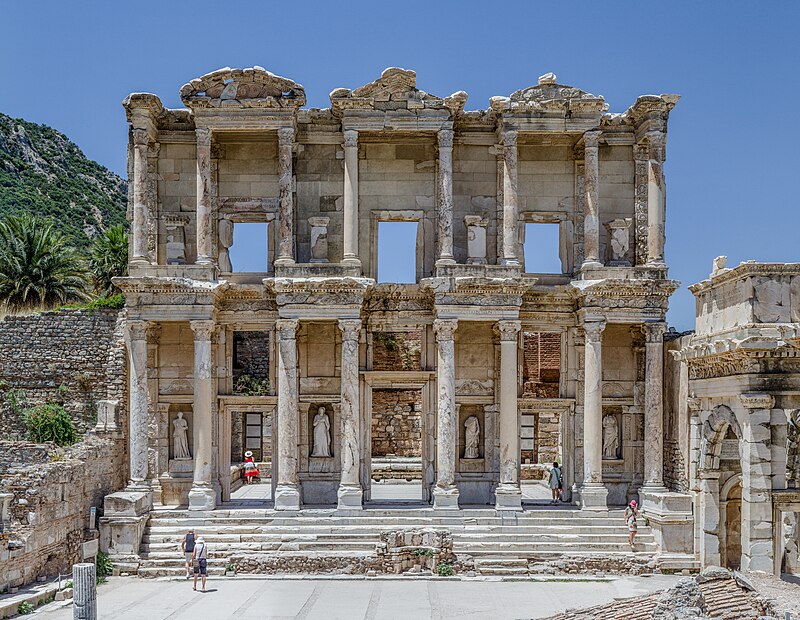
Ephesus today: the Library of Celsus. 
[By Benh LIEU SONG - Own work, CC BY-SA 3.0, https://commons.wikimedia.org/w/index.php?curid=15578063]

The Emperor, Theodosius II, hoping to find a solution, summoned a general council – the Third – at Ephesus which met in 431.  St. Augustine was actually invited, but he had died by the time the invitation arrived.  After a delay, owing to the absence of John of Antioch, the council finally opened in the blazing heat of June 431, with Cyril of Alexandria presiding as legate of the Pope.  The Council carefully read the teachings of Nestorius, and quickly condemned them.  Nestorius himself was given three warnings to arrive and answer, but he refused, and was deposed as Patriarch of Constantinople.  The Council unanimously declared that Mary was, indeed, Theotokos!  Torch-lit processions and celebrations met the declaration in Ephesus.

A more thorough account of the Council can be found here: Old Catholic Encyclopedia: Council of Ephesus

Today, then, of all days, it is a joy to affirm that Jesus Christ is one person with two natures, human and divine, and that his Holy Mother, the Blessed Virgin Mary, is most certainly the Mother of God!

St. Mary, Mother of God, pray for us sinners, now and at the hour of our death!

Live well!

Tuesday, October 9, 2018

Feast of St. Denis & Royal Necropolis

Today is the Feast of St. Denis (Dionysius in Latin), Martyr and first Bishop of Paris, France.  Pope St. Fabian dispatched Denis as a missionary to Gaul in the mid-third century.  Denis and his companions, Sts. Rusticus and Eleutherius, for their part, shed their blood for Christ during either the Decian persecution around 250AD or that of Valerian in 258 AD.  The place of their martyrdom was the hill of Montmartre.


Paris - Cathédrale Notre-Dame - Portail de la Vierge - PA00086250 - 003.jpg
Image of St. Denis (left) from the Nuremberg Chronicles, and (right) from a portal of Notre Dame.
[Image on right: By Thesupermat - Own work, CC BY-SA 3.0, https://commons.wikimedia.org/w/index.php?curid=21763309]

Legend has it that St. Denis, after being beheaded, picked up his head and walked some distance to the site of the Basilica of St. Denis -- hence his frequent presentation in art holding his own head.

For more on the Saint you can visit:
Catholic Saints Info: St. Denis of Paris

Old Catholic Encyclopedia: St. Denis

Saint-Denis - Façade.jpg

Facade of the Basilica of St. Denis.
[By Thomas Clouet - Own work, CC BY-SA 4.0, https://commons.wikimedia.org/w/index.php?curid=42109690]

Built on the site of a an earlier church, the Basilica of St. Denis was first constructed by orders of the Frankish King Dagobert I (reigned 629-634AD), and would house the relics of St. Denis.  This site of pilgrimage would also end up being the burial place of the Kings of France from the 10th through 18th century.  The would be coronated at the Catherdral of Rheims (the see of St. Remy or Remigius), but they would be buried here at St. Denis, near Paris.

You can visit the website of the Basilica here: Basilique Saint-Denis

File:Saint-Denis - Basilique -2.JPG
Interior of the Basilica of St. Denis.

The great Abbot Suger (+1151AD) began a project in 1135AD to remodel the Basilica, and giving rise to a new form of architecture: Gothic.  It is an architectural masterpiece.  You can read the Abbot's account of his renovations here: http://www.fordham.edu/halsall/source/sugar.html

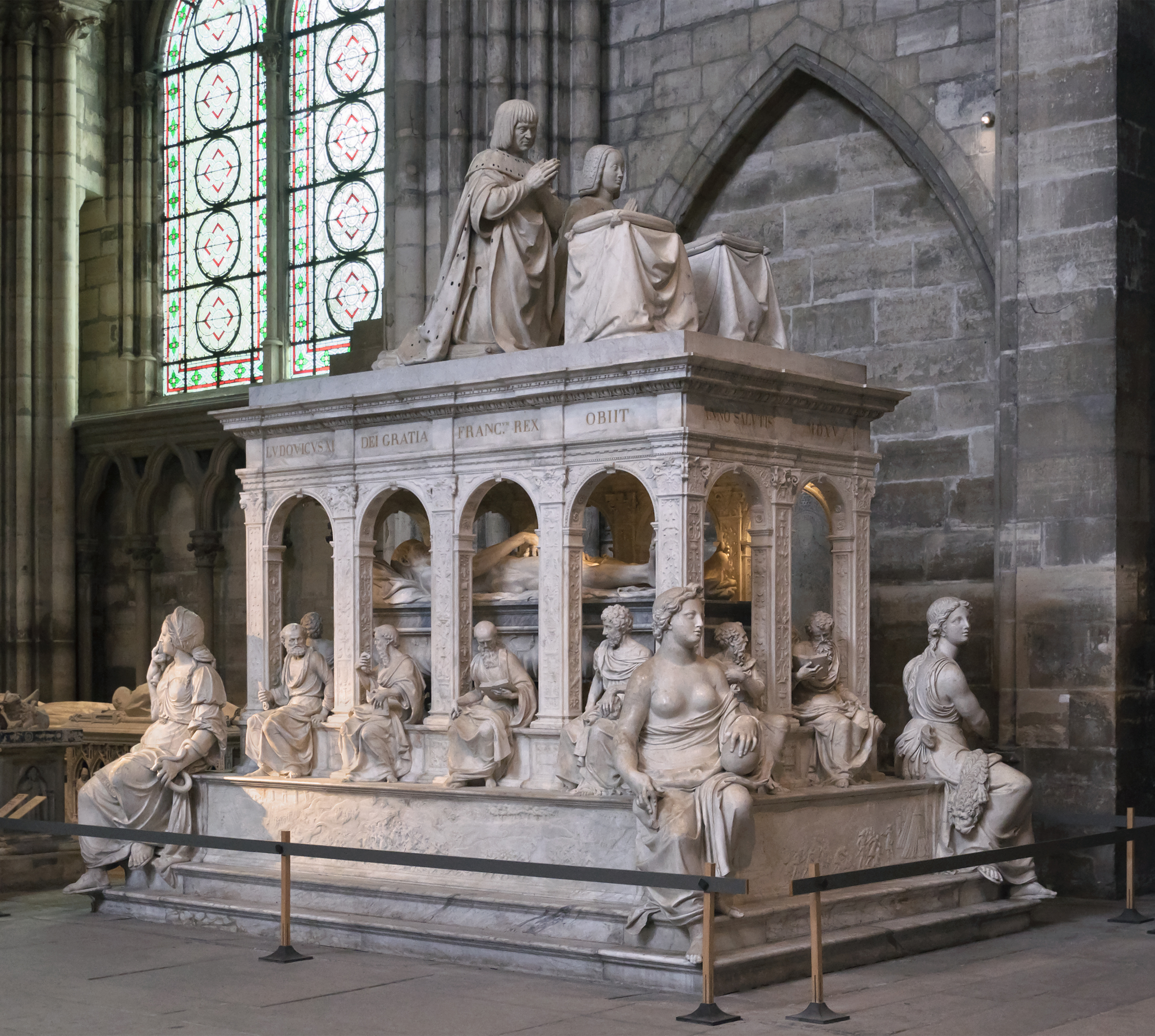
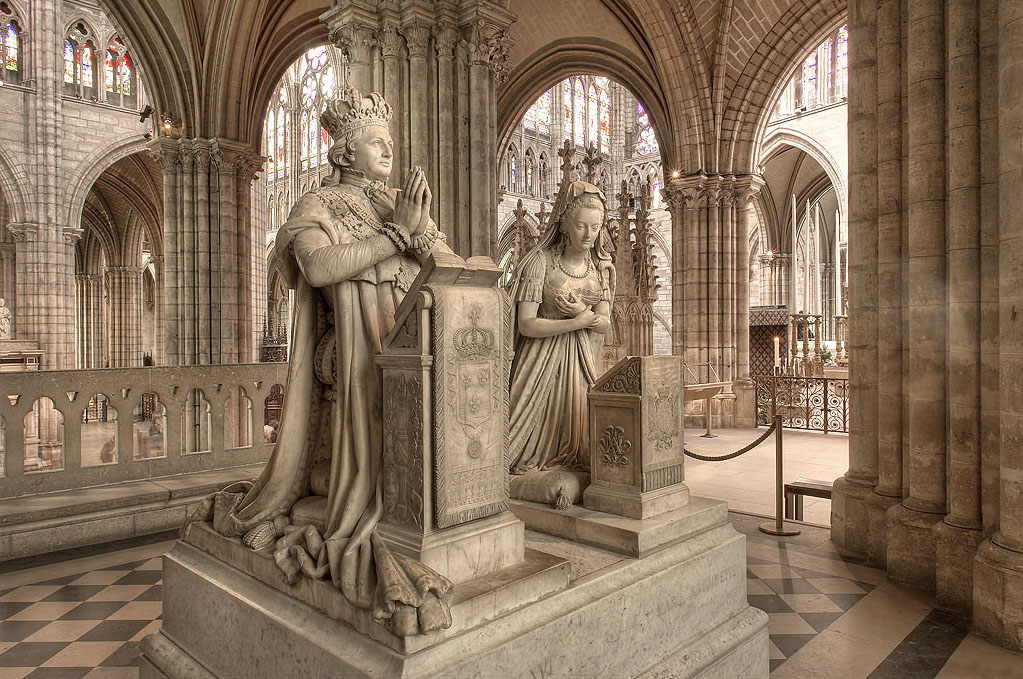
With the exception of but three, every King of France from Clovis I (+511AD) to Louis XVIII (+1824AD) is buried in this sacred place.  A couple of the monuments are pictured below:

File:Basilique Saint-Denis Louis XII Anne de Bretagne tombeau.jpg
Monument of King Louis XII (+1515AD) and his Queen, Anne of Brittany.
[By Photo: Myrabella / Wikimedia Commons, CC BY-SA 3.0, https://commons.wikimedia.org/w/index.php?curid=18611160]

File:Louis XVI et Marie-Antoinette.jpg
Monument of King Louis XVI (+1793AD) and his Queen, Marie Antoinette.
[By Eric Pouhier - Own work, CC BY-SA 2.5, https://commons.wikimedia.org/w/index.php?curid=1765224]


Live well!

Thursday, April 19, 2018

Feast of St. Alphege of Canterbury

File:St. Alphege, Archbishop of Canterbury, is asked for advice.jpg
St. Alphege of Canterbury, King and Martyr, asked for advice. 15th century.

St. Alphege (+1012AD), was a monk of the monastery of Deerhurst who was served as both Bishop of Winchester and then Archbishop of Canterbury.  He guided the English Church during a troubled period of Danish intervention.  The Saxon King Aethelred "the unready" ruled from 983-1013, when the Dane, Sweyn Forkbeard managed to seize power (1013-1014).  A brief return of Saxon rule (1014-1016) would be followed by a couple Danish monarchs from 1016-1042, including Canute the Great (1016-1035).

The Danes in this period were often at least nominally Christian, but were far from adopting all of the moral expectations of Christian life.  St. Alphege bear witness to the fact that amongst the Danes a number of pagans remain -- he was executed by some of them in 1012AD.

The Saxon chronicle describes his death in this way:
"... the raiding-army became much stirred up against the bishop, because he did not want to offer them any money, and forbade that anything might be granted in return for him. Also they were very drunk, because there was wine brought from the south. Then they seized the bishop, led him to their "hustings" on the Saturday in the octave of Easter, and then pelted him there with bones and the heads of cattle; and one of them struck him on the head with the butt of an axe, so that with the blow he sank down and his holy blood fell on the earth, and sent forth his holy soul to God's kingdom."

He was the first Archbishop of Canterbury to die a violent death.

For more on St. Alphege, you might note:
Catholic Saints Info: St. Alphege of Canterbury

Live well!