Formatting key (at least as much as this blog supports any manner of consistent formatting!)
- Sites in BOLD are
those visited or viewed by the whole group
- Those in regular
print were only visited by this blogger in smaller, optional groups.
- Italics indicate that a site was visited
- Non-Italics were only viewed from the exterior!

·
Casa per ferie
Santa Maria alle Fornaci: This was the Trinitarian-run hotel where we
stayed for the duration of our visit.
·
Santa Maria alle Fornaci: This was the Trinitarian church next to the Casa where
we stayed. It was never part of any
tour, but it was our neighboring church!

·
Piazza San Pietro:
[St. Peter’s Square] The famous piazza in front of the Basilica of San
Pietro in Vaticano [St. Peter’s at the Vatican] is notable for the views of the
colonnade by Gianlorenzo Bernini, the façade by Carlo Maderno, and the dome
designed by Michelangelo.
·
Borgo Pio:
This is one of the more concentrated areas of religious goods shops,
located between the Leonine Wall and the Via della Conciliazione.
·
Santa Maria in
Traspontina:
This is the Carmelite church on
the Via della Conciliazione between St. Peter’s and the Tiber River.

·
Castel Sant’Angelo: This was
originally the mausoleum of the Emperor Hadrian, later converted into the
fortress-palace that it is today.
·
Ponte Sant’Angelo: [Bridge of the
Angels] This historic bridge crosses the Tiber next to the imposing Mausoleum
of Hadrian (Castel Sant’Angelo) and affords great views of St. Peter’s. Of course, the sculptures of the angels with
the instruments of the Passion by Bernini and his school are memorable.

·
San Giovanni dei
Fiorentini: This
is the Florentine church in the city of Rome.
San Giovanni is right across the Tiber from St. Peter’s. It is also noteworthy for the statues on the
façade, for the statue of St. John the Baptist over the altar, for the dome by
Carlo Maderno, who is buried here along with Francesco Borromini, and the relic
of the foot of St. Mary Magdalene.
·
Porto Santo
Spirito: This
gate in the Leonine Walls of the Vatican side of the Tiber, which date to the 9th
century, was designed by Antonio da Sangallo the Younger in the 16th
century.
·
Santo Spirito in
Sassia: Once the home of the
Saxons in Rome, it is now the focus of the Divine Mercy devotion in the
city. The current church bears the
architectural mark of Antonio da Sangallo the Younger.
Tuesday, 24 November


- Chiesa Nuova: [New Church]: This,
officially called Santa Maria in Vallicella, is the burial place of St.
Philip Neri. It is a sumptuously
decorated baroque church on the Corso Vittorio Emanuele II.

- Santa
Maria della Pace:
We viewed this Church’s semi-circular portico, by Pietro da Cortona, from
the outside.

- Santa Maria dell’Anima: This is
the German national church in Rome, and the burial place of Pope Adrian
VI, the last non-Italian pope prior to St. John Paul II.

·
Piazza Navona: This oval piazza was once the Circus of Domitian, and
today is the site of three fountains, the largest being Bernini’s Fountain of
the Four Rivers at the center of the Piazza.

·
Sant’Agnese in
Agone: This Church on Piazza Navona was designed by
Francesco Borromini, and sits on the site of the martyrdom of St. Agnes. Her skull is kept here in a side chapel.

·
San Agostino: This church of St. Augustine has several notable sites
and pieces of art: the tomb of St. Monica and a painting of Our Lady by
Caravaggio. It has a ceiling similar to
that of Santa Maria sopra Minerva, i.e., painted blue with stars. Here is a video, taken from our visit, of the apse and then to the left, the chapel where St. Monica is buried:

·
San Luigi dei
Francesi: This baroque church is the French national
church in Rome. The Caravaggio paintings
of St. Matthew are its most famous feature.

- Santa Maria sopra Minerva: This
Dominican Gothic church, with its memorable blue, starry ceiling, is the
burial place of, amongst others, St. Catherine of Siena, Beato Fra
Angelico, Pope Clement VII, and Pope Leo X. The statue of Our Lord by Michelangelo
and the Bernini elephant obelisk in the piazza out front are notable. So, too, is the Carafa Chapel, in which
Pope Paul IV is buried, and which features magnificent work by Filippino
Lippi.

- Sant’Ignazio: This Jesuit baroque church of Saint Ignatius of Loyola is the
burial place of Saints Robert Bellarmine (author of Ars bene moriendi, tomb pictured above), Aloysius Gonzaga, and John
Berchmans. The ceilings that “open
to the skies,” and the false (painted) dome make this church
memorable. The piazza out front is
a wonderful example of 18th century urban space architecture.
- Piazza della Rotonda: This is
the city square in front of the Pantheon, marked with the obligatory
fountain and obelisk of a great square.

·
La Maddalena: This Roccoco Church
dedicated to St. Mary Magdalene is the burial place of St. Camillus de Lellis,
and a wonderful example of 18th century baroque.

·
Pantheon: [Church of Our Lady of the Martyrs]: This unusual church was once a pagan temple
dedicated to “all the gods” constructed in the waning years of the Roman
Republic, and completed during the reign of the Emperor Hadrian. It is notable for its massive concrete dome,
the tomb of Raphael, and the tombs of the liberal 19th and 20th
century Italian kings, including King Victor Emmanuel II.

- Area Sacra dell’Argentina: This archeological site features Republican era temples, and the site of the assassination of Julius Caesar in 44BC.
·
Campo de Fiori: This piazza is
a famous street market in Rome, known for its flowers, and for its statue of the
unfortunate fellow executed in the place, the heretic Giordano Bruno.
- Piazza Farnese: This piazza is dominated by the impressive
Palazzo Farnese, constructed for Cardinal Farnese, later Pope Paul III,
who opened the Council of Trent, by Antonio Sangallo the Younger and
Michelangelo, is now the French Embassy in Rome.

- Via Giulia: This
uncharacteristically straight road was laid out by Bramante for Pope
Julius II, and makes for a splendid 16th century architectural
walk. Along the way, we admired the
façade of the church, Santa Maria dell’Orazione e Morte (pictured above).

- Santa Maria in Monserrato: This is
the Spanish national church in Rome.
It is a charming church, whose side chapels were decorated with
nativity scenes from various Hispanic nations for Advent.

- San
Salvatore in Lauro: This
Church off of the historic Via della Coronari sat near the Ponte
Sant’Angelo where a grove of Laurels once grew. This is the burial place of Pope Eugene
IV and the site of modern devotion to Saint Pio and St. John Paul II.
Wednesday, 25 November, Assisi


- Porta Nuova: This gate is the easternmost in the upper city, and was our entry way into Assisi.

- Santa Chiara: This pink and white church is the location of the
tomb of St. Clare. It also houses
the San Damiano cross of St. Francis of Assisi.

- San Rufino: This is
the cathedral church of Assisi, and the place where St. Francis, St.
Clare, and Emperor Frederick II were all baptized. It has a splendid Umbrian Romanesque
façade.

- Piazza del Comune: This is
the main, central square, of Assisi, location of the medieval bell tower, city
hall, a fountain, and the church of Santa Maria sopra Minerva.

- Santa Maria sopra Minerva in Assisi: This
church, formerly a pagan temple to Minerva, is marked by its columns and
bell tower our front. Inside, it
has baroque furnishings, and a striking painting of the death of St.
Joseph.

·
Chiesa Nuova in
Assisi: This was the baroque
church commissioned by King Philip III that marked the birthplace of St.
Francis of Assisi. Here, too, is the
cell in which St. Francis was detained by his family.

- Santa
Maria Maggiore in Assisi: This Romanesque church was the cathedral
of Assisi until 1020, and remains the site of the bishop’s residence.

- San Francesco: This 13th century Italian Gothic
basilica is the location of the tomb of St. Francis of Assisi. It is notable for its rather extensive
frescoes of the lives of St. Francis, St. Martin and many others. It sits at the west end of Assisi.

·
Santa Maria degli
Angeli in Assisi: This
is the church inside the church: the basilica that houses the Porziuncola, the
little chapel restored by St. Francis.
It was here in the valley below the town of Assisi, and inside the
grounds of this basilica, that St. Francis died.
Thursday, 26 November
·
Vatican Scavi: the excavations under St. Peters, which
include the pre-Constantinian necropolis and the actual tomb and bones of St
Peters.

Above: Altar of St. Joseph at San Pietro in Vaticano

·
San Pietro in
Vaticano: We heard a public Mass at the altar of St.
Joseph, burial place of Sts. Simon and Jude. After Mass, everyone had an
opportunity to look about the Basilica: the tombs of St. Gregory and St. Leo
the Great, along with St. Pius X and St. John Paul II were highlights. Certainly, too, all noted the baldachin and
altar of the chair by Bernini, and the statue of St. Peter by Arnolfo da
Cambio. On other days, we heard Mass at
the altar of Sts. Processus and Martinian said by our chaplain.
- Santa Maria degli Angeli: This
massive Renaissance Church was designed by Michelangelo, who built it into
the baths of Diocletian. The
exterior, clearly part of the old Roman ruins, little prepares one of the
scope of the basilica inside.

·
Santa Maria della
Vittoria: This
little baroque gem is a splendid example of that architectural style. Here is housed the famous Bernini statue of
St. Teresa of Avila in ecstasy. This is
also the location of the tomb of St. Victoria.
·
Santa Susanna: This, the American church in Rome, boasts a façade by
Carlo Maderno. That was as much of the
church as we were able to admire on our visit.
·
San Bernardo alle Terme: This
austere Cistercian church in Rome was once the titular church of St. Pius X
when he was a cardinal. Only the dean
and his wife visited this church, while the rest of the group noted it from the
exterior.

- Santa Maria Maggiore: [St. Mary Major]: This Patriarchal Basilica
stands on the Esquiline hill, where, on 5 August, it once snowed to
indicate the place the church was to be built. This is another church packed with
notable items: the tombs of St. Pius V, Popes Paul V, Sixtus V, Clement
VIII, St. Matthias, St. Jerome, Gianlorenzo Bernini, the crib of the
Nativity, and the miraculous image of Our Lady Salus Populi Romani.
For those interested, the Torriti apse mosaic, the Cosmatesque
floor, and the gold ceiling decorated with the first gold brought back
from the New World, are worth noting, as well.

·
Santa Prassede: Aside from its splendid 9th century mosaic,
this church is known for housing the pillar of flagellation.
·
San Alfonso: This more modern Redemptorist church is the location
of the original image of Our Lady of Perpetual Help.
·
Arch of Gallienus:
Perhaps a few noted that we walked under this
arch, formerly the site of the Esquiline Gate in the Servian Wall.
Friday, 27 November
- Piazza del
Campidoglio: We walked through this magnificent
square on the top of the Capitoline Hill, next to the city hall of Rome.

- Roman Forum: We
walked past this massive archaeological site, the heart of Classical
Rome. We particularly noted the
triumphal arches – of Septimus Severus, Titus, and, closest to the
Colosseum, of Constantine.
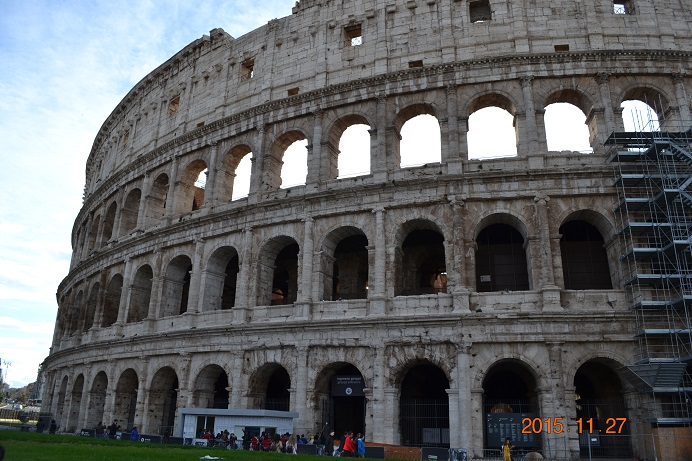
- Colosseum: This, the Flavian
Amphitheatre, is one of the iconic symbols of Rome. It was constructed by the Flavian
Emperors from 72-80AD.

- Santa Francesca Romana: This church,
tucked next to the forum not far from the Colosseum, is the burial place
of St. Frances of Rome, whose skeletal remains are visible to
visitors. It is marked by baroque
interior decorations along with Romanesque elements, like its bell tower.
- Santa Maria dei Monti: This 16th
century church is the burial place of St. Benoit-Joseph Labre.
- Ss. Sergius e Bacchus: This
little church is currently run by Ukrainian Catholics.

·
San Pietro in
Vincoli: This church is the home of both the relics of the
chains that bound St. Peter – displayed at the high altar – along with the
statue of Moses by Michelangelo, in what was part of his funeral monument for
Pope Julius II.
·
San Clemente: This was the twelfth-century basilica that was run by
Irish Dominicans. It had a wonderful
mosaic of the cross being the source of life for a vine, along with a courtyard
out front, and two layers of excavations (both a 4th century church
and 1st century temple of Mithras).

·
Scala Santa: [The Holy Stairs]: These stairs were those brought back from Jerusalem
by St. Helen. They originally lead to the Praetorium
there, where Our Lord would have been questioned by Pontius Pilate. Upstairs is the “Holy of Holies” where an
image reputed to have been painted by St. Luke is kept. On the side of the building is a mosaic that
would have once been in the Lateran Palace, and date to the pontificate of Pope
St. Leo III around 800AD.

·
Santa Croce in
Gerusalemme: This church is on the location of what was once the
palace of St. Helen. Here is housed the
relics of the Passion: part of the inscription, a nail, a couple of thorns,
parts of the True Cross, the cross beam of the good thief’s cross, and the
finger of St. Thomas.

·
San Giovanni in
Laterano: [St. John Lateran]:
The pope’s cathedral, this basilica is packed with numerous items of note. The Borromini interior and the Galilei façade
can hardly compare to the spiritual riches: the relics of the heads of Peter
and Paul, the table of the Last Supper, the papal altar of St. Peter, the tombs
of Popes Leo XIII, Innocent III, and Martin V.
The obelisk next to the basilica, decorated in hieroglyphics, happens to
be the oldest in Rome, brought to the city in 357AD by Constantine II, but
originally from the Temple of Amun at Thebes, Egypt, constructed in the 14th
century BC. We heard a public Mass here
in a side chapel.
Saturday, 28 November
 Not a church: a car along the Tiber River abandoned to the guano of the starling


·
Tiber Island: Walking across
the island in the Tiber River, we saw a few sites of note, including San Bartolomeo all’Isola. This Church on Tiber Island is the location of the relics of
St. Bartholomew the Apostle. Sadly, it
was closed to visitors when we came by. Ponte Cestio and Ponte Fabricio: The two
bridges to Tiber Island are two of the oldest across the river in Rome. Ponte Cestio crosses from the island to
Trastevere and was restored in 370AD, while Ponte Fabricio from the island to
downtown Rome and the Ghetto was built in 62BC.
·
Ghetto: This neighborhood, dominated by the Synagogue
of Rome, with its squarish dome, was the center of the Jewish population of the
city, and the required residence of Jews during much of the Papal rule of the
city.

·
Santa Maria in
Campitelli: This church, designed by Carlo Rainaldi in the
17th century, was built to house the image of the Madonna del
Portico. Today, it is also the home of
the tomb of St. John Leonardi.


·
Chiesa del Gesu: Often referred to simply as “The Gesu.” This is the
Jesuit headquarters church in Rome. It
is a splendid baroque church – the prototype of this style, in fact. Here is buried St. Ignatius of Loyola, and is
housed the arm of St. Francis Xavier.
Our group heard a public Mass here in a side chapel.

- Theatre
of Marcellus: This Imperial Theatre turned medieval
fortress was originally constructed by the Emperor Augustus.
- San Nicola in Carcere: This
medieval church sits on the site of Republican-era Temples, turned later
into the location of a prison.

·
Arch of
Janus: This Constantinian-era arch is distinctive for its four piers.

·
San Giorgio in
Velabro: This
ancient Romanesque Church houses the relics of St. George, and was once the
titular church of Blessed Cardinal John Henry Newman.

·
Santa Anastasia:
We viewed the façade of this church, formerly where the Holy Father
would worship on Christmas morning.

·
Circus Maximus: This was the
largest of the many circuses or race tracks, of Rome. This sits between the Palatine and Aventine
Hills. We had the good fortune of
reviving the races here.

- Santa Maria in Cosmedin: This
Romanesque church is now maintained by Eastern-Rite Catholics. It houses the skull of St. Valentine,
out front, is popular with tourists for the Boca della Verita: the Mouth of Truth.

- Forum
Boarium: This collection of Republican-era
temples sits next to the Tiber River.
We walked past and admired it!

- Santa Cecilia in Trastevere: This Romanesque church sits atop the ancient home
of St. Cecilia, and it is here that she is now buried. Famous, indeed, is the Maderno statue
here that portrays St. Cecilia as she was found in the catacombs.
- San Crisogono: This
Trinitarian church in the Trastevere neighborhood was the burial site of
Blessed Anna Maria Taigi. The
anticipated start of a funeral chased us out rather quickly.
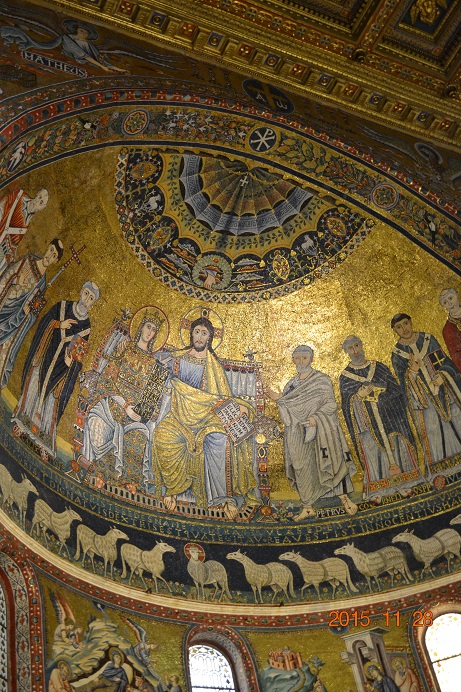
- Santa Maria in Trastevere: This
Romanesque church was the site of a splendid apse mosaic, the well of oil,
and one of the more magnificent stops in the tour of the Trastevere
neighborhood.
·
Ponte Sisto: We crossed the Tiber River on this 15th
century bridge, commissioned by Pope Sixtus IV, the same pontiff that had the
Sistine Chapel built.

·
Santa Maria in Aracoeli:
This church, wedged next to the Victor Emmanual Monument on the
Capitoline Hill, is a beautiful Romanesque structure, and the site of both the
tomb of St. Helen and the state of Bambino Jesu.
Sunday, 29 November


- Gesu e Maria: On Sunday
morning we heard Mass at the parish of Gesu e Maria on the Via del Corso,
said by Cardinal de Paolis. This is
an Augustinian church, designed by Carlo Rainaldi, where the Institute of
Christ the King offers their Sunday Mass in Rome.

- Piazza & Porta del Popolo: This is the north gate of Rome, and adjoining square, striking for its open space and the double domed churches, sits at the north gate of the city of Rome, and was once the site of public executions and the entry way of most pilgrims coming into Rome. The obelisk in the square was originally brought to Rome by the Emperor Augustus to sit in the Circus Maximus. The church of Santa Maria del Popolo was, sadly, not open for tours when we passed by.
·
S. Maria in Montesanto:
Looking south from Piazza del Popolo, this is the left of the twin
churches. This was designed by Carlo
Rainaldi and completed by Carlo Fontana.
·
S. Maria dei Miracoli: Looking south from Piazza del Popolo, this is
the right of the twin churches.
·
S. Atanasio: This 16th
century Eastern-Rite church sits on Via del Babuino, in a rather smart shopping
district. It is in the care of the
Congregation for the Oriental Churches.

- San
Francesco a Ripa: This 17th century Franciscan
church in Trastevere is the site where St. Francis of Assisi once stayed
while visiting Rome. It houses the
Bernini statue, Blessed Ludovica
Albertoni in Ecstasy. It is
also the burial place of St. Charles of Sezze.
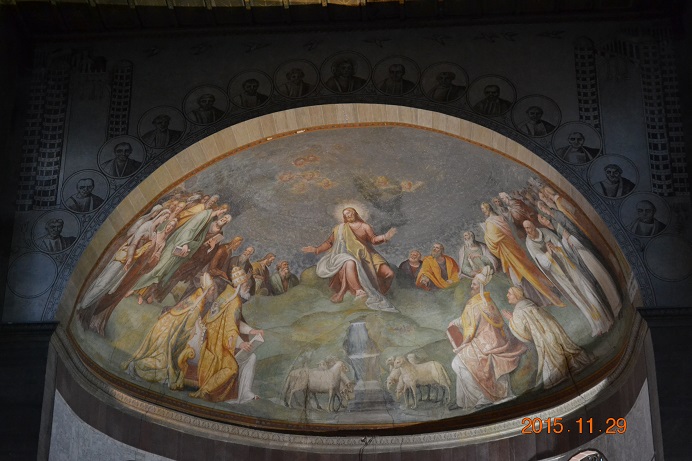
- Santa
Sabina: This Dominican church on the Aventine Hill is a
wonderful example of Romanesque architecture, and is where the Holy Father
traditionally says Mass on Ash Wednesday.

- Ss. Bonifacio
e Alessio: This church on the Aventine Hill marks
the site of the home of St. Alexius, the beggar saint who died after
living under the stair well of his our family’s home. This church on the Aventine Hill marks
the site of the home of St. Alexius, the beggar saint who died after
living under the stair well of his own family’s home. There is a memorable side chapel
featuring the stairs of St. Alexius.
This church is a dramatic mix of architectural styles and eras.

·
San Gregorio Magno: This church sits
on the site of the monastery-home of Pope St. Gregory the Great. It was from here that St. Augustine of
Canterbury was dispatched to preach the Gospel in Anglo-Saxon England. The church today has many 17th
century architectural elements and houses the chair of St. Gregory the Great.
Monday, 30 November


·
San Pietro in
Vaticano: Mass at the tomb of Pope St. Pius X with our chaplain.

·
Vatican Museums: This world-class museum includes the
master-Renaissance works of the Raphael rooms and Sistine Chapel.

·
Piazza di Spagna: The Spanish Steps, near the Spanish Embassy, with the church of S.
Trinita dei Monti at the top, is simply a classic Roman scene.

·
Column of the Immaculate Conception:
This column, erected in 1857, commemorates the solemn definition of Pope
Blessed Pius IX, and is marked with Old Testament prophecies related to the
Blessed Virgin Mary.
·
Via Condotti: We walked down this
street, lined with overpriced, designer shops.
·
Via del Corso: We visited this road on Sunday, as well – it is the straight
road from the Piazza Venezia and the Capitoline Hill in the south to the Porta
and Piazza del Popolo at the north gate of the city. It is lined with stylish
shops.

·
Santi Ambrogio e Carlo: This large baroque church dedicated to Saints Ambrose
and Charles Borromeo is the church of the Lombards (around Milan) in Rome. It is here that the heart of St. Charles
Borrromeo is kept.

·
San Silvestro in Capite: This, the English church in Rome, houses
the head of St. John the Baptist in a side chapel.

·
San Claudio: This little church, which features perpetual adoration, houses
the tomb of St. Peter Julian Eymard.

·
Santa Maria in Via: This modest church dedicated to Our Lady features a miraculous
well and image at the back of the church.
Pilgrims are able to drink from the well!

·
Trevi Fountain: Commissioned by Pope Clement XII, this 18th century fountain
is another classic Roman landmark.

·
Santi Vincenzio e Anastasio: This baroque church overlooks the Trevi
Fountain, and is the site of the hearts of the popes from Pope Sixtus V to Leo
XIII.

- Santi XII Apostoli: This church, located at the site of the 5th century church, was decorated in the early 18th century by Carlo Fontana. It houses the tombs of the Apostles, Sts. Philip and James the Lesser, along with Pope Clement XIV.
·
Piazza Venezia: This grand square sits at the base of the Capitoline Hill, and
is the location of the Palazzo Venezia, the former Venetian Embassy, and
favorite speech site of Benito Mussolini, and the Victor Emmanuel Monument, the
“wedding cake.” Likewise, the Venetian
Church in Rome, San Marco, is on this square.

·
Sant’Andrea della Valle: This is a Theatine church on the Corso Vittorio
Emmanuelle. It is the burial place of
Popes Pius II and Pius III; also St. Joseph Mary Tomasi. It is memorable for its large dome, and the
giant paintings of St. Andrew’s martyrdom around the altar.
·
San Lorenzo in Damaso:
This church, originally constructed by the 4th century Pope,
St. Damasus I, is now attached to the Palazzo della Cancelleria, the seat of
the Apostolic Signatura, and formerly the site of the Papal Chancellery.
Tuesday, 1 December


·
San Paolo fuori le
mura: [St. Paul’s outside the
walls]: This is the Patriarchal Basilica where Saint Paul the Apostle is
buried. It is memorable for its
medallions of all of the popes, and for the splendid courtyard in the front
with its statue of Paul. This church is
Romanesque in style, rebuilt in the 19th century imitating the
earlier design of the church.

·
Catacombs of San
Callisto: This massive underground Christian cemetery is
located on the old Appian Way. It was in
these catacombs that St. Cecilia and a number of Pontiffs were buried.
·
San Sebastiano fuori le mura:
This basilica on the old Appian Way, in addition to acting as the
entrance to another set of catacombs, is the burial place of St. Sebastian and
home of a bust by Bernini of Jesus Christ.
·
Tomb of Cecilia
Matella: This massive mausoleum on the old Appian Way
was converted into a fortress during the medieval era. Across the street is the ruined Cistercian
Gothic church, San Nicola.
On our
bus trip to the sites outside the walls that day, we saw, but did not stop at:
·
Pyramid of Caius Cestius: This peculiar monument was built as a
memorial to a praetor who died in 12BC, later set into the Aurelian Wall as we
see today.
·
Porta di San Sebastiano:
This is the massive gate in the Aurelian Wall of Rome that marks where
the Via Appia Antica enters the old city.
·
Baths of Caracalla: These massive
ruins are the site of the bath complex constructed during the 3rd
century AD for the Emperor Caracalla.
·
Via Appia Antica: This is the most
famous of the old Roman roads. Along
this road are the Catacombs of San Callisto, San Sebastiano, and just south of
the Tomb of Cecilia Matella, a stretch still paved with the original basalt
boulders.
·
Church of Domine Quo Vadis: This little chapel is built on the
site where St. Peter had his vision of Christ during the persecution of Nero.
All photos courtesy of this blogger's father!
Live well!
All photos courtesy of this blogger's father!
Live well!